Some snakes look as though they have grown tiny horns over their eyes or on the tip of the nose.
But these structures are not horns like those of cattle, antelope or goats.
Snake “horns” are usually enlarged, modified scales that project from the head.
They have evolved independently in several snake lineages, especially among vipers.
Some species have a pair of scales above the eyes, others have a single projection on the nose, and a few have clusters of multiple horn-like scales.
Many of the best-known horned snakes are venomous, so appearance should never be treated as an invitation to approach or handle one.
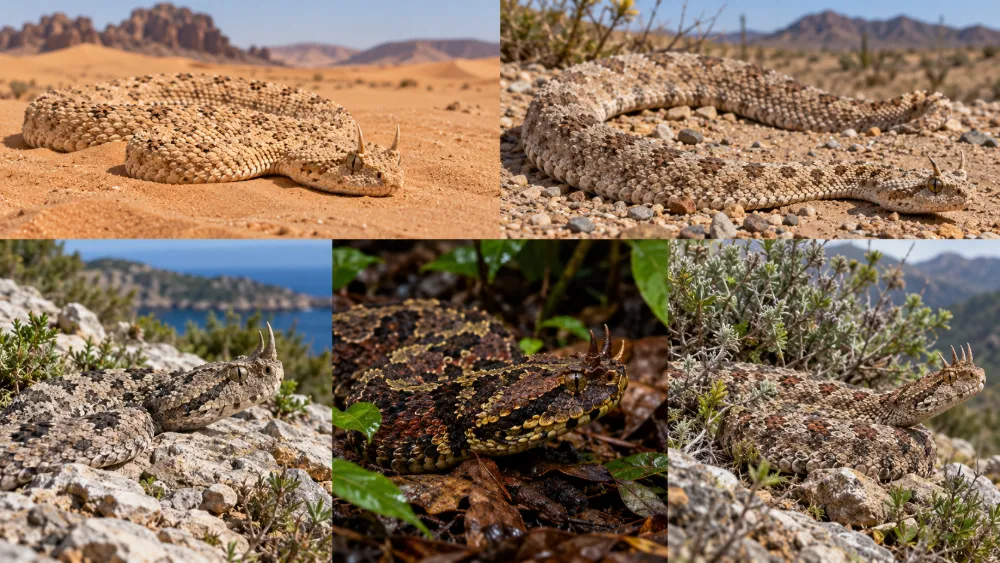
8 Horned Snakes at a Glance
| Snake | Scientific Name | Horn Location | Venomous? |
|---|---|---|---|
| Saharan Horned Viper | Cerastes cerastes | Above the eyes | Yes |
| Arabian Horned Viper | Cerastes gasperettii | Usually above the eyes | Yes |
| Sidewinder | Crotalus cerastes | Above the eyes | Yes |
| Nose-Horned Viper | Vipera ammodytes | Tip of the snout | Yes |
| Horned Adder | Bitis caudalis | Above the eyes | Yes |
| Rhinoceros Viper | Bitis nasicornis | Above the nostrils | Yes |
| Matilda's Horned Viper | Atheris matildae | Above the eyes | Yes |
| Eyelash Palm Pitviper | Bothriechis schlegelii | Bristly scales above the eyes | Yes |
1. Saharan Horned Viper
Scientific name: Cerastes cerastes
The Saharan Horned Viper is probably the animal most people picture when they hear the phrase “horned snake.”
Many individuals possess one enlarged pointed scale above each eye.
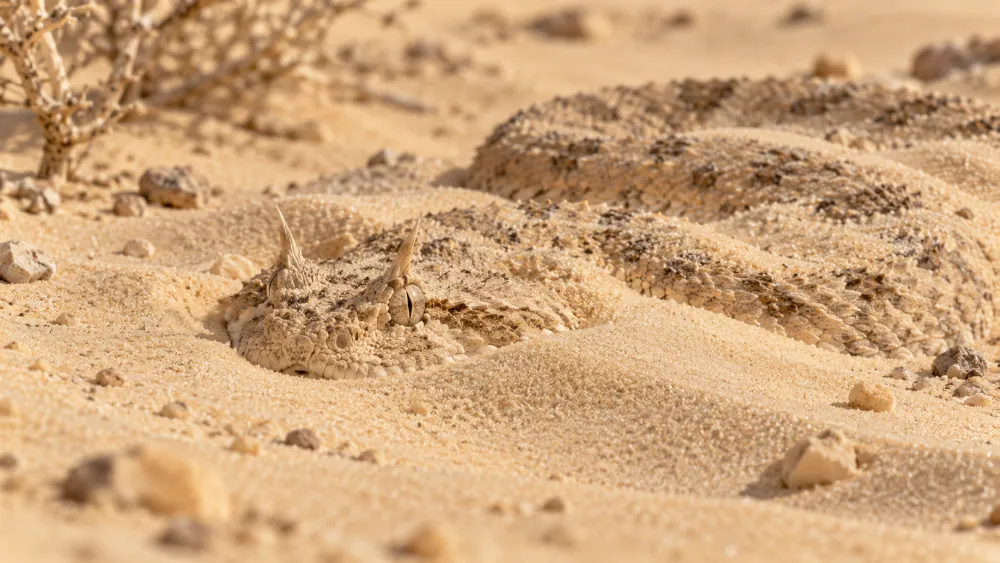
The snake is strongly adapted to deserts of North Africa and nearby regions.
Its sandy coloration helps it blend into:
sand dunes;
semi-stable desert sand;
rocky desert;
and other arid environments.
It is an ambush predator and may partially bury itself in sand while waiting for prey.
Prey includes:
small rodents;
lizards;
geckos;
and birds.
Does Every Saharan Horned Viper Have Horns?
No.
Although the horned form is famous, the size and presence of supraocular projections can vary.
This is an important identification lesson:
the absence of obvious horns does not automatically rule out a horned-viper species.
2. Arabian Horned Viper
Scientific name: Cerastes gasperettii
The Arabian Horned Viper is closely related to the Saharan species but occurs mainly in the Arabian Peninsula and surrounding regions.
Its range includes areas of:
Saudi Arabia;
United Arab Emirates;
Oman;
Yemen;
Jordan;
Israel;
and neighboring regions.
Many individuals have a pointed hornlike scale over each eye.
However, hornless individuals are also known.
One recognized form from the Arava Valley is characteristically hornless.
Saharan vs. Arabian Horned Viper
These snakes are similar enough that identification should not rely solely on whether horns are visible.
Geographic location, scale arrangement and other anatomical details are important.
Both belong to the genus Cerastes and both are venomous desert vipers.
3. Sidewinder
Scientific name: Crotalus cerastes
North America has its own famous horned snake: the Sidewinder.
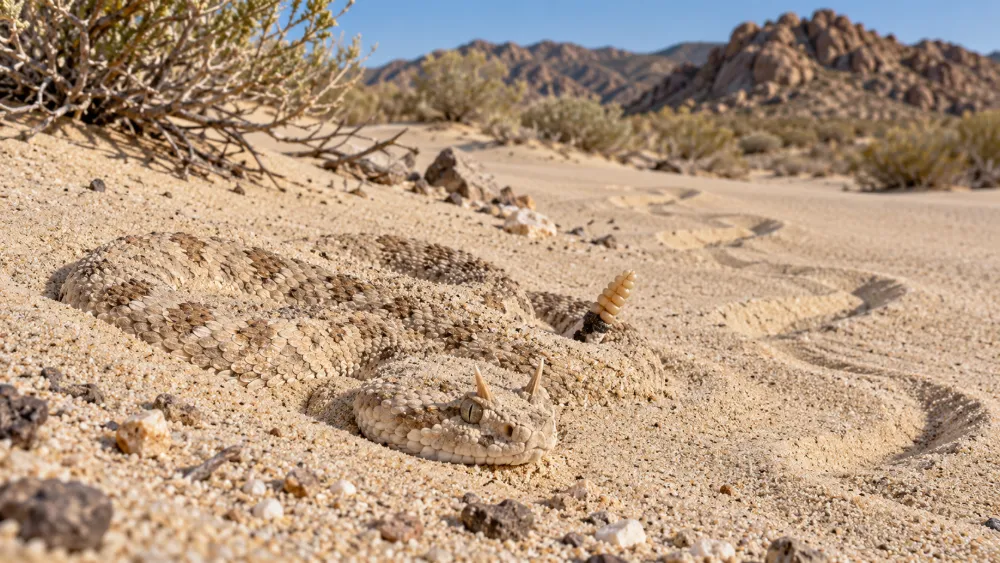
The Sidewinder is a small rattlesnake of the deserts of the southwestern United States and northwestern Mexico.
It has distinctive hornlike scales above its eyes.
The National Park Service notes that these scales can fold down and may help protect the eyes while the snake moves through or buries itself in sand.
Why Is It Called a Sidewinder?
The name comes from its unusual movement.
Instead of moving forward with the familiar wavy motion used by many snakes, a Sidewinder throws loops of its body diagonally across loose sand.
This locomotion:
reduces slipping;
works efficiently on loose desert substrate;
and reduces prolonged contact with extremely hot sand.
Sidewinders may leave distinctive J-shaped tracks.
Are Sidewinders Venomous?
Yes.
Sidewinders are rattlesnakes in the family Viperidae.
They should always be observed from a safe distance.
Their relatively small size does not make them appropriate to handle.
4. Nose-Horned Viper
Scientific name: Vipera ammodytes
The Nose-Horned Viper has a completely different style of horn.
Instead of two projections over the eyes, it has a single conspicuous appendage on the tip of the snout.
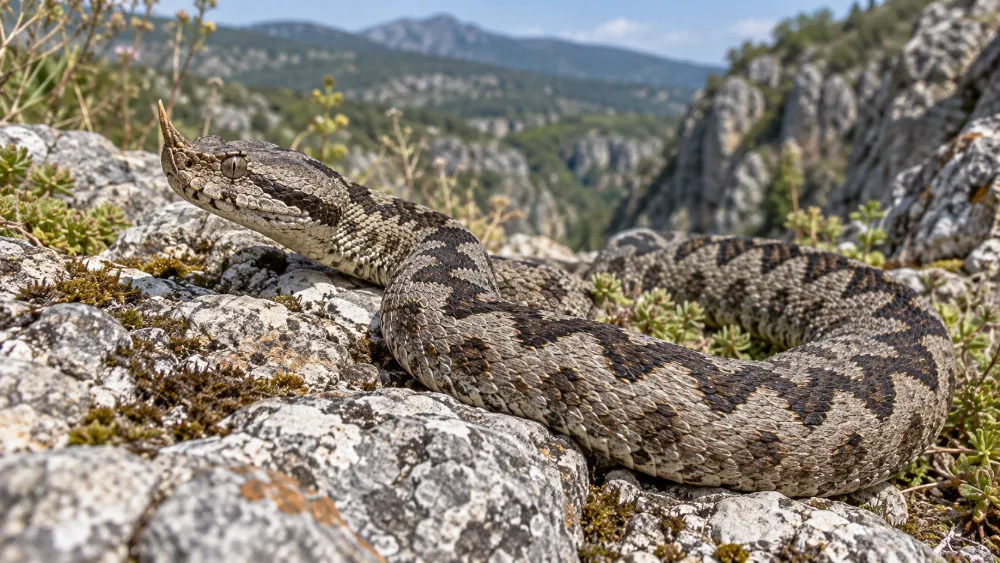
The species occurs in parts of southeastern Europe and surrounding regions.
It is recognizable by a combination of:
a scale-covered nasal horn;
a broad viper-like head;
a strong zigzag dorsal pattern in many individuals;
and a relatively robust body.
What Is the Nose Horn For?
The exact function is still being investigated.
For many years, researchers proposed possibilities such as:
camouflage;
disrupting the outline of the head;
physical protection;
or interactions with the environment.
Recent anatomical research has added another intriguing possibility.
Scientists studying the nasal appendage of Vipera ammodytes found extensive nerve supply from a branch of the trigeminal nerve, along with sensory structures in the skin.
This suggests that the horn may also have a sensory role.
That hypothesis is still being investigated and should not be generalized automatically to every horned snake.
5. Horned Adder
Scientific name: Bitis caudalis
The Horned Adder is a small venomous viper from southern Africa.
Its range includes parts of:
Namibia;
Botswana;
South Africa;
Angola;
Zimbabwe;
and Zambia.
The snake usually has a conspicuous scale projection over each eye.
Its body is relatively short and stout, and coloration varies with the surrounding habitat.
The result is an animal well suited to remaining difficult to see against dry ground.
6. Rhinoceros Viper
Scientific name: Bitis nasicornis
The Rhinoceros Viper takes horned-snake anatomy in another direction.
Instead of one or two eye horns, it has multiple horn-like projections around the nostrils.
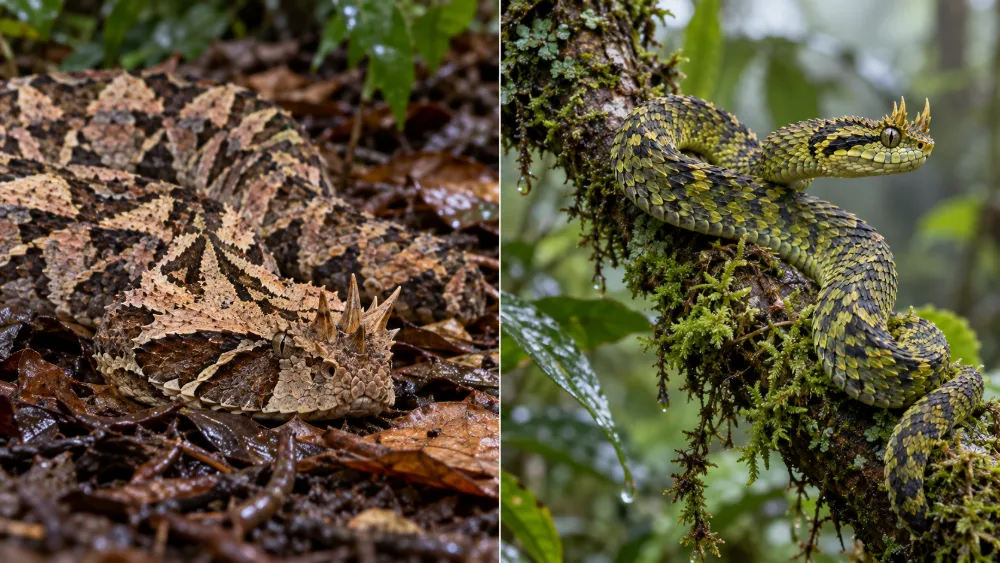
Animal Diversity Web describes the species as having approximately two or three horn-like projections above each nostril.
The Rhinoceros Viper is also one of the world's most dramatically patterned vipers.
Its skin can include combinations of:
blue-green;
olive;
brown;
yellow;
black;
and reddish tones.
Despite the vivid appearance when viewed up close, the complex geometric pattern can blend extremely well with rainforest leaf litter.
Where Do Rhinoceros Vipers Live?
They are associated primarily with humid forests of central and western Africa.
They are heavy-bodied ambush predators and spend much of their time on or close to the forest floor.
7. Matilda's Horned Viper
Scientific name: Atheris matildae
Matilda's Horned Viper is a rare East African bush viper scientifically described in 2011.
It is known from a restricted montane-forest region in southern Tanzania.
The snake has:
two or three greatly enlarged upright scales above the eye;
an arboreal body shape;
a prehensile-looking tail;
and a patterned green-brown coloration.
The exact wild locality was intentionally withheld in the original description because of concerns about illegal collection for the exotic-animal trade.
Are Matilda's Horned Vipers Venomous?
Yes.
They belong to the viper family Viperidae.
Their rarity and restricted distribution are additional reasons they should never be disturbed or collected.
8. Eyelash Palm Pitviper
Scientific name: Bothriechis schlegelii
The Eyelash Palm Pitviper does not have a single large horn.
Instead, several modified scales project above each eye and look like eyelashes or small horns.
Smithsonian describes these as distinctive bristly scales above the eyes.
The species can occur in many colors, including:
yellow;
green;
brown;
gray;
and reddish tones.
It is an arboreal venomous pitviper from Central and northern South America.
Do Snakes Have Real Horns?
Not in the mammalian sense.
A cow or antelope horn contains a bony core covered by keratin.
Snake horns are generally modifications of the scales and skin.
They may consist of:
one enlarged scale;
several elongated scales;
clusters of scales;
or a larger scale-covered appendage.
So the word “horn” describes their appearance rather than indicating that they evolved the same structure as a mammalian horn.
Why Do Some Snakes Have Horns?
Scientists do not have one universal answer.
Different horned snakes may use their appendages differently.
Proposed functions include:
camouflage;
breaking up the visible outline of the head;
protecting the eyes;
helping with life in sand;
sensory functions;
and other ecological roles.
Are Horns Associated With Ambush Hunting?
Apparently, very strongly.
A large comparative study examined nearly 2,000 species of snakes and lizards.
The researchers found that cephalic horns occur almost exclusively among sit-and-wait predators.
One proposed explanation is that horns may improve camouflage or provide other benefits in an animal that remains motionless for long periods.
An actively hunting animal with large head projections might instead become more conspicuous while moving.
Do Horns Protect a Snake's Eyes?
In some species they may.
The National Park Service reports that a Sidewinder's horn-like eye scales can fold down, helping protect the eyes in sandy terrain.
But that should not automatically be assumed to be the main function in every species.
A nose horn and an eye horn are anatomically different structures occurring in different evolutionary lineages.
Can Snake Horns Sense Things?
Possibly, at least in some species.
A 2026 anatomical study of the Nose-Horned Viper found that its nasal appendage is richly supplied by the ophthalmic branch of the trigeminal nerve.
Researchers also found sensory structures in the associated skin.
The result suggests that the appendage could help detect mechanical information from the environment.
Further behavioral work is needed to determine exactly how the snake uses that sensory input.
Did Horns Evolve Only Once in Snakes?
No.
Horn-like head appendages have evolved repeatedly in different snake lineages.
This is called convergent evolution.
Examples include:
supraocular horns in Cerastes;
horn-like scales in Sidewinders;
the nasal appendage of Vipera ammodytes;
nasal projections in Bitis nasicornis;
and eyebrow-like horns in some Atheris.
They may look similar, but they did not all come from one horned ancestral snake.
Are All Horned Snakes Venomous?
Many of the best-known horned snakes are venomous vipers.
Every species listed in this guide belongs to the viper family and possesses venom.
But the broader concept of a snake with a head appendage is not itself a reliable venom test.
People should never use “horn present” or “horn absent” as a rule for determining whether an unidentified snake is safe.
What Should You Do if You See a Horned Snake?
If you encounter an unidentified horned snake:
Keep a safe distance.
Do not attempt to pick it up.
Do not disturb a partially buried animal.
Keep children and pets away.
Photograph it only from a safe distance.
Use a qualified local wildlife authority or expert for identification if necessary.
Many horned vipers rely on camouflage and may remain motionless rather than flee immediately.
That behavior can make them easy to approach accidentally.
FAQ
What snake has horns?
Saharan Horned Vipers, Arabian Horned Vipers, Sidewinders, Nose-Horned Vipers, Horned Adders and several other vipers have horn-like scales or appendages on the head.
Are snake horns made of bone?
No. Most snake horns are enlarged or modified scales rather than bony horns like those of mammals.
Why do horned vipers have horns?
The exact function varies and is still being studied. Proposed roles include camouflage, eye protection, sensory function and adaptations associated with ambush hunting.
Do Sidewinders have horns?
Yes. Sidewinders have distinctive horn-like scales above their eyes.
Are Sidewinders venomous?
Yes. Sidewinders are venomous rattlesnakes.
What snake has one horn on its nose?
The European Nose-Horned Viper, Vipera ammodytes, has a conspicuous single scale-covered appendage on its snout.
What snake has horns on its nose?
The Rhinoceros Viper has multiple horn-like projections around the nostrils.
Are all Saharan Horned Vipers horned?
No. Horn size varies, and not every individual has equally conspicuous projections.
Can snake horns feel things?
Possibly. A recent anatomical study found extensive nerve supply and sensory structures within the nose horn of Vipera ammodytes, suggesting a potential sensory role.
Are horned snakes dangerous?
Many famous horned snake species are venomous vipers and should be given substantial distance. Appearance alone should never be used to judge whether an unknown snake is safe.
Final Answer
Horned snakes do exist, but their “horns” are usually modified scales rather than true bony horns.
The Saharan Horned Viper and Arabian Horned Viper carry pointed scales above the eyes, while the North American Sidewinder has flexible horn-like eye scales adapted to sandy desert life.
The Nose-Horned Viper has a single projection on its snout, the Rhinoceros Viper carries several nasal horns, and Matilda's Horned Viper has upright scales over the eyes.
Scientists are still working out exactly why these structures evolved.
Current evidence suggests that horn-like appendages are strongly associated with sit-and-wait predation and may assist with camouflage, protection or other ecological functions. New anatomical evidence also suggests that at least some snake horns may have a sensory role.
The simplest rule is:
snake horns are specialized scales—and their appearance can hide surprisingly complex biology.
Related Reading
Sources Used for Fact Checking
U.S. National Park Service — Sidewinder
The Reptile Database — Cerastes cerastes
The Reptile Database — Cerastes gasperettii
The Reptile Database — Vipera ammodytes
The Reptile Database — Bitis caudalis
Animal Diversity Web — Rhinoceros Viper
The Reptile Database — Matilda's Horned Viper
Smithsonian's National Zoo — Eyelash Palm Pitviper
Proceedings of the Royal Society B — Evolution of Cephalic Horns in Squamates
Journal of Anatomy — Sensory Anatomy of the Nose-Horned Viper Appendage