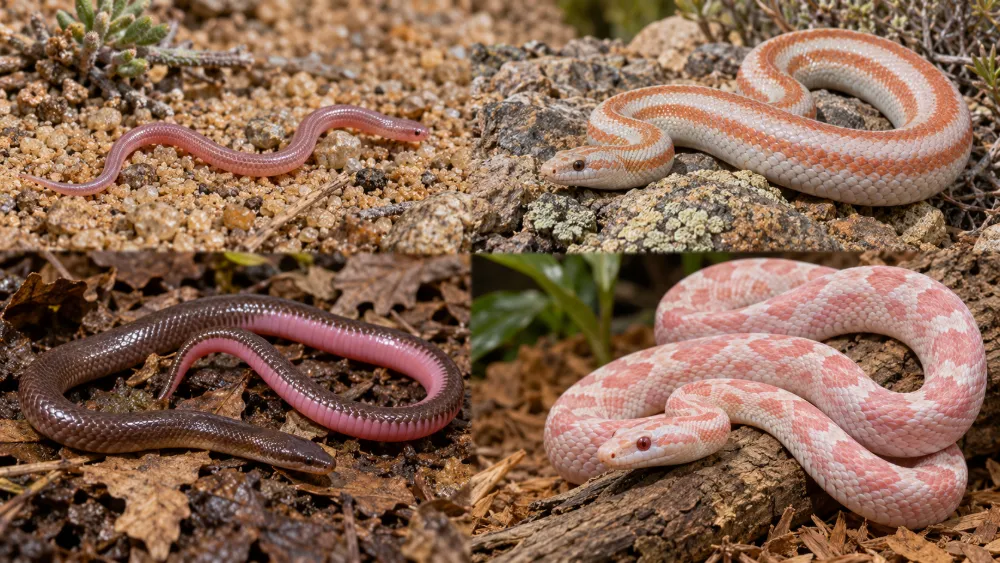
Snakes are not usually the first animals people describe as cute, but some species have features that make even snake-skeptics look twice.
Some have tiny upturned noses. Others have round faces, small eyes, miniature bodies, soft colors or unusually blunt heads.
“Cute” is subjective, but hognose snakes, sand boas, rubber boas and rosy boas are among the species most often described as adorable because of their distinctive proportions and facial features.
That does not mean every cute-looking snake is harmless, tame or appropriate to handle. Wild snakes should be observed from a respectful distance, and pet suitability depends on much more than appearance.
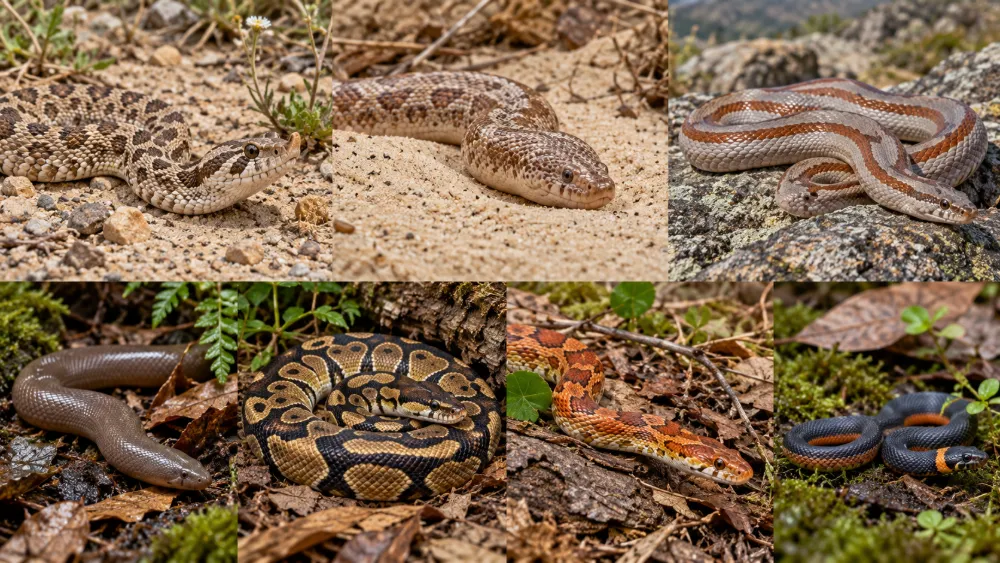
10 Cute Snakes at a Glance
| Snake | Why People Find It Cute | Typical Size |
|---|---|---|
| Western Hognose Snake | Tiny upturned snout | Small to medium |
| Kenyan Sand Boa | Round head and tiny high-set eyes | About 1–2 ft commonly |
| Rosy Boa | Soft colors and rounded body | Usually under about 3.5 ft |
| Northern Rubber Boa | Blunt head, blunt tail and smooth body | Usually under about 2–2.5 ft |
| Ball Python | Rounded head and tightly curled resting posture | Medium-sized |
| Corn Snake | Bright face and colorful pattern | About 2–6 ft |
| Ring-necked Snake | Tiny body and bright neck collar | Small |
| California Kingsnake | Clean black-and-white or cream pattern | Medium-sized |
| Smooth Green Snake | Small head and vivid green color | Small and slender |
| Arabian Sand Boa | Extremely unusual small eyes and blunt face | Small |
1. Western Hognose Snake
Scientific name: Heterodon nasicus
The Western Hognose Snake is one of the strongest candidates for the title of “cutest snake.”
Its most obvious feature is the small, sharply upturned scale at the end of its nose.
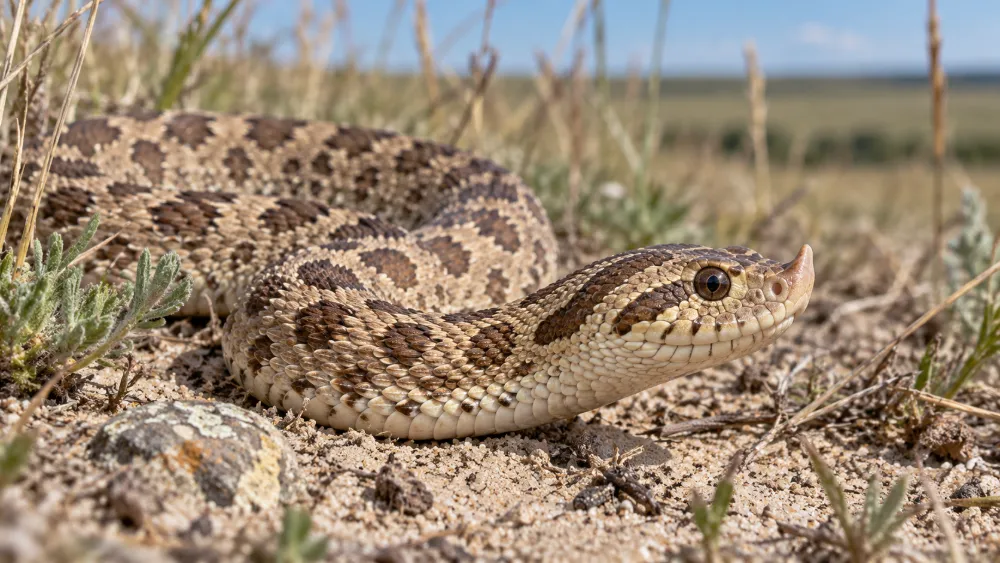
The snout works like a miniature shovel.
Hognose snakes use it to dig through:
loose soil;
sand;
leaf litter;
and burrows.
The combination of a short head, small nose and stocky body creates the expression that many people interpret as cute.
Why Do Hognose Snakes Have Upturned Noses?
The specialized rostral scale helps with digging.
Hognose snakes search through soil and loose substrate for prey and shelter.
It is therefore a functional adaptation rather than a decorative feature.
Do Hognose Snakes Play Dead?
Some do.
Hognose snakes are famous for elaborate defensive displays.
A frightened individual may:
flatten its neck;
hiss loudly;
make bluff strikes;
roll onto its back;
and remain motionless as if dead.
This dramatic performance is intended to discourage predators.
It should not be interpreted as the snake enjoying interaction with people.
Are Hognose Snakes Venomous?
Hognose snakes have enlarged rear teeth and saliva that helps subdue prey.
They are not treated like medically important front-fanged venomous snakes such as rattlesnakes, but bites should still be taken seriously.
Reported bites can cause local symptoms such as:
pain;
swelling;
discoloration;
or irritation.
Wild hognose snakes should therefore be left alone rather than picked up because they look cute.
2. Kenyan Sand Boa
Scientific name: Eryx colubrinus
The Kenyan Sand Boa has an almost cartoon-like face.
Its tiny eyes and nostrils sit high on the head, while the snout is broad and blunt.
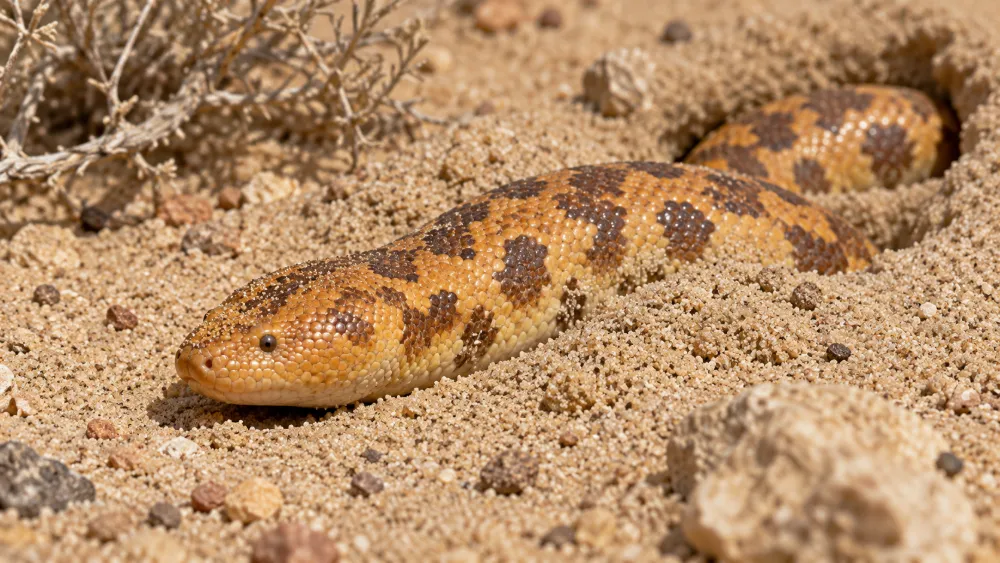
Those proportions are adaptations for a life spent largely under loose soil and sand.
Kenyan Sand Boas are short and stout, commonly around one to two feet long.
They typically show:
yellow or orange background coloration;
dark brown or black irregular blotches;
a pale underside;
and a short blunt tail.
Why Are a Sand Boa's Eyes on Top of Its Head?
The arrangement helps the snake remain almost completely buried while still monitoring the surface.
Oakland Zoo notes that the high-set eyes and nostrils help keep the snake's sensory openings clear while it burrows.
A modified scale at the tip of the snout also works like a small shovel.
3. Rosy Boa
Scientific name: Lichanura trivirgata
Rosy Boas are compact North American boas with gentle-looking rounded heads and soft longitudinal stripes.
The base color can include shades such as:
cream;
beige;
gray;
rose;
or slate.
Three darker stripes normally run along the length of the body.
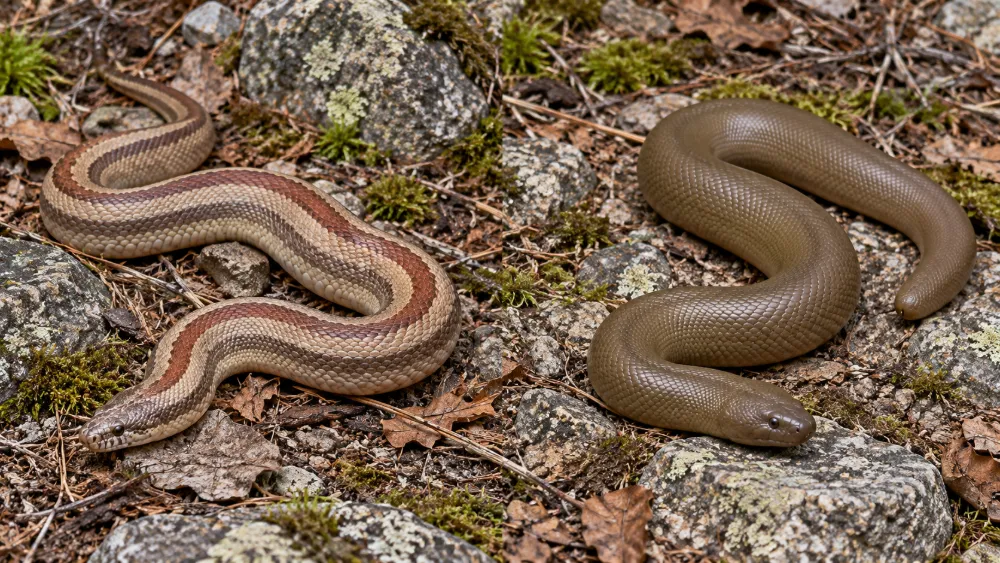
Rosy Boas occur naturally in parts of:
southern California;
southwestern Arizona;
and northwestern Mexico.
They are associated especially with rocky desert foothills and similar habitats.
How Big Does a Rosy Boa Get?
The Arizona-Sonora Desert Museum reports lengths up to approximately 3.25 feet (107 cm).
That is much smaller than the giant boas people may imagine when they hear the word “boa.”
4. Northern Rubber Boa
Scientific name: Charina bottae
The Northern Rubber Boa may be one of the least threatening-looking snakes in North America.
Its unusual features include:
tiny eyes;
smooth-looking skin;
a short blunt head;
and a short blunt tail.
The head and tail can look surprisingly similar.
Washington Department of Fish and Wildlife suggests that the tail's head-like shape may help redirect predator attacks away from the real head.
Why Is It Called a Rubber Boa?
The loose, wrinkled skin and smooth body can give the snake a rubber-like appearance.
Common colors include:
tan;
brown;
olive;
gray;
charcoal;
and sometimes rosy tones.
In Washington, adults rarely exceed about two feet in length.
Are Rubber Boas Aggressive?
They are generally slow and secretive.
Washington wildlife authorities contrast them with faster defensive racers and describe rubber boas as non-aggressive snakes.
That still does not mean wild individuals should be collected or handled unnecessarily.
5. Ball Python
Scientific name: Python regius
Ball Pythons are widely recognized for their rounded head and compact body.
The common name comes from a characteristic defensive behavior.
When frightened, a Ball Python may curl tightly into a ball with its head protected inside the coils.
This compact posture contributes to the rounded appearance many people find appealing.
Wild-type animals typically have dark brown or nearly black markings over a lighter brown background.
Does a Ball Python Stay Small?
It stays much smaller than giant python species such as reticulated or Burmese pythons, but it is still a substantial snake.
A juvenile that looks tiny can grow into a much larger adult.
This is one reason appearance alone should never determine whether an exotic animal is appropriate for someone's home.
6. Corn Snake
Scientific name: Pantherophis guttatus
Corn Snakes are among the most recognizable colorful snakes in North America.
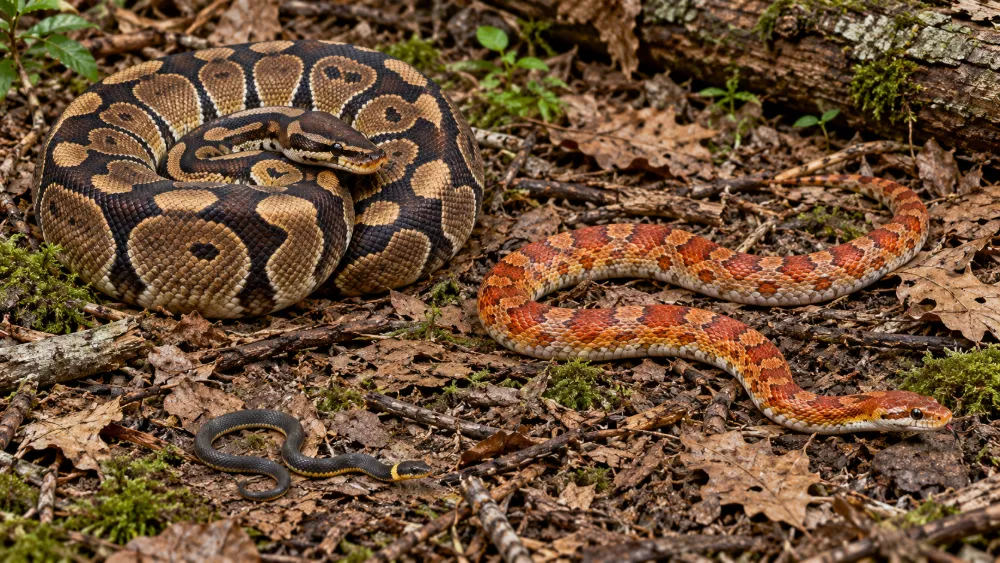
Wild-type Corn Snakes usually have:
an orange or brownish-yellow background;
large reddish blotches;
dark outlines around those blotches;
and a black-and-white checkerboard belly.
The Smithsonian reports adult lengths of roughly 24 to 72 inches (61–182 cm).
They are nonvenomous constrictors.
Why Are Corn Snakes Popular?
The combination of relatively moderate body size, attractive coloration and long history in captive breeding has made the species common in the reptile trade.
However, wild Corn Snakes are native wildlife and should not simply be collected when found outside.
7. Ring-Necked Snake
Scientific name: Diadophis punctatus
The Ring-necked Snake is tiny compared with many familiar snakes.
Most individuals have:
a dark gray or nearly black back;
a thin yellow or cream-colored ring behind the head;
and a yellow, orange or reddish underside.
Its miniature body and narrow colored collar give it a distinctive appearance.
Ring-necked snakes spend much of their time hidden beneath:
logs;
rocks;
leaf litter;
and other ground cover.
8. California Kingsnake
Scientific name: Lampropeltis californiae
California Kingsnakes often have crisp contrasting patterns.
Depending on the individual, they may be:
dark with pale crossbands;
black and cream;
brown and yellow;
or longitudinally striped.
The clean geometric appearance is one reason many people find them visually attractive.
They are nonvenomous constrictors.
They also prey on other snakes, including some venomous species.
9. Smooth Green Snake
Scientific name: Opheodrys vernalis
The Smooth Green Snake is almost exactly what its name suggests.
It is a small, slender snake with a bright green upper body and pale underside.
Its:
small rounded head;
large-looking eyes;
slender body;
and vivid green color
give it an appearance very different from heavily built boas and pythons.
The green coloration provides camouflage among grass and vegetation.
10. Arabian Sand Boa
Scientific name: Eryx jayakari
The Arabian Sand Boa is one of the strangest-looking small snakes.
Its tiny eyes sit high on the head, producing a face that people often describe as cartoon-like.
Like other sand boas, it spends much of its life hidden beneath loose desert substrate.
The high-set eyes allow the snake to remain buried while still detecting activity above the surface.
Its unusual appearance is therefore a direct result of adaptation to burrowing life.
What Makes a Snake Look Cute?
Humans tend to describe certain visual characteristics as cute even when they occur in animals very different from mammals.
In snakes, those features may include:
large-looking eyes;
a small or rounded head;
a short upturned nose;
a compact body;
bright simple patterns;
or miniature size.
A Kenyan Sand Boa's eyes, for example, are not high on the head to look adorable. They are positioned there because the snake is adapted to burying itself in sand.
The feature humans interpret as “cute” often has a practical biological function.
What Is the Cutest Snake in the World?
There is no scientific answer because cuteness is subjective.
Common favorites include:
Western Hognose Snakes for their upturned noses;
Kenyan Sand Boas for their small high-set eyes;
Rubber Boas for their rounded heads;
and Rosy Boas for their soft colors and compact shape.
What Is the Smallest Cute Snake?
Several very small snakes could qualify depending on what someone finds attractive.
Ring-necked snakes are small North American examples, while various tiny threadsnakes and blindsnakes are considerably smaller.
However, the smallest species are not necessarily suitable as pets or easy animals to care for.
Are Cute Snakes Harmless?
No.
Appearance is not a safety test.
A snake can have:
a small head;
large-looking eyes;
bright colors;
or a tiny body
and still possess defensive teeth or venom.
Conversely, many intimidating-looking snakes are nonvenomous.
Species identification should come before assumptions about danger.
Do Snakes Smile?
No evidence suggests that snakes use a human-style smile to communicate happiness.
The apparent “smile” in photographs usually comes from:
jaw shape;
scale arrangement;
head proportions;
or camera angle.
It should not be interpreted as a human-like emotional facial expression.
Are Snakes Friendly?
“Friendly” is not a particularly useful biological description for snakes.
Some captive individuals become accustomed to routine care and may remain calm around people.
But tolerance of handling is not the same as mammalian social affection.
Wild snakes generally benefit most from being left undisturbed.
Which Cute Snakes Are Kept as Pets?
Species commonly maintained in captivity include:
Corn Snakes;
Ball Pythons;
Rosy Boas;
Kenyan Sand Boas;
and captive-bred hognose snakes in places where ownership is legal.
But a species appearing on a pet list does not mean it is suitable for every owner.
Before obtaining any reptile, important questions include:
adult size;
lifespan;
temperature and humidity needs;
feeding requirements;
veterinary access;
local laws;
and whether the animal was legally captive-bred.
Should You Catch a Cute Wild Snake?
No.
If you find a wild snake, observe it from a safe distance and allow it to continue on its way.
Capturing wildlife can:
stress the animal;
expose you to bites;
violate wildlife regulations;
and remove an animal from its ecological role.
If you cannot identify the snake, avoiding handling is even more important.
FAQ
What is the cutest snake?
There is no objective winner, but Western Hognose Snakes and Kenyan Sand Boas are frequently described as cute because of their unusual small noses and high-set eyes.
What snake has a cute upturned nose?
Hognose snakes have a distinctive upturned rostral scale that acts like a shovel when digging.
What snake has tiny eyes on top of its head?
Sand boas, including the Kenyan Sand Boa, have small high-set eyes adapted for watching the surface while much of the body remains buried.
Are hognose snakes harmless?
They are not considered like medically important front-fanged venomous snakes, but bites can produce pain, swelling and other local effects. They should not be handled casually in the wild.
Are rubber boas real boas?
Yes. The Northern Rubber Boa belongs to the family Boidae even though it is much smaller than famous giant boas.
How big do rosy boas get?
Rosy Boas can reach roughly 3.25 feet, although many individuals are smaller.
Are Corn Snakes venomous?
No. Corn Snakes are nonvenomous constrictors.
What snake looks like it has two heads?
A Rubber Boa's blunt tail resembles its blunt head, which may help confuse predators.
Do snakes smile?
Snakes do not use human-style smiling as an emotional signal. A smiling appearance usually comes from their natural jaw and scale structure.
Can you keep any cute snake as a pet?
No. Wildlife laws, husbandry requirements and conservation concerns vary greatly. Pet snakes should come from appropriate legal captive sources rather than being collected simply because they look appealing.
Final Answer
Some snakes look surprisingly cute because of unusual adaptations such as upturned noses, tiny high-set eyes, rounded heads and miniature bodies.
Western Hognose Snakes use their tiny shovel-like noses for digging, while Kenyan Sand Boas have eyes positioned high on the head so they can remain buried in sand.
Rubber Boas have rounded heads and tails, Rosy Boas combine compact bodies with soft stripes, and Ring-necked Snakes add a tiny splash of bright color.
But “cute” describes how humans perceive an animal—it tells us nothing reliable about whether the snake is safe, tame or appropriate as a pet.
The best way to enjoy a cute wild snake is simple:
identify it, appreciate its adaptations and leave it where it belongs.
Related Reading
Sources Used for Fact Checking
Missouri Department of Conservation — Hog-Nosed Snakes
Oakland Zoo — Kenyan Sand Boa
Arizona-Sonora Desert Museum — Rosy Boa
Washington Department of Fish & Wildlife — Northern Rubber Boa
Smithsonian's National Zoo — Eastern Corn Snake