Black and yellow is a striking combination in snakes, but color alone is not enough to identify a species safely.
In North America, many black-and-yellow snakes are nonvenomous species such as kingsnakes, garter snakes, ribbon snakes and ring-necked snakes.
But other snakes—including the venomous Eastern Coral Snake—can also contain black and yellow in their pattern.
The safest way to identify a black-and-yellow snake is to combine pattern, body shape, size and geographic location rather than relying on color alone.
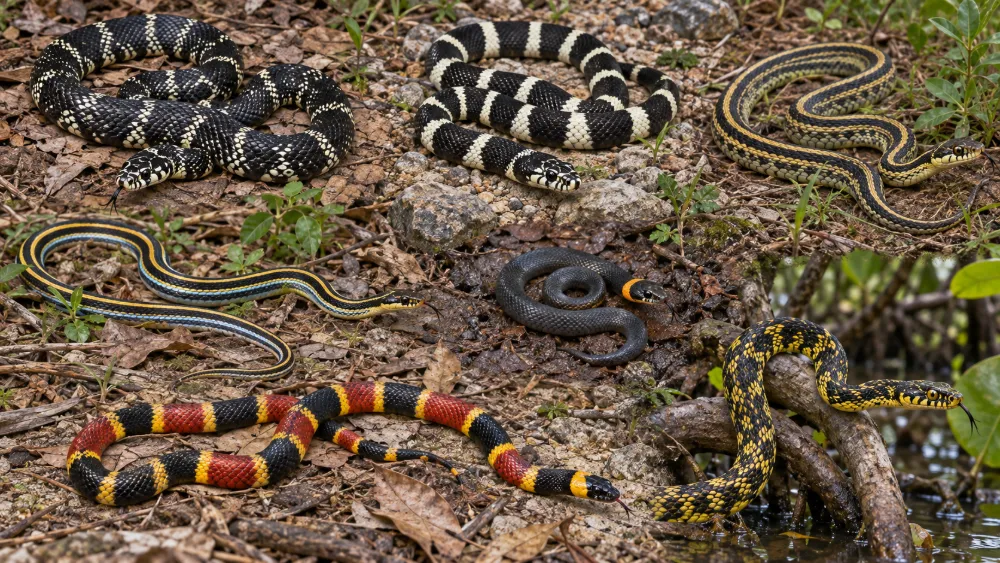
Black and Yellow Snake Identification Chart
| Species | Black & Yellow Pattern | Venom Risk to Humans | Main Range |
|---|---|---|---|
| Eastern Kingsnake | Black with narrow yellow or cream chain-like bands | Nonvenomous | Eastern U.S. |
| California Kingsnake | Black or dark brown with pale yellow/cream bands or stripes | Nonvenomous | Western U.S. |
| Common Garter Snake | Dark body with three yellow or yellow-green stripes | Not dangerous to people | Much of North America |
| Eastern Ribbon Snake | Dark slender body with three bold yellow stripes | Nonvenomous | Eastern North America |
| Ring-necked Snake | Dark back with yellow neck ring and yellow belly | Not dangerous to people | Much of North America |
| Alameda Whipsnake | Dark body with yellow-orange side stripe | Nonvenomous | San Francisco Bay Area |
| Eastern Coral Snake | Red and black rings separated by yellow | Venomous | Southeastern U.S. |
| Mangrove Snake | Glossy black with narrow yellow bands | Rear-fanged, mildly venomous | Southeast Asia |
1. Eastern Kingsnake
Scientific name: Lampropeltis getula
The Eastern Kingsnake is one of the clearest matches for a black snake with yellow markings.
Typical individuals have:
a glossy black body;
thin yellow, cream or whitish crossbands;
bands that may form a chain-like appearance;
and small pale markings on the head.
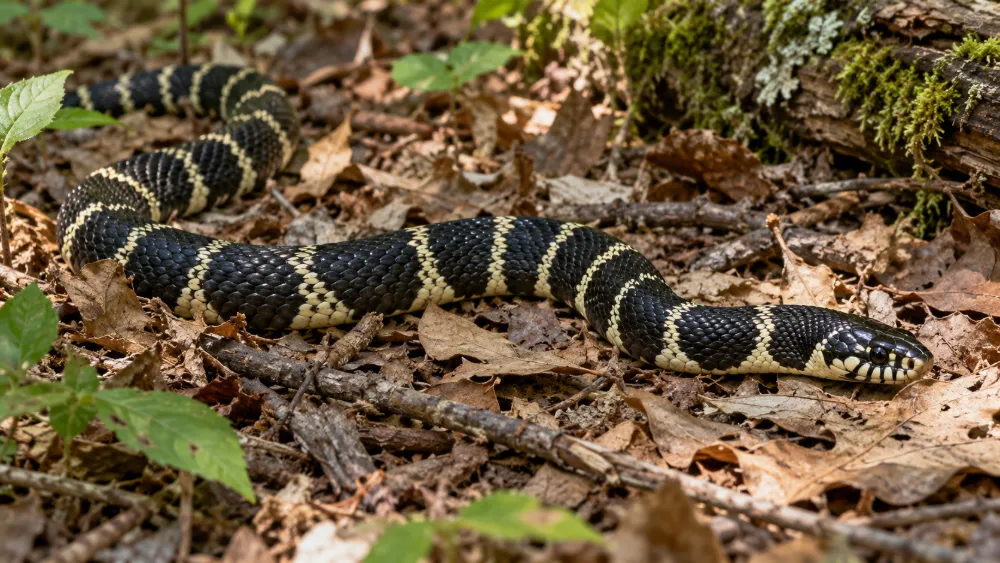
Eastern Kingsnakes are nonvenomous constrictors.
They eat a wide range of prey, including:
Kingsnakes are especially famous for eating venomous snakes such as rattlesnakes.
Why Is It Called a Kingsnake?
The name refers largely to the snake's ability to prey on other snakes.
Kingsnakes are constrictors and possess resistance to the venom of some venomous snakes they encounter as prey.
That does not mean they are completely immune to every snake venom or every possible dose.
2. California Kingsnake
Scientific name: Lampropeltis californiae
In western North America, a black-and-yellow snake may be a California Kingsnake.
This highly variable species can be:
black with cream or yellow bands;
dark brown with pale bands;
longitudinally striped;
or a mixture of banded and striped patterns.
California Kingsnakes are nonvenomous and commonly grow to around 3 to 4 feet long.
They occur in many habitats, including:
desert;
grassland;
woodland;
wetland edges;
farmland;
and suburban areas.
3. Common Garter Snake
Scientific name: Thamnophis sirtalis
A dark snake with several long yellow stripes may be a Common Garter Snake.
Many individuals show:
three yellow, olive or yellow-green longitudinal stripes;
dark brown or black areas between the stripes;
a checkered pattern between the stripes;
and a yellowish or pale-green belly.
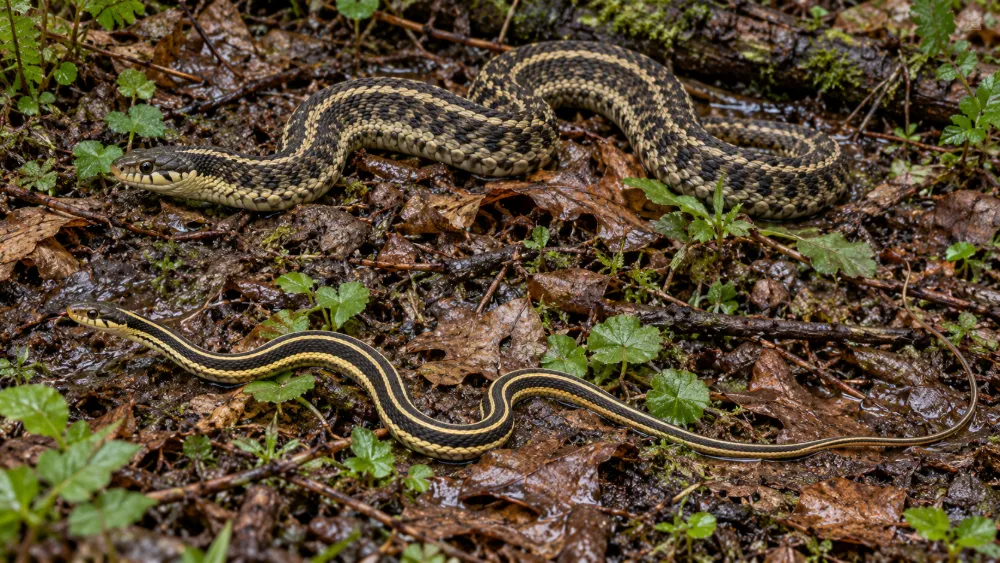
Common Garter Snakes are widespread and frequently appear in yards, gardens and areas near water.
They are not considered dangerous to humans.
4. Eastern Ribbon Snake
Scientific name: Thamnophis sauritus
Eastern Ribbon Snakes look similar to garter snakes but are usually much more slender.
Key features include:
three bold yellow or yellow-green stripes;
a dark brown or nearly black background;
a very thin body;
and an exceptionally long tail.
The tail may account for roughly one-third of total body length.
Ribbon snakes are closely associated with wetlands and water.
Garter Snake vs. Ribbon Snake
| Feature | Common Garter Snake | Eastern Ribbon Snake |
|---|---|---|
| Body | More robust | Very slender |
| Tail | Moderate | Exceptionally long |
| Pattern | Often striped plus checkered | Cleaner bold stripes |
| Habitat | Very broad range of habitats | Strongly associated with water |
5. Ring-necked Snake
Scientific name: Diadophis punctatus
If the snake is small and almost completely black above except for one bright yellow collar, it may be a Ring-necked Snake.
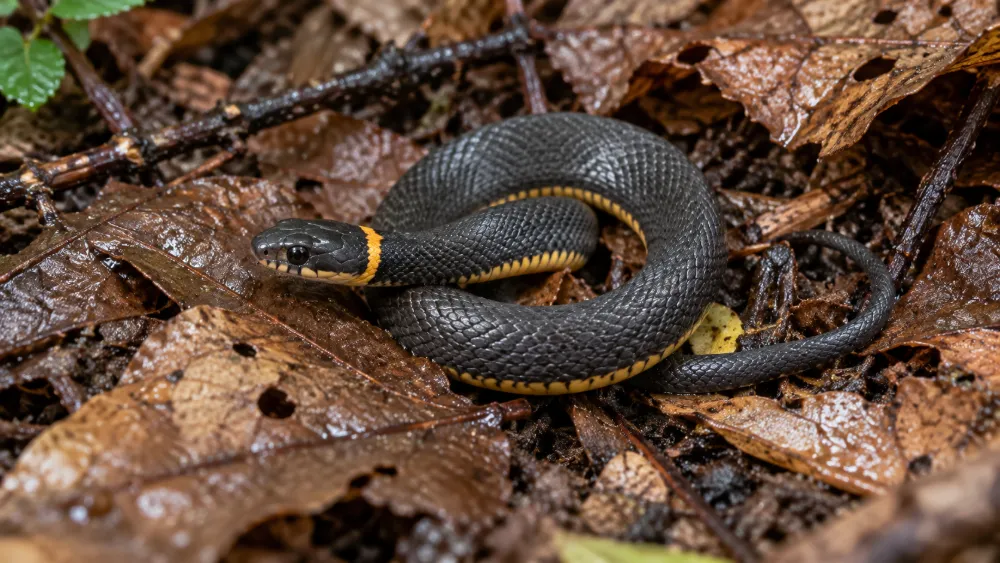
Typical features include:
slate-gray, charcoal or bluish-black upperparts;
a narrow yellow or cream ring behind the head;
a yellow, orange or reddish underside depending on population;
smooth scales;
and a small body.
Many adults are only around 9 to 20 inches long.
When threatened, a ring-necked snake may coil its tail upward and expose its brightly colored underside.
It poses no meaningful danger to people.
6. Alameda Whipsnake
Scientific name: Masticophis lateralis euryxanthus
A long dark snake with a bright yellow stripe along each side in California's San Francisco Bay Area may be an Alameda Whipsnake.
This slender, fast-moving snake typically has:
a black or dark-brown back;
a yellow to yellow-orange stripe running along each side;
a slim athletic body;
and a relatively long tail.
It is nonvenomous.
The Alameda Whipsnake has a restricted geographic range and is a protected threatened taxon, so it should never be captured or disturbed.
7. Eastern Coral Snake
Scientific name: Micrurus fulvius
The Eastern Coral Snake is the important venomous species to know.
It is not simply black and yellow—it has a distinctive pattern of:
broad red rings;
broad black rings;
narrow yellow rings separating them;
and a black rounded snout.
Most adults are roughly 20 to 30 inches long.
Eastern Coral Snakes are venomous and bites can be medically serious.
However, they are secretive snakes and bites are rare, with most bites occurring when people intentionally handle or disturb them.
Should You Use the Coral Snake Rhyme?
No color rhyme should be your only identification method.
The familiar “red touches yellow” rhyme was developed around certain North American coral snakes and their mimics.
It is easy to remember incorrectly and does not reliably apply to every coral snake or similarly colored species worldwide.
If you cannot confidently identify a brightly banded snake, leave it alone.
8. Mangrove Snake
Scientific name: Boiga dendrophila
The Mangrove Snake is one of the world's most striking black-and-yellow snakes.
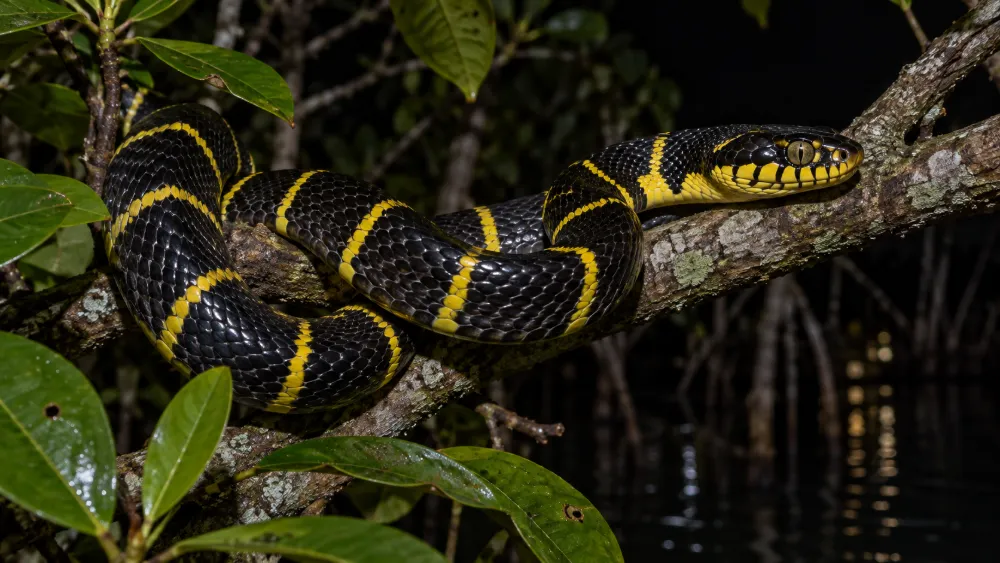
It has:
a glossy black body;
narrow yellow bands;
yellow markings around the face;
large eyes;
and vertically slit pupils.
This species is native to Southeast Asia and is primarily nocturnal and arboreal.
Unlike North American kingsnakes, the Mangrove Snake is a rear-fanged venomous snake.
Its venom is not generally regarded as lethal to humans, but bites can cause significant pain, swelling and discoloration.
It should not be handled casually.
Is a Black and Yellow Snake Poisonous?
Color alone cannot answer that question.
Also, the technically correct term for a snake that injects toxin through a bite is usually venomous, not poisonous.
Many black-and-yellow snakes are harmless to people:
Eastern Kingsnake;
California Kingsnake;
Eastern Ribbon Snake;
Ring-necked Snake;
and Alameda Whipsnake.
But some snakes with black-and-yellow coloration possess venom, including Eastern Coral Snakes and Mangrove Snakes.
What Black Snake Has Yellow Stripes?
If the yellow markings run lengthwise from head toward tail, likely possibilities include:
Common Garter Snake — three stripes, often with checkering;
Eastern Ribbon Snake — very slender, three clean stripes;
Alameda Whipsnake — yellow stripe along each side.
What Black Snake Has Yellow Bands?
If the yellow markings cross the body instead of running lengthwise, consider:
Eastern Kingsnake — thin chain-like bands;
California Kingsnake — variable pale crossbands;
Mangrove Snake — glossy black with narrow yellow bands.
Black-and-Yellow Stripe vs. Band: Why It Matters
In snake identification, “stripe” and “band” describe different directions.
Stripe: runs lengthwise along the snake.
Band: crosses around or across the body.
This simple distinction can immediately narrow down the possibilities.
What Black Snake Has a Yellow Ring Around Its Neck?
A small snake with a single bright yellow collar is likely a Ring-necked Snake.
Check underneath if it can be observed safely without touching the animal.
The belly is typically bright yellow, orange or reddish and may have dark spots.
Black and Yellow Snake in My Yard: What Should I Do?
If you find an unidentified snake:
Keep your distance.
Keep children and pets away.
Do not attempt to pick it up.
Do not try to kill it.
Photograph it from a safe distance if possible.
Use a regional wildlife agency or qualified local expert for identification.
Most snakes want to avoid humans and will leave if given space.
Can You Identify a Snake From Color Alone?
No.
Snake color varies because of:
age;
geographic population;
individual variation;
lighting;
shedding condition;
and genetic color morphs.
The same species can sometimes look dramatically different across its range.
A better identification uses:
pattern direction;
body proportions;
head markings;
scale appearance;
size;
habitat;
and geographic location.
Are Black and Yellow Kingsnakes Dangerous?
No.
Kingsnakes are nonvenomous constrictors and are not considered dangerous to humans.
They may bite defensively if grabbed, but their normal response to people is avoidance.
They are beneficial predators because they consume rodents and other snakes.
FAQ
What kind of snake is black with yellow stripes?
Common possibilities include Common Garter Snakes, Eastern Ribbon Snakes and some whipsnakes. The body shape, number of stripes and geographic location help identify the species.
What black snake has yellow bands?
Eastern Kingsnakes and some California Kingsnakes have pale yellow or cream crossbands. In Southeast Asia, the Mangrove Snake has striking black-and-yellow bands.
Are black and yellow snakes venomous?
Some are and some are not. Most common North American examples such as kingsnakes and ribbon snakes are nonvenomous, while Eastern Coral Snakes are venomous.
Is a black and yellow kingsnake poisonous?
No. Kingsnakes are nonvenomous constrictors.
What snake is black with a yellow ring around its neck?
A small dark snake with a yellow collar is likely a Ring-necked Snake.
What snake has three yellow stripes?
Common Garter Snakes and Eastern Ribbon Snakes frequently show three longitudinal yellow or yellow-green stripes.
How can you tell a ribbon snake from a garter snake?
Ribbon snakes are usually much more slender, have a very long tail and show cleaner longitudinal stripes. Garter snakes tend to be more robust and often have checkered markings between the stripes.
Is a Mangrove Snake venomous?
Yes. It is a rear-fanged, mildly venomous species. Bites can cause pain and swelling and the snake should not be handled.
Is an Eastern Coral Snake black and yellow?
It has black and yellow in its pattern, but also prominent red rings. It is venomous and should never be handled.
Should I kill a black and yellow snake in my yard?
No. Keep people and pets away and allow the snake to leave. If removal is necessary, contact an appropriate local wildlife professional rather than attempting to handle it yourself.
Final Answer
A black-and-yellow snake cannot be identified safely from color alone.
A glossy black snake crossed by narrow yellow chain-like bands may be an Eastern Kingsnake. A dark snake with three long yellow stripes may be a Common Garter Snake or Eastern Ribbon Snake, while a tiny black snake with one yellow collar may be a Ring-necked Snake.
Most of these common North American species are not dangerous to people.
However, venomous snakes can also contain black and yellow. Eastern Coral Snakes have red and black rings separated by yellow, while the Southeast Asian Mangrove Snake is black and yellow and possesses rear-fanged venom.
The safest identification therefore combines pattern, body shape, location and behavior—not color or a rhyme alone.
Related Reading
Sources Used for Fact Checking
U.S. National Park Service — Common and California Kingsnakes
Massachusetts Division of Fisheries and Wildlife — Common Gartersnake
Massachusetts Division of Fisheries and Wildlife — Eastern Ribbonsnake
Massachusetts Division of Fisheries and Wildlife — Ring-necked Snake
Florida Museum of Natural History — Harlequin/Eastern Coralsnake
Smithsonian's National Zoo — Mangrove Snake