Some of the world's weirdest-looking monkeys include bald uakaris, proboscis monkeys, pied tamarins, white-faced sakis, owl-faced monkeys and brightly colored doucs. Their unusual faces are not biological mistakes: red skin, oversized noses, contrasting fur, facial stripes and exaggerated colors can help with communication, mate choice, species recognition or life in a particular habitat. This list includes only true monkeys, so unusual primates such as aye-ayes and tarsiers are not included.
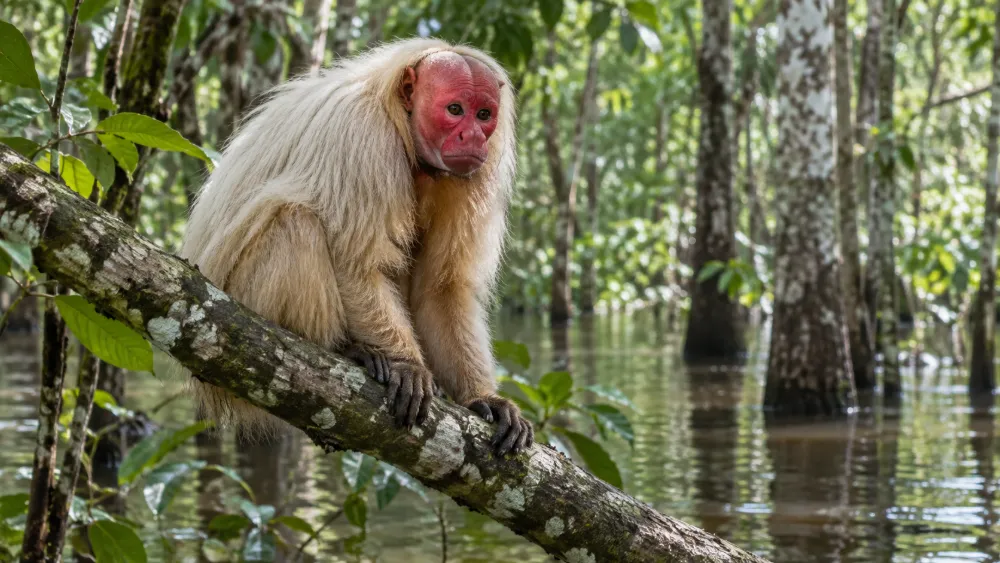
The bald uakari's vivid red face comes from unusual facial skin with abundant blood vessels close to the surface.
10 Weird-Looking Monkeys at a Glance
| Monkey | Scientific Name | Most Unusual Feature | Native Range |
|---|---|---|---|
| Bald uakari | Cacajao calvus | Hairless bright-red face | Brazilian Amazon |
| Golden-headed lion tamarin | Leontopithecus chrysomelas | Golden mane around a dark face | Bahia, Brazil |
| White-faced saki | Pithecia pithecia | Male's bright pale face against black fur | Northern South America |
| Proboscis monkey | Nasalis larvatus | Huge male nose | Borneo |
| Pied tamarin | Saguinus bicolor | Bare dark face and sharply contrasting fur | Brazilian Amazon near Manaus |
| Tufted capuchin | Sapajus apella | Dark horn-like head tufts | Northern South America |
| Owl-faced monkey | Cercopithecus hamlyni | White T-shaped facial stripe | Central Africa |
| Red-shanked douc | Pygathrix nemaeus | Multicolored face, legs and coat | Vietnam and Laos |
| Mandrill | Mandrillus sphinx | Red and blue facial coloration | Central Africa |
| De Brazza's monkey | Cercopithecus neglectus | Orange crown and long white beard | Central and eastern Africa |
“Weird-looking” is subjective. These animals are included because they have particularly unusual or distinctive anatomical features, not because there is a scientific ranking of animal appearance.
Bald Uakari — Cacajao calvus
Few monkeys are as immediately recognizable as a bald uakari.
The most striking feature is its almost hairless, intensely red face.
The color is not produced by ordinary red pigment in the skin. Research on bald uakari facial tissue found a thin epidermis with little or no melanin covering a dense network of blood vessels close to the surface.
That allows circulating blood to produce the vivid crimson appearance.
Why Is the Bald Uakari's Face So Red?
Researchers have proposed that facial redness may provide information about an individual's physiological condition.
A healthy animal with good blood circulation can maintain strong coloration, while illness or anemia may make the face appear paler.
This makes the face a possible visual signal of condition, although scientists should be cautious about reducing such a complex trait to a simple “health meter.”
Bald Uakari Taxonomy Has Changed
Older books and websites often described Cacajao calvus as ranging broadly through Brazil, Peru and Colombia.
Modern genetic research has divided the former broad bald-uakari complex into several recognized species.
As a result, populations once grouped under C. calvus may now be classified as species such as Cacajao ucayalii or Cacajao rubicundus.
This is why old distribution descriptions can differ significantly from modern databases.
Golden-Headed Lion Tamarin — Leontopithecus chrysomelas
The golden-headed lion tamarin looks as though someone placed a small golden mane around a mostly dark-bodied monkey.
Its black body contrasts sharply with long golden to orange fur around the head and shoulders.
The species occurs naturally in the Atlantic Forest of Bahia in eastern Brazil.
Golden-Headed vs Golden Lion Tamarin
These two species are frequently confused.
The correct scientific name of the golden-headed lion tamarin is:
Leontopithecus chrysomelas.
The golden lion tamarin, which has a much more extensively golden-orange body, is:
Leontopithecus rosalia.
They belong to the same genus but are not the same species.
White-Faced Saki — Pithecia pithecia
The white-faced saki is one of the best examples of dramatic differences between male and female monkeys of the same species.
Adult males develop predominantly black fur with a pale cream or whitish facial mask.
Females look very different. Their coat is generally brownish-gray, with pale lines extending around the face.
This difference between male and female coloration is called sexual dichromatism.
White-faced sakis live mainly in forests of the Guianas, parts of Venezuela and northern Brazil.
They are excellent leapers and spend much of their lives in trees.
Does a White-Faced Saki Have a Prehensile Tail?
No.
Its large, furry tail helps with balance but cannot grip branches in the way a spider monkey's tail can.
Proboscis Monkey — Nasalis larvatus
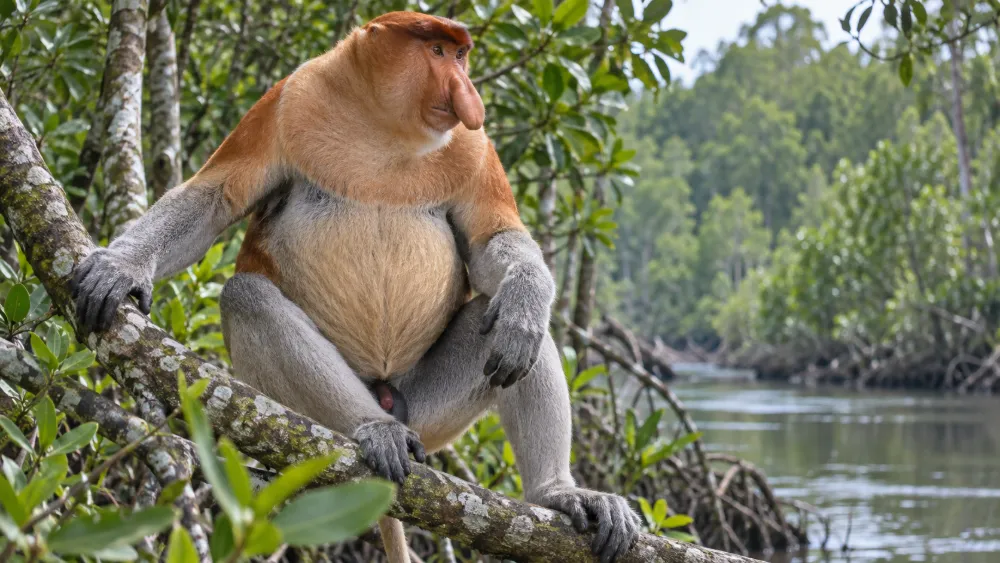
Adult male proboscis monkeys develop dramatically enlarged noses that function as both visual and acoustic social signals.
The proboscis monkey has one of the most exaggerated facial structures of any primate.
Adult males develop a long, pendulous nose that may hang down over the mouth.
Females also have distinctive noses, but they are much smaller.
The species is found naturally only on Borneo and is especially associated with riverine forests, mangroves and swamp habitats.
Why Do Male Proboscis Monkeys Have Such Big Noses?
Modern research suggests the nose is connected with sexual and social signaling.
Studies have found relationships between male nose size, body size and the number of adult females associated with a male.
The enlarged nose also alters the resonance of vocalizations.
This means the nose is probably useful in more than one way: it is a conspicuous visual signal and also changes how the male sounds.
So the proboscis monkey's most unusual feature is not just decorative. It appears to be part of the species' communication system.
Pied Tamarin — Saguinus bicolor
The pied tamarin, sometimes called the pied bare-faced tamarin, has an unusually sharp contrast between its nearly naked dark face and the surrounding pale fur.
Its ears are also largely bare.
Adults are tiny compared with large monkeys such as mandrills or proboscis monkeys, weighing only around half a kilogram.
Their small size makes the dark bare face appear even more prominent.
Where Do Pied Tamarins Live?
The species has an exceptionally restricted distribution around Manaus in the Brazilian Amazon.
Its habitat increasingly overlaps an expanding urban landscape.
Habitat fragmentation, roads, power lines, domestic animals and competition with neighboring tamarin populations create serious conservation problems.
The pied tamarin is currently regarded as Critically Endangered.
Tufted Capuchin — Sapajus apella
The tufted capuchin gets its name from dark tufts of hair rising on either side of the top of the head.
Depending on the individual, these tufts can resemble small horns, ears or a sharply pointed hairstyle.
The species is also a robust monkey with a powerful jaw and darker hands, feet and tail.
Is the Tufted Capuchin Cebus apella or Sapajus apella?
Modern taxonomic databases generally recognize the species as Sapajus apella.
The older combination Cebus apella appears throughout historical scientific literature and is still encountered on older websites.
This resulted from a revision that separated the more robust capuchins into the genus Sapajus.
It does not mean that scientists suddenly discovered the tufted capuchin as a new species in 2012.
Owl-Faced Monkey — Cercopithecus hamlyni
Hamlyn's monkey is better known by one particularly descriptive common name: the owl-faced monkey.
The name comes from the unusual markings on its face.
A pale horizontal line runs across the brow while another line descends toward the mouth, producing a distinctive T-shaped pattern.
Against the monkey's dark face and gray-black coat, the marking can give the impression of an owl-like facial disk.
The species lives in parts of the Democratic Republic of the Congo, Rwanda and Uganda, particularly in dense forests that include bamboo habitat.
Why Does the Owl-Faced Monkey Have Long Fingers?
Owl-faced monkeys have relatively elongated finger bones that provide a strong grip.
This is useful when moving through wet, dense vegetation and bamboo.
Its unusual hands and distinctive face are therefore both connected to its way of life rather than being random peculiarities.
Red-Shanked Douc — Pygathrix nemaeus
Few mammals look as though they are wearing as many different colors as the red-shanked douc.
Its coat combines gray, black, white, reddish-brown and other contrasting tones.
The face is pale to yellowish with long white cheek fur, while the lower legs have striking reddish coloration that gives the species its English name.
This elaborate appearance has sometimes led people to nickname doucs “costumed” monkeys.
The red-shanked douc is an Old World monkey of Vietnam and Laos.
Despite its spectacular appearance, its future is uncertain because hunting and forest loss have caused severe declines. It is currently classified as Critically Endangered.
Mandrill — Mandrillus sphinx
The mandrill may be the most colorful monkey on Earth.
Large adult males develop bright red coloration along the center of the nose, surrounded by strongly ridged blue facial skin.
The rump can also become blue to purple.
Females and juveniles have much less intense coloration.
This makes adult males particularly striking.
Is a Mandrill an Ape or a Monkey?
A mandrill is a true Old World monkey in the family Cercopithecidae.
It is not an ape.
Mandrills are also among the largest living monkeys, with adult males dramatically heavier than females.
Color intensity can play a role in social signaling, particularly among mature males.
De Brazza's Monkey — Cercopithecus neglectus
De Brazza's monkey looks as though it has been carefully styled.
It combines a dark forehead, an orange crown, a pale muzzle and a long white beard.
The result is one of the most recognizable faces among African guenons.
Its overall coat is mostly gray with darker limbs and tail.
De Brazza's monkeys typically live in forests near rivers, swamps and other wet habitats across parts of Central and eastern Africa.
They are often secretive and can remain motionless in dense vegetation when threatened, making the dramatic facial pattern easier to see in photographs than in a shaded forest.
Why Isn't the Aye-Aye on This List?
The aye-aye certainly has one of the strangest appearances among primates.
It has enormous ears, ever-growing incisors and an extremely thin, elongated middle finger used to locate and extract insect larvae from wood.
But the aye-aye is a lemur, not a monkey.
It belongs to an ancient primate lineage found only in Madagascar.
Putting an aye-aye on a list of monkey species creates a basic taxonomic error.
Why Aren't Tarsiers on This List?
Tarsiers are also primates, but they are not monkeys.
They belong to their own ancient lineage within the haplorhine primates.
Their enormous eyes are adaptations for nocturnal vision, and unlike human eyes they cannot rotate very far within their sockets.
Tarsiers compensate with an unusually flexible neck.
They are fascinating candidates for a list of unusual-looking primates, but not for a scientifically accurate list of monkeys.
What Makes a Monkey Look Unusual?
Human observers tend to notice features that differ strongly from the faces we see in most familiar mammals.
Among monkeys, these can include:
bare brightly colored skin;
exaggerated noses;
strongly contrasting facial masks;
crests and hair tufts;
beards and cheek manes;
unusually long limbs;
bright sexual coloration.
But these features often have real biological functions.
Evolution does not produce facial traits because they look strange to humans. Natural and sexual selection preserve features that affect survival and reproduction.
Why Do Some Monkeys Have Brightly Colored Faces?
Facial coloration can transmit information between members of the same species.
Depending on the monkey, color may be connected to:
individual condition;
sex;
age;
dominance;
reproductive status;
species recognition.
Bald uakaris and mandrills provide particularly striking examples, although their colors are produced by different anatomical mechanisms.
Which Monkey Has the Biggest Nose?
The proboscis monkey is the obvious record-holder in appearance.
Adult males develop a uniquely enlarged fleshy nose that can hang well below the nostrils.
Research indicates that larger noses are associated with visual social signaling and also influence vocal resonance.
Which Monkey Has the Strangest Face?
There is no scientific answer because “strange” is subjective.
The bald uakari and proboscis monkey are two particularly strong candidates because their faces are highly specialized in ways rarely seen in other primates.
The uakari has exposed red vascular skin, while the male proboscis monkey has an extremely enlarged nose.
Are Weird-Looking Monkeys Rare?
Some are, but unusual appearance and rarity are unrelated.
A species can look highly distinctive while maintaining relatively broad populations, while another visually ordinary monkey may be close to extinction.
Examples on this list include both relatively widespread species and highly threatened species such as the pied tamarin and red-shanked douc.
Monkeys vs Primates: What's the Difference?
Every monkey is a primate, but not every primate is a monkey.
Primates include several major groups:
| Group | Examples | Are They Monkeys? |
|---|---|---|
| Lemurs and lorises | Aye-aye, ring-tailed lemur, slow loris | No |
| Tarsiers | Philippine and Sulawesi tarsiers | No |
| New World monkeys | Uakaris, tamarins, capuchins, sakis | Yes |
| Old World monkeys | Proboscis monkeys, mandrills, guenons, doucs | Yes |
| Apes | Gibbons, orangutans, gorillas, chimpanzees, humans | No |
This distinction is important when creating animal rankings. A list titled “monkeys” should not automatically include every unusual-looking primate.
Frequently Asked Questions
What is the weirdest-looking monkey?
There is no objective scientific ranking, but bald uakaris and proboscis monkeys are among the most distinctive. Bald uakaris have bright red bare faces, while adult male proboscis monkeys have extremely enlarged noses.
What monkey has a red face?
Bald uakaris are famous for their hairless red faces. Mandrills also have vivid red facial coloration combined with blue ridges on the muzzle.
What monkey has the biggest nose?
The adult male proboscis monkey, Nasalis larvatus, is famous for its exceptionally large pendulous nose.
Why do proboscis monkeys have large noses?
Research supports a role in sexual and social signaling. Nose size is associated with male body size and social characteristics, and the enlarged nasal structures also influence the resonance of male calls.
What monkey has a white face?
Adult male white-faced sakis, Pithecia pithecia, have a striking pale facial mask surrounded by predominantly black fur.
Is an aye-aye a monkey?
No. The aye-aye is a lemur from Madagascar. It is a primate, but it does not belong to the monkey lineage.
Is a tarsier a monkey?
No. Tarsiers are haplorhine primates, but they form a separate evolutionary lineage from anthropoid primates such as monkeys and apes.
Is a mandrill a monkey?
Yes. The mandrill is an Old World monkey in the family Cercopithecidae. It is not an ape.
Is a pied tamarin a monkey?
Yes. Tamarins are small New World monkeys in the family Callitrichidae.
What is the correct scientific name of the golden-headed lion tamarin?
The correct name is Leontopithecus chrysomelas. Leontopithecus rosalia is the golden lion tamarin, a different species.
What is the scientific name of the tufted capuchin?
Modern taxonomic databases generally use Sapajus apella. The older combination Cebus apella remains common in historical literature.
Related Monkey Guides
If you want to explore more primates, see our guides to the world's rarest monkeys, smartest monkeys and cutest monkey species. These rankings focus on different traits and should not be treated as interchangeable measures of the same animals.
Scientific and Reference Sources
American Society of Mammalogists Mammal Diversity Database — current taxonomy of bald uakaris, lion tamarins, pied tamarins and red-shanked doucs.
Animal Diversity Web, University of Michigan — species accounts for white-faced sakis, proboscis monkeys, owl-faced monkeys, De Brazza's monkeys and mandrills.
Scientific Advances and Scientific Reports — research on the visual and acoustic functions of the enlarged male proboscis-monkey nose.
Royal Society Open Science — research on the anatomy and possible signaling role of bald-uakari facial coloration.
NCBI Taxonomy and ITIS — current use of Sapajus apella and historical synonym Cebus apella.
Duke Lemur Center — aye-aye taxonomy and specialized anatomy.
Oryx — conservation research on the Critically Endangered pied tamarin.