There is no scientific way to rank the “cutest monkey in the world,” because cuteness is subjective. But if you want a strong candidate, the pygmy marmoset is hard to ignore: it is the world’s smallest monkey, with a tiny body, expressive face and long tail. Other visually distinctive true monkeys include cotton-top tamarins, emperor tamarins, golden lion tamarins, golden snub-nosed monkeys, red-shanked doucs, squirrel monkeys, night monkeys, Japanese macaques and dusky leaf monkeys.
This list includes only true monkey species. Tarsiers, slow lorises and lemurs are all primates, but they belong to different primate groups and are not monkeys.
Top 10 Cutest Monkeys at a Glance
| # | Monkey | Scientific name | Native region | Standout feature |
|---|---|---|---|---|
| 1 | Pygmy marmoset | Cebuella pygmaea | Western Amazon Basin | World’s smallest monkey |
| 2 | Cotton-top tamarin | Saguinus oedipus | Northwestern Colombia | Large white crest |
| 3 | Emperor tamarin | Saguinus imperator | Western Amazon Basin | Long white moustache |
| 4 | Golden lion tamarin | Leontopithecus rosalia | Southeastern Brazil | Bright golden coat and mane |
| 5 | Golden snub-nosed monkey | Rhinopithecus roxellana | Central China | Blue face and golden-orange fur |
| 6 | Red-shanked douc | Pygathrix nemaeus | Vietnam, Laos and Cambodia | Multicolored face and limbs |
| 7 | Common squirrel monkey | Saimiri sciureus | Northern South America | Small face with bright eye mask |
| 8 | Azara’s night monkey | Aotus azarae | Central South America | Huge nocturnal eyes |
| 9 | Japanese macaque | Macaca fuscata | Japan | Round face and thick winter coat |
| 10 | Dusky leaf monkey | Trachypithecus obscurus | Southeast Asia | White eye-rings and pale mouth |
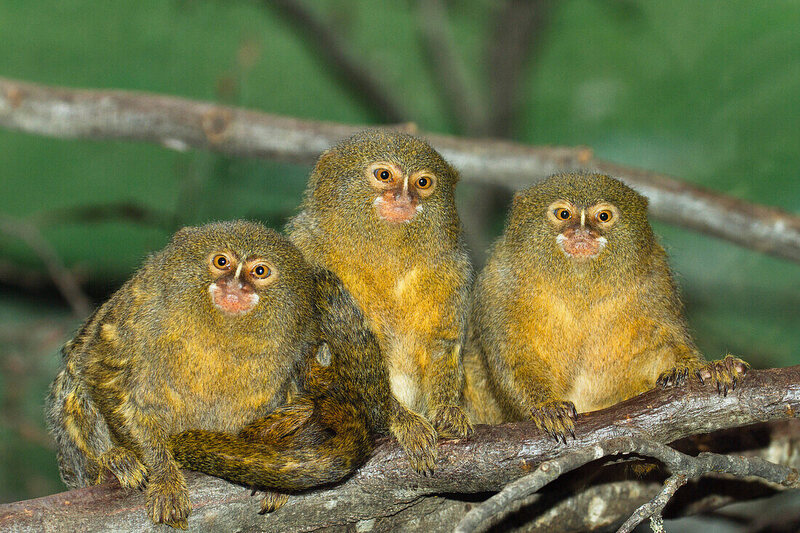
Pygmy marmosets are the world’s smallest monkeys, although they are not the smallest primates.
Pygmy Marmoset
The pygmy marmoset is an obvious contender for the title of cutest monkey because of its tiny size. Adults are only about 12–16 cm long excluding the tail and typically weigh around 85–140 grams. Their long tails are longer than their bodies and help with balance as they move through dense forest vegetation.
Pygmy marmosets live in the Amazon region of South America, especially forests near rivers and floodplains. They spend much of their time climbing tree trunks and feeding on plant gums and sap, using specialized lower teeth to gouge small holes in bark.
The pygmy marmoset is the smallest monkey, not the smallest primate. Some mouse lemurs are smaller, but mouse lemurs are lemurs rather than monkeys.
Their tiny size also makes them vulnerable to the illegal pet trade. Cute appearance is not a reason to keep a wild primate as a household pet.
Cotton-Top Tamarin
The cotton-top tamarin (Saguinus oedipus) is a small New World monkey instantly recognizable by the dramatic white crest running from its forehead toward the back of the head.
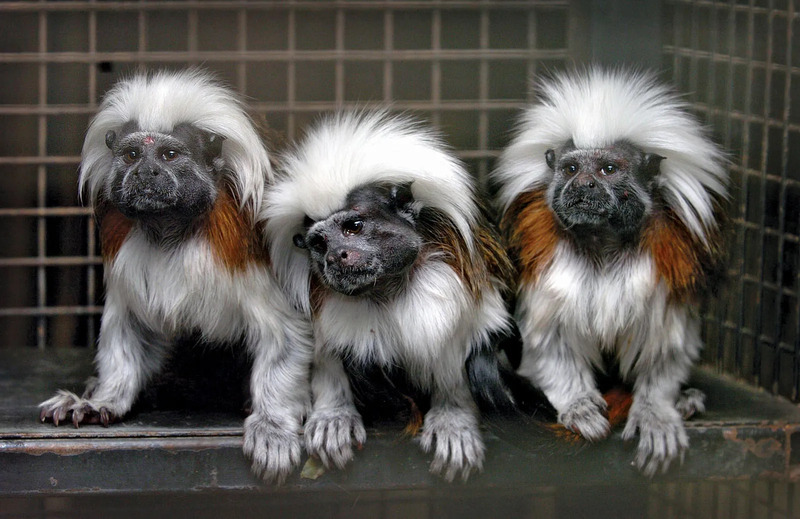
Adults weigh only about half a kilogram, but their tails are longer than their bodies and help them balance in the canopy. Smithsonian reports that they live naturally only in the tropical and semi-dry forests of northwestern Colombia.
Cotton-top tamarins are highly social. Family groups communicate using whistles, chirps, squeaks, barks and other calls, and older group members help care for young.
The cute appearance hides a serious conservation story: fewer than 6,000 are estimated to remain in the wild, with habitat loss and the illegal pet trade among the major threats.
Emperor Tamarin
The emperor tamarin (Saguinus imperator) has one of the most recognizable faces in the monkey world. Long white moustache hairs extend outward from both sides of the muzzle, giving the animal an almost theatrical expression.
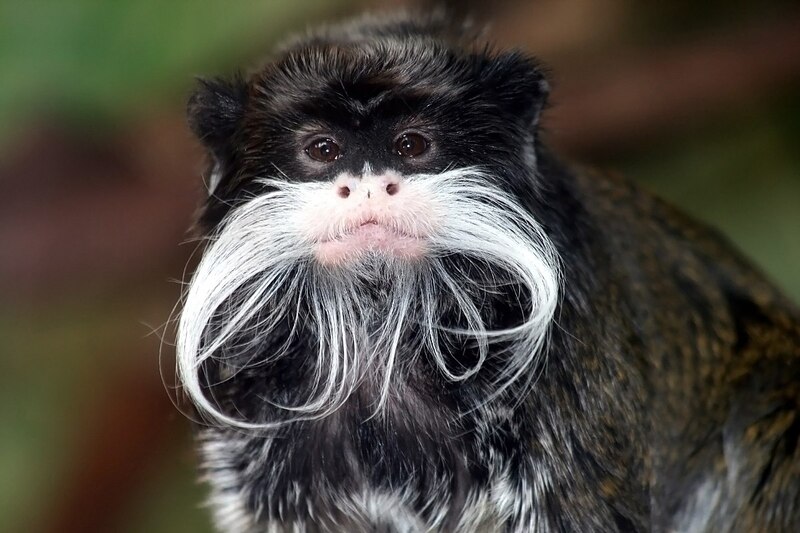
Emperor tamarins are small, arboreal monkeys from the western Amazon Basin, including parts of Peru, Bolivia and Brazil. Like other tamarins, they live socially and spend much of their time moving through branches in search of fruit, insects, nectar and other foods.
Habitat loss and fragmentation are important conservation concerns for emperor tamarins, and threats should be evaluated using species-specific evidence rather than generalized claims.
Golden Lion Tamarin
The golden lion tamarin (Leontopithecus rosalia) looks almost unreal: its reddish-gold fur forms a mane around a dark face, giving this small Brazilian monkey the appearance of a miniature lion.
Adults generally weigh about 482–680 grams. They live in Atlantic coastal forest in southeastern Brazil and move through dense canopy vegetation in family groups.
Golden lion tamarins are also one of the best-known primate conservation success stories. Their wild population once fell to roughly 200 animals, but captive breeding, reintroduction, habitat restoration and wildlife corridors helped the species recover substantially. It remains Endangered and still depends on conservation work.
Its story is a useful reminder that the most attractive wild primates are best protected in functioning forests—not turned into novelty pets.
Golden Snub-Nosed Monkey
The golden snub-nosed monkey (Rhinopithecus roxellana) combines an unusual pale blue face with orange-gold fur. Young individuals have round faces and thick coats that make them especially photogenic.

This Old World monkey is native to mountainous forests of central China. It is adapted to cold conditions and can live in habitats that experience snow and freezing temperatures.
The name “golden monkey” can be ambiguous, so this list uses the specific species Rhinopithecus roxellana, commonly called the golden snub-nosed monkey.
Red-Shanked Douc
The red-shanked douc (Pygathrix nemaeus) is sometimes nicknamed the “costumed ape” because of its extraordinary combination of colors. Despite that nickname, it is not an ape—it is an Old World monkey.
Its gray body is contrasted with reddish lower legs, dark limbs, a pale tail, orange-toned facial skin and white whiskers. Few monkeys have such a naturally elaborate color pattern.
Red-shanked doucs are arboreal leaf-eaters found in parts of Vietnam, Laos and Cambodia. Their appearance may be appealing, but they are sensitive forest specialists and should never be treated as novelty pets.
Common Squirrel Monkey
Common squirrel monkeys (Saimiri sciureus) are small South American monkeys with a white facial mask, dark muzzle and large expressive eyes. Their energetic movements and curious social behavior help explain why people often describe them as cute.
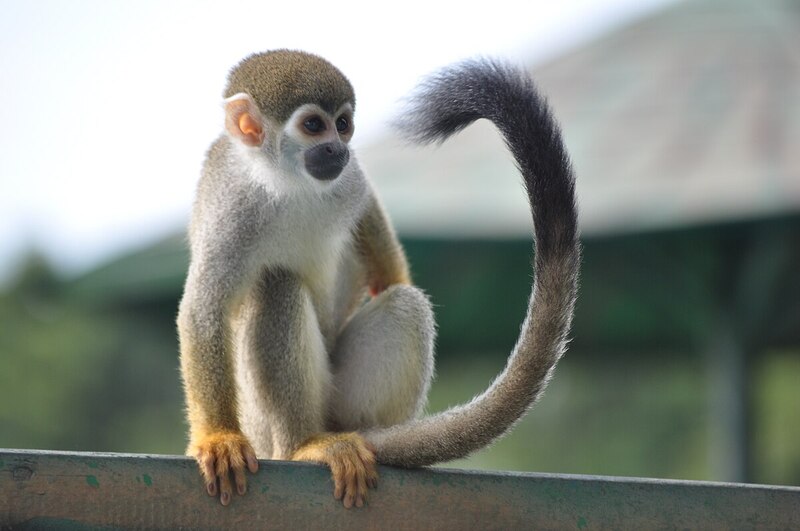
The adult squirrel monkey tail is not truly prehensile; it is used mainly for balance as the monkey moves through the canopy.
Squirrel monkeys are highly social and can live in large groups. Their intelligence and social needs are another reason they are unsuitable as ordinary household pets, despite how frequently primates are marketed online as “cute exotic pets.”
Azara’s Night Monkey
Azara’s night monkey (Aotus azarae) belongs to the night-monkey or owl-monkey group. Its enormous eyes are an adaptation to a lifestyle with substantial nocturnal activity and give it an instantly recognizable expression.
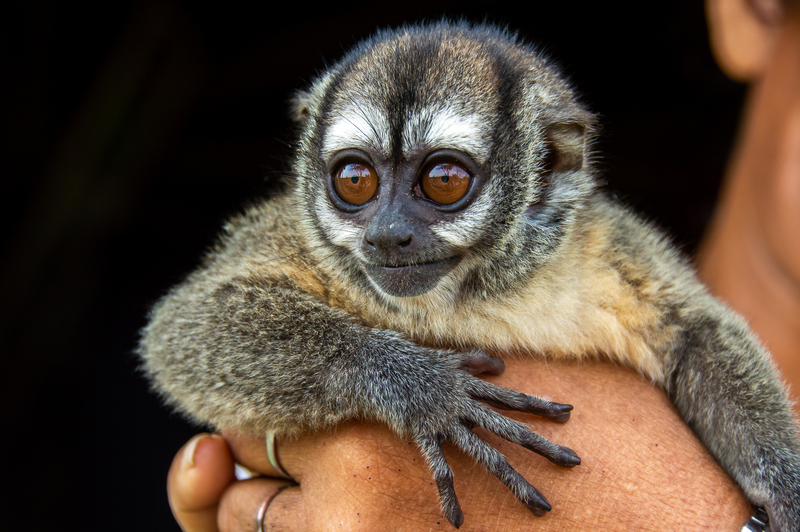
Night monkeys live in South America and are unusual among anthropoid primates because most species in the group are active mainly at night. They communicate socially, form pair bonds in many populations and use scent as well as vocal signals.
Aotus contains multiple night-monkey species; this list uses Azara’s night monkey (Aotus azarae) as a representative example.
Japanese Macaque
The Japanese macaque (Macaca fuscata) is famous for its pinkish face, thick winter coat and ability to live farther north than any other non-human primate population.
Young Japanese macaques have especially rounded faces and expressive eyes. In winter populations, the contrast between a dense coat and bare red-pink facial skin creates one of the most recognizable primate appearances.
“Miniature Stone Monkey” is not a recognized monkey species or breed. Japanese macaques grow according to their genetics, nutrition and health; deliberately restricting food is not a legitimate way to create a miniature animal.
Dusky Leaf Monkey
The dusky leaf monkey (Trachypithecus obscurus) is a Southeast Asian langur with a dark gray coat, conspicuous white eye-rings and a pale patch around the mouth. Those markings create a naturally wide-eyed expression.
Infants look even more different from adults because many are born with bright yellow-orange fur that darkens as they grow. This dramatic age-related color change makes the species especially striking.
Dusky leaf monkeys are mainly leaf-eaters but also consume fruit, flowers and other plant material. Their specialized digestive system helps process a fibrous diet.
Which Monkey Is the Cutest in the World?
There is no scientific winner because cuteness is a human perception rather than a biological measurement.
If you judge by small size, the pygmy marmoset is a strong candidate. If you prefer distinctive faces, cotton-top and emperor tamarins stand out. If bright color matters, golden lion tamarins, golden snub-nosed monkeys and red-shanked doucs are hard to beat.
A better way to use a “cutest monkey” list is to discover real species and then learn why their appearance, behavior and habitat evolved.
Monkeys vs Lemurs, Lorises and Tarsiers
Monkeys are part of the simian or anthropoid branch of primates. Lemurs and lorises belong to Strepsirrhini, while tarsiers are haplorhine primates but are not monkeys.
| Primate | Is it a monkey? | Group |
|---|---|---|
| Tarsier | No | Tarsiiform primate |
| Slow loris | No | Strepsirrhine primate |
| Ring-tailed lemur | No | Lemur |
| Mouse lemur | No | Lemur |
This distinction is useful when comparing primate species because “primate” is a broader category than “monkey.”
Are Pygmy Marmosets the Smallest Primates?
No. They are the smallest monkeys, which is already remarkable. The smallest primates belong to mouse-lemur lineages in Madagascar.
“Smallest primate” and “smallest monkey” are not the same category: pygmy marmosets hold the monkey distinction, while smaller primates occur among mouse lemurs.
Do Monkeys Make Good Pets?
Generally, no. Monkeys are intelligent, social wild animals with complex behavioral, dietary and veterinary needs that are difficult to meet in ordinary homes.
Primates are intelligent, social wild animals with demanding dietary, behavioral and veterinary needs. Many species live in complex groups, travel through large home ranges and communicate constantly with other members of their species.
San Diego Zoo specifically warns that monkeys do not make good pets and notes that pygmy marmosets face pressure from the pet trade. Cotton-top tamarins have also historically been captured for illegal trade.
If you like these animals because they are cute, supporting habitat protection and responsible accredited zoos is far better than trying to keep one privately.
Why Do Baby Monkeys Look So Cute to Humans?
Humans tend to respond strongly to features such as large eyes, round faces, small noses and small body size. Several monkey species naturally display some of these proportions, while infants exaggerate them even further.
That does not mean the animals evolved “to look cute to people.” These features have their own developmental and evolutionary explanations. Cuteness is the interpretation our brains place on them.
Explore More Monkey Rankings
If you are comparing monkey species, see 10 Rarest Monkeys in the World, Top 10 Smartest Monkeys in the World, and 10 Most Powerful Monkeys in the World.
These pages answer different questions—rarity, intelligence and physical power—without mixing those traits into the subjective idea of cuteness.
Frequently Asked Questions
What is the cutest monkey in the world?
There is no scientific ranking, but the pygmy marmoset is a popular candidate because it is the world’s smallest monkey and has a very small body, expressive face and long tail.
What are the cutest monkey species?
Popular examples include pygmy marmosets, cotton-top tamarins, emperor tamarins, golden lion tamarins, golden snub-nosed monkeys, red-shanked doucs, squirrel monkeys, night monkeys, Japanese macaques and dusky leaf monkeys.
What is the smallest monkey in the world?
The pygmy marmoset is widely recognized as the world’s smallest monkey. Adults typically weigh only around 85–140 grams.
Is a mouse lemur a monkey?
No. Mouse lemurs are primates, but they are lemurs rather than monkeys.
Is a slow loris a monkey?
No. Slow lorises are strepsirrhine primates and are more closely grouped with lorises and lemurs than with monkeys.
Is a tarsier a monkey?
No. Tarsiers are haplorhine primates, but they are not monkeys. They form their own distinctive primate lineage.
Are “monkey breeds” the same as monkey species?
No. Wild monkeys are classified into species, genera and families. “Breed” is mainly used for selectively bred domestic animals. Terms such as “cute monkey breeds” are common searches, but “cute monkey species” is the scientifically correct phrase.
Can you keep a pygmy marmoset as a pet?
Primate ownership laws vary, but legal possibility does not make a pygmy marmoset a suitable household pet. They have complex social, dietary and environmental needs, and wild primate trade can harm conservation.
Are squirrel monkey tails prehensile?
Adult squirrel monkeys do not have truly prehensile tails. The tail mainly functions in balance and movement through the canopy.
Official and Reference Sources
Final Takeaway
The cutest monkey is a matter of personal taste. Pygmy marmosets stand out for tiny size, tamarins for extraordinary faces and coats, golden snub-nosed monkeys and red-shanked doucs for striking colors, and squirrel monkeys and night monkeys for their large expressive eyes. Most importantly, these are wild primates—not novelty pets—and learning their real biology is more rewarding than turning cuteness into a reason for private ownership.