Mantis shrimp punch so hard because they use a spring-loaded striking system rather than relying on muscle contraction alone. Powerful muscles gradually store energy in elastic parts of the exoskeleton, and a latch-like mechanism helps control its sudden release. In the peacock mantis shrimp, this produces extremely fast strikes with specialized hammer-shaped appendages. The impact can break the shells of prey such as snails and crabs. The rapid movement also causes cavitation, producing vapor bubbles that collapse and generate an additional force. However, not all mantis shrimp species use the same striking structures or hunt in the same way.
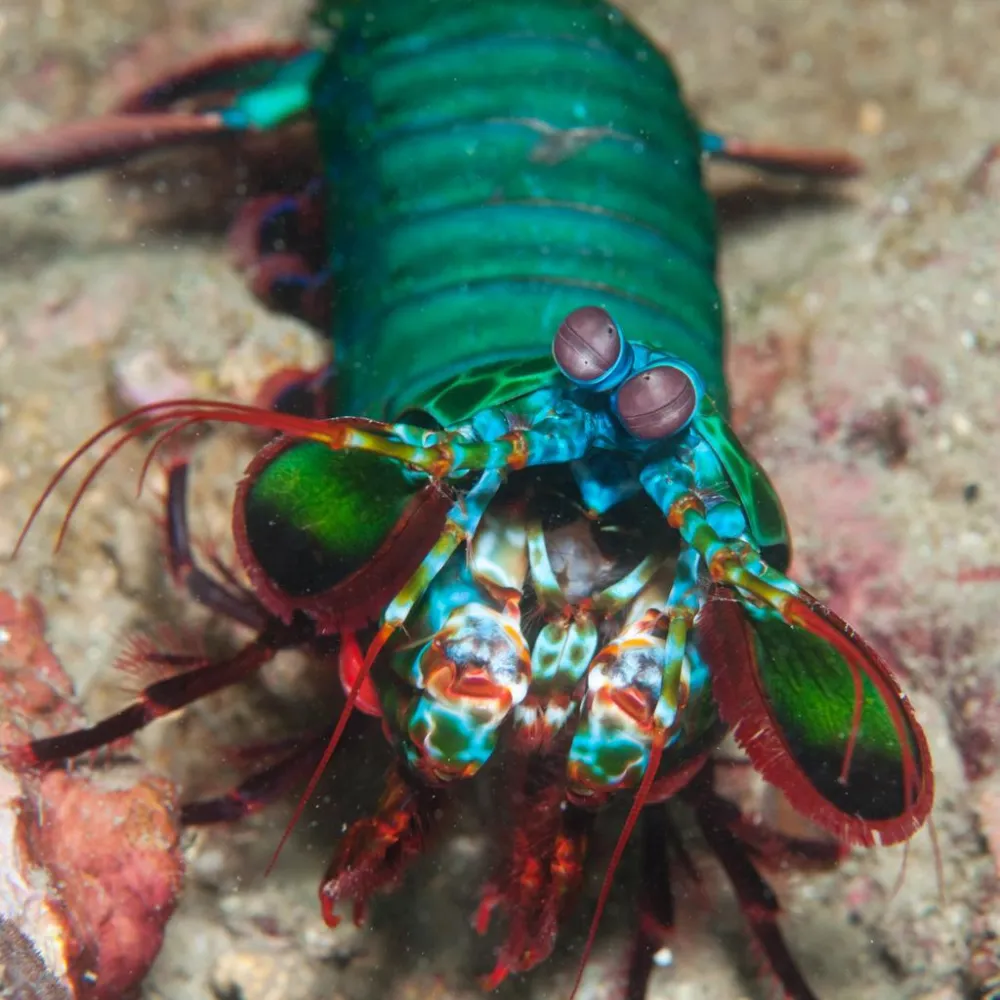
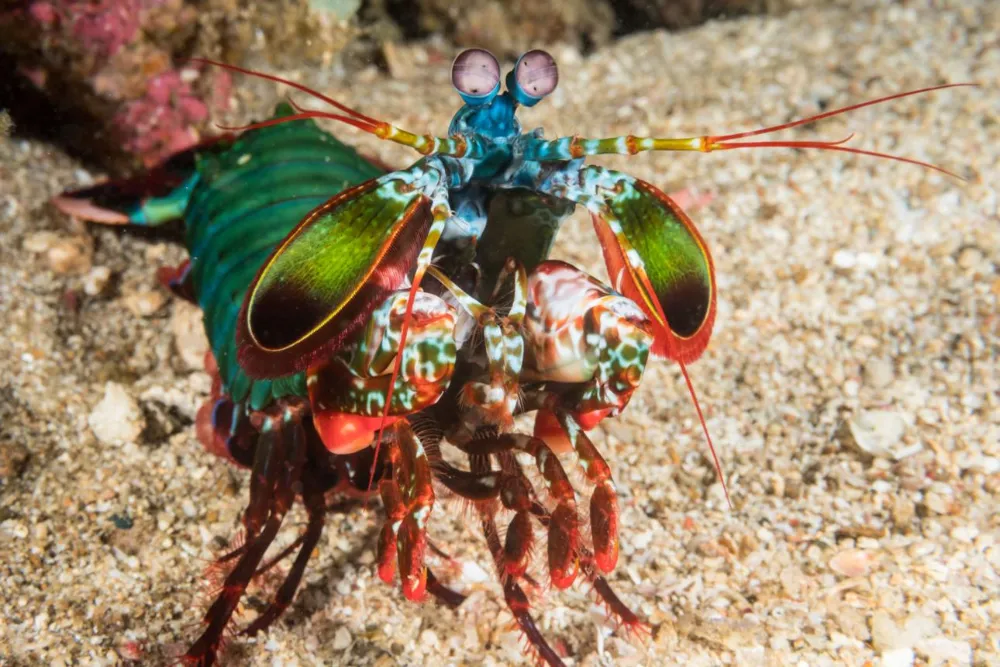
The peacock mantis shrimp uses specialized hammer-like appendages to strike hard-shelled prey.
Why Do Mantis Shrimp Punch So Hard?
Mantis shrimp are marine crustaceans famous for their extremely powerful and rapid attacks.
Some species use their front appendages as biological hammers.
Others possess sharp appendages adapted to seize or impale softer prey.
In the hammer-like striking species, the extraordinary speed comes from an energy-storage mechanism involving muscles, elastic structures, and a latch.
The animal stores mechanical energy before releasing it rapidly.
This allows the striking appendage to accelerate faster than ordinary muscle contraction alone would permit.
Research on the peacock mantis shrimp has demonstrated both tremendous impact forces and the additional effects of collapsing cavitation bubbles.
What Is a Mantis Shrimp?
Mantis shrimp belong to the crustacean order Stomatopoda.
Despite their name, they are not true shrimp.
They are marine predators with specialized grasping or striking appendages.
Many species live in burrows, crevices, coral reefs, or sandy marine habitats.
They are known for their unusual eyes and rapid predatory movements.
However, mantis shrimp species differ significantly in size, anatomy, prey choice, and hunting strategy.
Are Mantis Shrimp Actually Shrimp?
No. Mantis shrimp are not classified with the familiar shrimp commonly eaten by people.
They are stomatopod crustaceans.
Their name reflects superficial similarities to shrimp and their specialized predatory appendages.
However, they possess their own distinctive body organization.
Their striking or grasping limbs are particularly different from the claws of ordinary shrimp or crabs.
How Does a Mantis Shrimp Punch Work?
The mantis shrimp's strike involves several coordinated mechanical steps.
First, muscles load elastic structures within the appendage.
A latch-like mechanism prevents immediate release.
When the latch is released, stored energy accelerates the striking limb.
The hammer-shaped portion moves toward the target.
The resulting impact can generate a brief but powerful force.
In some species, the movement is fast enough to create cavitation bubbles in the surrounding water.
However, the detailed anatomy differs among species.
What Is a Spring-Loaded Strike?
A spring-loaded strike uses elastic energy stored before movement begins.
Instead of requiring muscles to generate the full speed during the strike, the animal first loads a spring-like structure.
The stored energy is released rapidly.
This mechanism is sometimes called latch-mediated spring actuation.
It is an important way that animals can achieve movements exceeding the speed limits of direct muscular action.
Mantis shrimp provide one of the best-studied examples of this principle.
Why Can't Muscles Alone Produce Such a Fast Punch?
Muscle contraction has physiological limits on how quickly force and mechanical work can be produced.
However, elastic tissues can store energy over a longer period.
When that energy is released within a short time, the resulting movement can be much faster.
This is known as power amplification.
The 2004 study in Nature demonstrated that the extreme striking speed of the peacock mantis shrimp required a specialized energy-storage system.
The animal's exoskeleton contains spring-like structures that contribute to this mechanism.
What Is the Mantis Shrimp Saddle?
The saddle is a specialized region of the mantis shrimp's striking appendage.
Its curved structure helps store elastic energy during loading.
The saddle is part of a larger mechanical system that also includes other elastic structures and a latch.
However, it should not be described as the only spring responsible for every part of the movement.
A 2013 comparative study described an integrated system of exoskeletal springs, linkages, and latches.
These components work together to create the rapid strike.
What Is a Latch Mechanism?
A latch is a structure that temporarily prevents movement while energy is stored.
In mantis shrimp, specialized skeletal and muscular arrangements help hold the striking appendage in a loaded position.
When the restraint is released, elastic energy drives rapid movement.
The concept is similar to a mechanical catch that holds a loaded spring.
However, the real biological system is more complex than a simple household spring toy.
What Did the 2004 Nature Study Discover?
In 2004, researchers published Deadly Strike Mechanism of a Mantis Shrimp in Nature.
The study examined the peacock mantis shrimp, Odontodactylus scyllarus.
High-speed imaging revealed that the striking appendage could reach peak speeds of approximately 14 to 23 meters per second.
The researchers also measured extraordinarily high angular velocities and accelerations.
These movements were too rapid to be explained by ordinary muscle contraction alone.
The investigators identified a specialized elastic mechanism involving the saddle-shaped exoskeleton.
They also observed cavitation bubbles associated with the strike.
How Fast Is a Mantis Shrimp Punch?
In the 2004 study, the peacock mantis shrimp's striking appendage reached peak speeds between approximately 14 and 23 meters per second.
That is an extremely fast movement for a small animal appendage.
However, these values were measured in a particular species under experimental conditions.
They are not a universal fixed speed for every mantis shrimp.
Different species and individual strikes can vary in performance.
How Fast Is 23 Meters per Second?
A speed of 23 meters per second is approximately 83 kilometers per hour or 51 miles per hour.
However, this comparison describes the peak movement speed of a specialized limb.
It does not mean the entire mantis shrimp swims through the ocean at that speed.
It also does not mean the striking appendage maintains that speed for a long period.
The movement occurs in a very short burst.
How Hard Can a Mantis Shrimp Punch?
Mantis shrimp can generate remarkable forces relative to their body size.
A 2005 study measured peak direct impact forces ranging from approximately 400 to 1,501 newtons in the peacock mantis shrimp.
However, these values describe the forces recorded in specific laboratory trials.
They should not be treated as the exact force of every strike.
The study also detected separate force peaks associated with cavitation bubble collapse.
These additional forces help explain the effectiveness of the attack against hard shells.
What Is a Newton of Force?
The newton is the standard scientific unit of force.
One newton is the force required to accelerate a one-kilogram mass at one meter per second squared.
In mantis shrimp research, force measurements allow scientists to compare the mechanical impact of strikes.
However, peak force alone does not describe every aspect of an impact.
The duration of the force, impact area, target structure, and material properties also influence the damage caused.
What Did the 2005 Impact Study Find?
In 2005, researchers Sheila Patek and Roy Caldwell published Extreme Impact and Cavitation Forces of a Biological Hammer in the Journal of Experimental Biology.
They measured direct striking forces and analyzed the pressure effects of cavitation.
The researchers found that individual strikes could produce two distinct force peaks.
The first was associated with contact between the striking appendage and the target.
The second was associated with the collapse of cavitation bubbles.
The two peaks were separated by only a fraction of a millisecond.
The findings demonstrated that the animal's attack combines direct impact and fluid-dynamic forces.
Why Does a Mantis Shrimp Produce Two Impacts?
The first impact comes from the hammer-shaped appendage striking the target.
The second force peak occurs when nearby cavitation bubbles collapse.
The bubbles form because extremely rapid movement changes the pressure of the surrounding water.
When the bubbles collapse, they produce additional pressure effects.
However, the second event is not a separate muscular punch.
It is a consequence of the fluid dynamics created by the original strike.
What Is Cavitation?
Cavitation occurs when the local pressure in a liquid becomes low enough for vapor-filled bubbles to form.
These bubbles may rapidly collapse when they move into regions of higher pressure.
The collapse can generate sharp pressure changes.
In engineering, cavitation can damage propellers and other surfaces exposed to fast-moving water.
In mantis shrimp, the same physical phenomenon can occur near the rapidly moving striking appendage.
The 2004 and 2005 studies provided experimental evidence of these bubbles and their associated forces.
Do Mantis Shrimp Create Underwater Shock Waves?
Rapid strikes can create strong pressure disturbances in water.
The collapse of cavitation bubbles contributes additional forces.
However, describing every event as an explosion or shock wave can oversimplify the fluid dynamics.
The scientifically established observations include vapor bubble formation, bubble collapse, and brief associated force peaks.
The exact pressure field depends on the strike, target, and water conditions.
Can Cavitation Damage Prey?
Yes. Experiments suggest that cavitation contributes to the mechanical forces experienced by hard-shelled prey.
The 2005 study found that cavitation force peaks could reach approximately 504 newtons in the tested conditions.
However, the relative contribution of cavitation differed among strikes.
Direct impact remained an important source of force.
The animal's effectiveness comes from a combination of fast movement, direct contact, and hydrodynamic effects.
Does the Mantis Shrimp Punch Create Heat and Light?
Collapsing cavitation bubbles can sometimes produce extremely localized heating and light in physical systems.
However, those effects should not be confused with a large visible fireball around a mantis shrimp's punch.
The key verified findings in the mantis shrimp experiments are the presence of cavitation and its mechanical effects.
Claims about particular temperatures or flashes of light during natural strikes should be supported by direct measurements rather than repeated as universal facts.
How Does a Mantis Shrimp Break Shells?
Some mantis shrimp specialize in attacking animals protected by hard shells.
They strike the shell repeatedly with a hammer-shaped portion of the raptorial appendage.
The concentrated impact force can initiate cracks or fractures.
Cavitation effects may contribute additional loading.
However, success depends on the shell's thickness, shape, and material properties.
A large or unusually strong shell may require multiple strikes.
What Animals Do Mantis Shrimp Punch?
Smashing mantis shrimp often prey on hard-shelled invertebrates.
These can include snails, crabs, and other crustaceans.
However, diets vary among species and habitats.
The peacock mantis shrimp is a well-known example of a shell-breaking predator.
Other mantis shrimp use different hunting methods and target different prey.
Are All Mantis Shrimp Punchers?
No. Mantis shrimp are often divided into smashing and spearing forms.
Smashers possess enlarged, club-like structures used for striking.
Spearers possess more elongated, spiny appendages used to capture softer prey.
However, the diversity of stomatopod feeding anatomy is more complex than a simple two-category division.
The distinction is useful for understanding broad differences in hunting behavior.
Smashers vs. Spearers
| Feature | Smashing Mantis Shrimp | Spearing Mantis Shrimp |
|---|---|---|
| Main weapon | Hammer-like dactyl club | Spiny grasping appendage |
| Typical prey | Hard-shelled animals | Fish and softer-bodied animals |
| Attack style | Rapid blunt-force impact | Rapid grasping or impaling strike |
| Cavitation in studied strikes | Well documented in peacock mantis shrimp | Not the defining mechanism |
| Example | Odontodactylus scyllarus | Several Lysiosquillina species |
What Is the Peacock Mantis Shrimp?
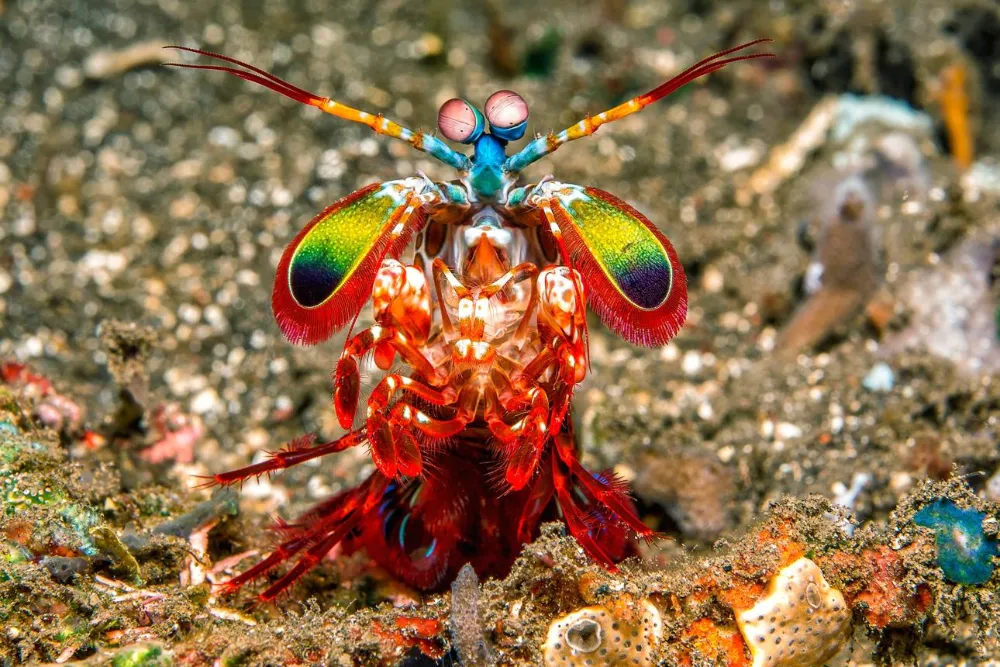
The peacock mantis shrimp is a colorful marine stomatopod scientifically named Odontodactylus scyllarus.
It is found in the Indo-Pacific region.
The species is particularly well known for its powerful smashing appendages.
It has been the subject of several important studies of spring mechanics, strike speed, cavitation, and impact-resistant materials.
However, results measured in this species should not automatically be applied to every other mantis shrimp.
Why Is the Mantis Shrimp Club So Strong?
Smashing mantis shrimp repeatedly strike hard surfaces.
Their clubs must withstand substantial forces without failing after every impact.
The dactyl club contains a complex arrangement of mineralized and organic materials.
Research has shown that different regions contribute to hardness, toughness, and energy dissipation.
This makes the structure unusually resistant to repeated damage.
However, the club is a living biological structure and is not indestructible.
What Did the 2012 Science Study Discover?
In 2012, researchers published The Stomatopod Dactyl Club: A Formidable Damage-Tolerant Biological Hammer in Science.
The study examined the organization of the mantis shrimp's striking structure.
Researchers identified a highly mineralized outer impact region and underlying layers with complex fiber arrangements.
These structural features help distribute stress and resist damage.
However, the club's durability does not come from one material alone.
Its performance depends on the organization of several components across different length scales.
What Is a Helicoidal Structure?
A helicoidal structure contains layers whose fiber orientations rotate gradually through the material.
This arrangement is sometimes compared with a spiral or twisted plywood structure.
In the mantis shrimp club, a related arrangement contributes to energy dissipation and resistance to crack propagation.
However, the exact arrangement differs among regions of the club.
The structure is an important example of how biological materials can achieve high performance through architecture as well as composition.
How Does the Club Avoid Breaking?
The club's surface is highly mineralized and capable of withstanding repeated contact.
Underlying structures help spread impact energy.
Fiber arrangements may redirect or slow the growth of cracks.
However, no biological material is completely immune to damage.
The mantis shrimp's striking surface is especially effective because multiple structural mechanisms work together.
Can a Mantis Shrimp Break Aquarium Glass?
Large smashing mantis shrimp can damage some aquarium materials, and their powerful strikes warrant careful husbandry.
However, not every species or individual can break every thickness of aquarium glass.
Risk depends on the species, animal size, container construction, and repeated impacts.
Therefore, a blanket claim that any mantis shrimp can shatter any aquarium is inaccurate.
Specialist aquarium care is advisable for species with powerful smashing appendages.
Can a Mantis Shrimp Break Human Bones?
A smashing mantis shrimp can injure human tissue if handled carelessly.
However, direct claims that every mantis shrimp can break human bones are not supported by a universal set of measurements.
Force alone does not determine the outcome of contact with a particular bone.
Impact geometry, body size, and the contacted tissue all matter.
These animals should not be handled with bare hands or provoked into striking.
Can a Mantis Shrimp Hurt a Human?
Yes. A mantis shrimp may injure someone through a powerful strike or sharp grasping appendage.
The risk varies among species and circumstances.
Some species can cause painful punctures or lacerations.
However, the animals do not normally seek encounters with people.
They should be observed without touching or disturbing their burrows.
Can a Mantis Shrimp Punch More Than Once?
Yes. Smashing mantis shrimp can deliver repeated strikes.
However, the striking system must be mechanically reloaded between attacks.
The time between strikes and their performance depend on the species and conditions.
The animal does not release unlimited energy from a continuously loaded spring.
Repeated attacks are supported by the coordinated action of its muscles and elastic structures.
Does Punching Damage the Mantis Shrimp?
The striking club is adapted to tolerate repeated impacts.
However, that does not mean the animal can never suffer damage.
Natural materials experience wear and mechanical stress.
Research on the dactyl club helps explain why it can withstand the forces involved in shell breaking.
Nevertheless, extreme impacts or unfavorable conditions can still produce injury.
How Do Mantis Shrimp Know Where to Strike?
Mantis shrimp use vision and other sensory information to locate prey.
Their eyes are unusually sophisticated among crustaceans.
However, the striking movement itself also requires precisely coordinated motor control.
The animal must position its body and appendages before releasing stored energy.
This coordination ensures that the mechanical strike is directed toward a target.
Do Mantis Shrimp Have Good Eyesight?
Mantis shrimp possess complex compound eyes.
Many species can detect polarization and possess a diversity of photoreceptor types.
However, the details vary among species, and complex eyes do not automatically mean superior visual discrimination in every task.
The mantis shrimp visual system is a separate and substantial research topic.
Its role in detecting prey complements the mechanical effectiveness of the striking appendages.
Where Do Mantis Shrimp Live?
Mantis shrimp occur in marine habitats across many tropical and temperate regions.
Some live in burrows excavated into sand or sediment.
Others occupy crevices in coral reefs and rocky habitats.
The peacock mantis shrimp is associated with Indo-Pacific reef environments.
However, habitat preferences vary across the group.
How Big Do Mantis Shrimp Get?
Mantis shrimp vary greatly in size.
Some species remain relatively small, while others reach considerably greater lengths.
Body size can influence appendage dimensions and striking mechanics.
However, performance does not depend on size alone.
Spring geometry, muscle loading, latch function, and appendage structure are also important.
Are Mantis Shrimp the Fastest Punchers in Nature?
Mantis shrimp are among the best-known examples of exceptionally rapid animal strikes.
However, ranking them as the absolute fastest in every category is difficult.
Different animals produce rapid movements using different structures and timescales.
Some insects and other small organisms have extremely fast snapping, jumping, or striking mechanisms.
Comparisons require consistent definitions of speed, acceleration, and movement type.
The well-supported conclusion is that mantis shrimp possess an extraordinary spring-driven strike.
What Is Power Amplification in Animals?
Power amplification allows an animal to release stored energy faster than muscles alone could generate it.
Muscles load an elastic structure over time.
A latch holds the system in place.
Rapid release produces a brief high-power movement.
Mantis shrimp, some jumping insects, and other animals use versions of this principle.
However, the specific spring and latch structures differ among groups.
How Are Mantis Shrimp Like Trap-Jaw Ants?
Trap-jaw ants and mantis shrimp can both produce rapid movements using specialized mechanical systems.
In some trap-jaw ants, their mandibles are held in a loaded position and then released.
Mantis shrimp use a spring-loaded raptorial appendage.
However, the two systems are not anatomically identical.
They illustrate how similar physical principles can evolve in different animal lineages.
Could Mantis Shrimp Inspire Stronger Materials?
Yes. Researchers study the mantis shrimp dactyl club because it combines high stiffness with resistance to repeated damage.
Its layered structure helps spread energy and limit crack growth.
These principles can inspire engineered composite materials.
However, producing a synthetic material that matches the full biological structure remains challenging.
The natural club operates across multiple length scales, from microscopic fibers to the overall shape of the striking appendage.
What Are Mantis Shrimp-Inspired Composites?
Mantis shrimp-inspired composites are engineered materials that imitate aspects of the dactyl club's layered architecture.
Researchers have investigated helicoidal fiber arrangements and mineral-reinforced structures.
These designs may improve toughness and impact resistance in certain applications.
However, laboratory demonstrations do not mean all commercial protective materials already reproduce mantis shrimp anatomy.
Research continues to explore how biological structure can guide material design.
Why Is Mantis Shrimp Research Important?
Mantis shrimp provide an unusual opportunity to study the combination of muscle physiology, elastic energy storage, fluid dynamics, and materials science.
Their strike is a complete biological system rather than a single powerful muscle.
Researchers examine how energy is stored, released, transferred to prey, and absorbed by the striking appendage.
These findings help explain the evolution of extreme animal movements.
They also provide inspiration for specialized mechanical devices and impact-resistant materials.
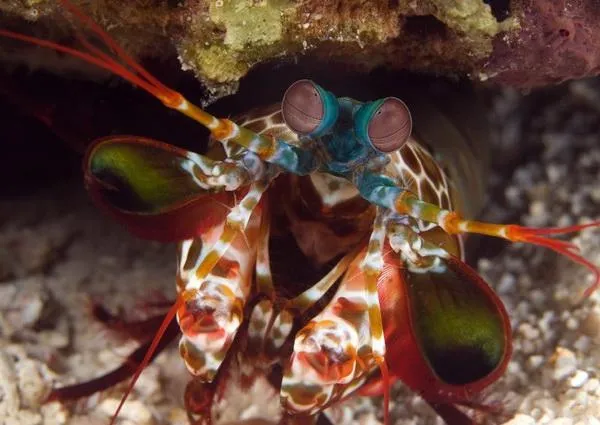
The peacock mantis shrimp is a highly specialized reef predator whose powerful strike reflects remarkable adaptations in anatomy and materials.
Frequently Asked Questions
Why do mantis shrimp punch so hard?
They store energy in elastic exoskeletal structures and release it rapidly through a specialized latch and linkage system.
How fast is a mantis shrimp punch?
A 2004 study measured peak speeds of about 14–23 meters per second in the peacock mantis shrimp.
How much force can a mantis shrimp punch produce?
A 2005 study recorded direct impact force peaks of approximately 400–1,501 newtons under experimental conditions.
What is mantis shrimp cavitation?
It is the formation and collapse of vapor bubbles caused by extremely rapid appendage movement through water.
Do mantis shrimp produce two impacts?
Experiments have identified a first force peak from direct contact and a second associated with cavitation bubble collapse.
What is the mantis shrimp spring mechanism?
It is a system of elastic structures, latches, and linkages that stores mechanical energy before releasing it rapidly.
Can mantis shrimp break shells?
Yes. Smashing species use their powerful clubs to fracture the shells of prey such as snails and crabs.
Do all mantis shrimp punch?
No. Some species are smashers, while others possess spearing appendages used to capture prey.
Can a mantis shrimp break aquarium glass?
Powerful smashing species can damage some aquarium materials, but the risk depends on species, size, and tank construction.
Can a mantis shrimp hurt humans?
Yes. Direct strikes or sharp appendages can cause injuries, so the animals should not be handled or provoked.
Why doesn't a mantis shrimp break its own club?
Its club has a layered, impact-resistant structure that helps dissipate energy and limit damage, although it is not indestructible.
Are mantis shrimp actually shrimp?
No. They belong to the crustacean order Stomatopoda rather than the group containing familiar true shrimp.
Do mantis shrimp have powerful eyesight?
They possess complex compound eyes, although their visual abilities differ by species and task.
What do mantis shrimp eat?
Depending on species, they consume snails, crabs, fish, and other marine animals.
Can mantis shrimp inspire new technology?
Yes. Their spring-powered strike and damage-resistant club have inspired research in mechanical systems and engineered composites.
The Bottom Line
Mantis shrimp deliver extremely powerful strikes because their appendages combine muscle loading, elastic energy storage, and rapid mechanical release.
The peacock mantis shrimp can move its hammer-shaped club at extraordinary speeds.
Its strikes generate both direct impacts and cavitation effects in the surrounding water.
Research has also revealed that the club contains a sophisticated layered structure that resists repeated damage.
However, striking speed and force vary among species and experimental conditions.
The mantis shrimp is therefore one of nature's clearest examples of how biomechanics, fluid physics, and biological materials work together to produce an extreme predatory adaptation.
Sources & Further Reading
Patek, Korff and Caldwell (2004) — Deadly Strike Mechanism of a Mantis Shrimp. Nature. Original high-speed measurements and spring-mechanism explanation.
Patek and Caldwell (2005) — Extreme Impact and Cavitation Forces of a Biological Hammer. Journal of Experimental Biology. Direct force measurements and cavitation force analysis.
PubMed — Extreme Impact and Cavitation Forces of a Biological Hammer. Indexed research record.
Weaver et al. (2012) — The Stomatopod Dactyl Club: A Formidable Damage-Tolerant Biological Hammer. Science. Original analysis of the club's impact-resistant composite structure.
Patek, Rosario and Taylor (2013) — Comparative Spring Mechanics in Mantis Shrimp. Journal of Experimental Biology. Comparative research on springs, linkages, and latches.
Impact-Resistant Materials Inspired by the Mantis Shrimp's Dactyl Club (2021). Matter. Review of biomimetic materials based on the impact-resistant club.