Frogs are often imagined as simply green or brown, but some species look as if they have been painted in electric blue, orange, scarlet, yellow and turquoise.
Many of the world's most colorful frogs live in tropical forests, especially in Central America, South America and Madagascar. Some use bright colors to warn predators that their skin is toxic. Others use color for camouflage, recognition or a sudden startle display.
There is no scientific ranking for the single “most colorful frog,” so this guide highlights 12 of the most spectacularly colored frog species and explains what their colors actually do.
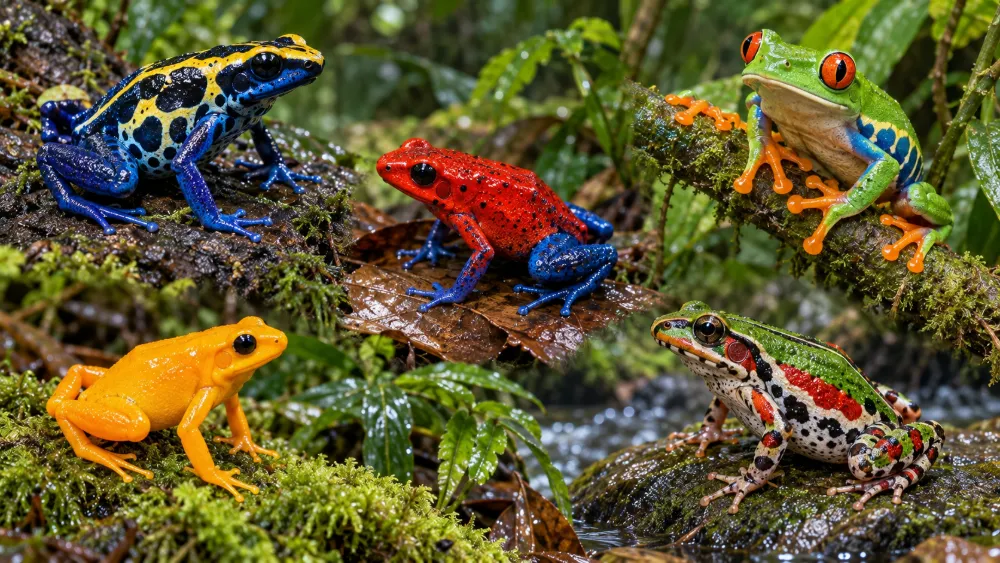
12 Colorful Frogs at a Glance
| Species | Famous Colors | Native Region |
|---|---|---|
| Dyeing poison frog | Blue, yellow, black, white | Northeastern South America |
| Strawberry poison frog | Red, blue, orange, green and many morphs | Central America |
| Golden poison frog | Yellow, gold, orange or mint-green | Colombia |
| Yellow-banded poison frog | Black and bright yellow | Northern South America |
| Green-and-black poison frog | Metallic green and black | Central America |
| Red-eyed tree frog | Green, red, blue, yellow and orange | Central America |
| Golden mantella | Yellow, orange or red-orange | Madagascar |
| Blue-legged mantella | Yellow-green, black and blue | Madagascar |
| Malagasy rainbow frog | Green, orange-red, black and cream | Madagascar |
| Panamanian golden frog | Gold or yellow with black markings | Panama |
| Variable harlequin frog | Green, yellow, orange, pink and black | Costa Rica and Panama |
| Tomato frog | Orange to deep red | Madagascar |
1. Dyeing Poison Frog
Scientific name: Dendrobates tinctorius
The dyeing poison frog may be the ultimate example of a frog that refuses to settle on one color pattern.
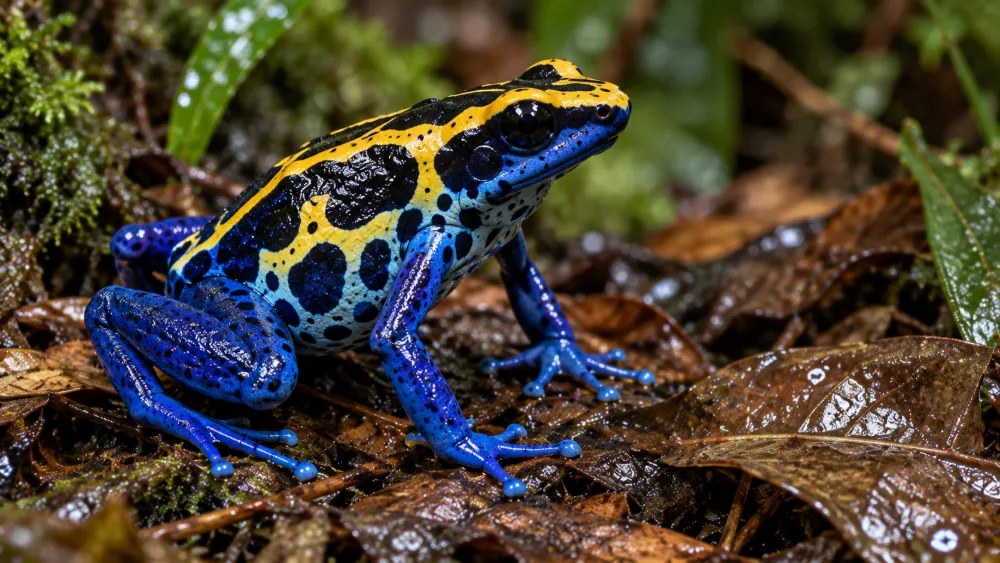
Different populations can combine intense:
cobalt blue;
turquoise;
black;
yellow;
white;
and sometimes orange.
Toronto Zoo describes one common form as bright blue with broad yellow stripes, while other individuals may have mostly yellow backs or dramatically different combinations.
The famous “blue poison frog” or azureus form is now generally treated as a color form of Dendrobates tinctorius, rather than needing to be presented here as a completely separate species.
2. Strawberry Poison Frog
Scientific name: Oophaga pumilio
The name suggests a red frog, and much of the species' range does contain animals with red bodies.
But the strawberry poison frog is much more variable than that.
Populations around Panama's Bocas del Toro archipelago display an extraordinary range of colors, including:
red;
orange;
yellow;
green;
blue;
and combinations of several colors.
Some famous frogs have scarlet upper bodies and dark blue legs, while neighboring island populations can look completely different.
This remarkable variation has made the species an important research subject for scientists studying how animal coloration evolves.
3. Golden Poison Frog
Scientific name: Phyllobates terribilis
The golden poison frog combines visual simplicity with extreme intensity.
Rather than wearing elaborate stripes and spots, many individuals are almost uniformly bright yellow or golden.
Other color forms may appear orange or pale mint-green.
The bright coloration is a warning.
Golden poison frogs are famous for powerful skin alkaloids in the wild and belong to the small group of poison frogs actually documented in connection with poisoned hunting darts.
Their striking appearance is therefore not simply decorative—it is a classic example of aposematic coloration.
4. Yellow-Banded Poison Frog
Scientific name: Dendrobates leucomelas
This species combines a black body with bold yellow bands and spots.
The contrast can make the frog appear almost artificially patterned when seen among dark, wet forest leaves.
The Los Angeles Zoo lists the yellow-banded poison frog among the brightly colored poison frog species native to northern South America.
Like other poison frogs, its visibility is part of the message: a predator does not need to attack the frog repeatedly if it learns to associate the distinctive pattern with an unpleasant experience.
5. Green-and-Black Poison Frog
Scientific name: Dendrobates auratus
The green-and-black poison frog has one of the most recognizable high-contrast patterns in Central American amphibians.
Many animals have metallic or mint-green bands and blotches arranged across a black background.
However, color can vary among populations, and blue-green or other color forms also occur.
The pattern does more than make the frog visually striking. As with many poison frogs, conspicuous coloration helps advertise its chemical defenses.
6. Red-Eyed Tree Frog
Scientific name: Agalychnis callidryas
The red-eyed tree frog proves that a brightly colored frog does not have to be a poison dart frog.
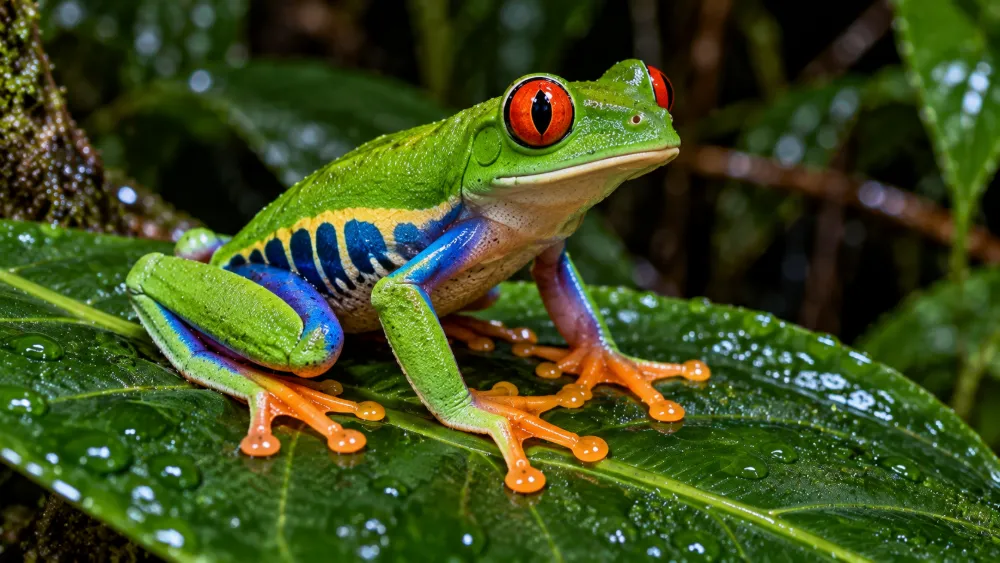
Its color palette can include:
a vivid green back;
large scarlet-red eyes;
blue flanks;
yellow or pale side stripes;
and bright orange toes.
During the day, a resting frog can tuck its legs against its body and close its eyes, hiding many of those brilliant colors while its green back blends into a leaf.
If disturbed, opening its red eyes and exposing its colorful sides and feet produces a sudden visual change that may momentarily confuse a predator and give the frog time to escape.
7. Golden Mantella
Scientific name: Mantella aurantiaca
Madagascar has its own spectacular group of tiny, brightly colored frogs: the mantellas.
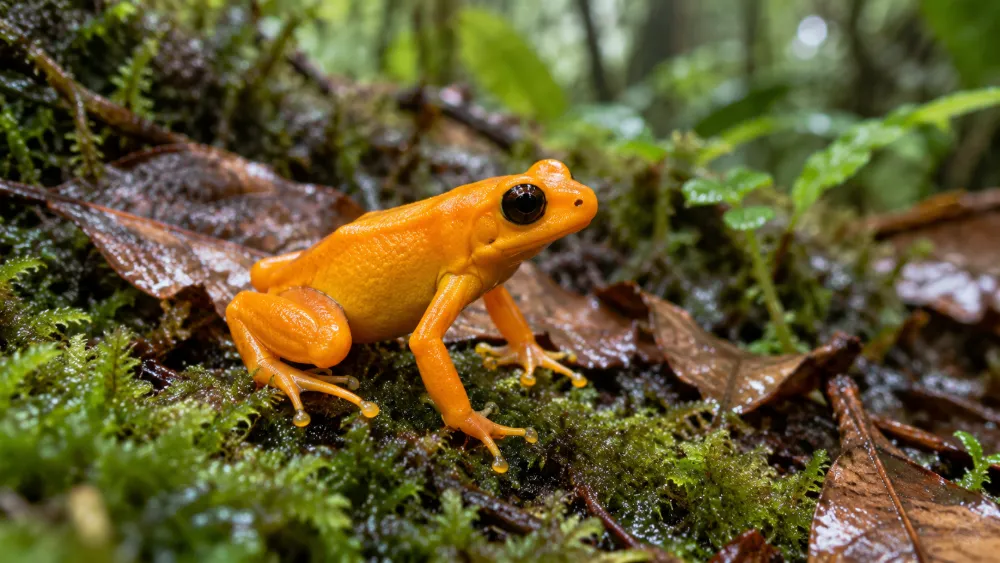
The golden mantella can be:
bright yellow;
golden orange;
or reddish orange.
The color can cover almost the entire visible body, producing an unusually clean, saturated appearance.
Smithsonian describes this tiny Madagascar endemic as critically endangered and restricted to a very small area.
Mantellas are not poison dart frogs—they evolved separately in Madagascar—but their vivid warning coloration creates a striking example of convergent evolution.
8. Blue-Legged Mantella
Scientific name: Mantella expectata
This Madagascar endemic adds another unusual color combination.
Its body can show yellow, yellow-green and dark markings, while the limbs can contain striking blue coloration.
The species occurs in and around the Isalo Massif of southwestern Madagascar.
Its mixture of warm yellow and cool blue helps make it one of the visually distinctive mantellas.
9. Malagasy Rainbow Frog
Scientific name: Scaphiophryne gottlebei
Few frog names are as appropriate as “rainbow frog.”
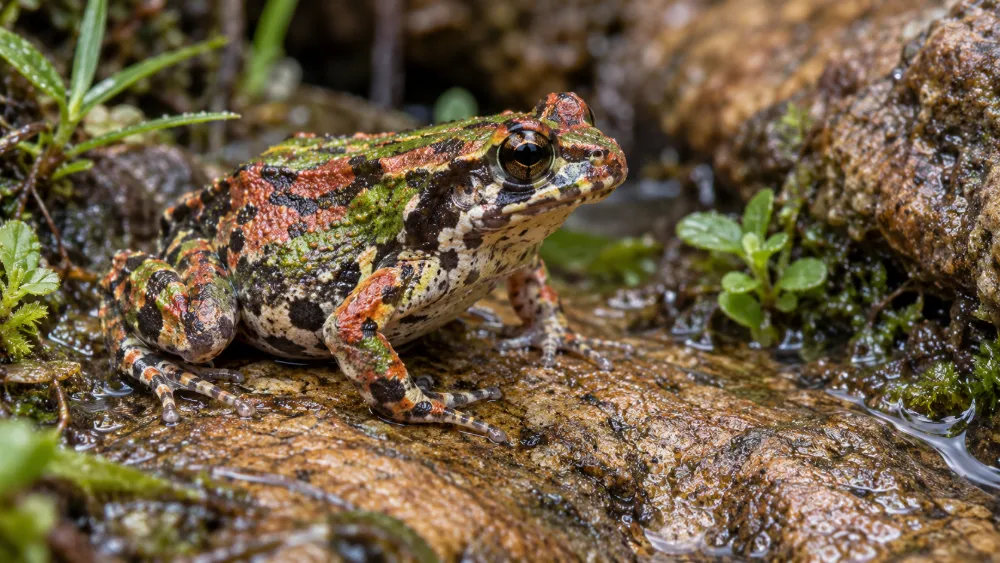
The Malagasy rainbow frog can combine sharply defined areas of:
green;
orange or reddish orange;
black;
cream or white;
and sometimes additional muted shades.
The exact pattern varies among individuals.
This small frog is endemic to the Isalo Massif region of Madagascar, where it occurs in a very restricted geographical area.
Its pattern is not a simple gradient—the colors appear in sharply separated patches that give the animal an almost mosaic-like appearance.
10. Panamanian Golden Frog
Scientific name: Atelopus zeteki
Despite its common name, the Panamanian golden frog is actually a member of the true-toad family Bufonidae.
Adults range from yellow-green to brilliant gold, often with irregular black markings.
The color serves as a warning to predators because the animal has toxic skin secretions.
The species became a conservation symbol after chytrid fungus devastated wild populations.
Its story is an important reminder that some of the world's most visually spectacular amphibians are also among the most threatened.
11. Variable Harlequin Frog
Scientific name: Atelopus varius
The word variable is especially appropriate here.
Smithsonian describes variable harlequin frogs with neon colors that can include:
green;
yellow;
orange;
pink;
and black.
Individual patterns differ dramatically, often combining a very bright background color with irregular black blotches.
The species historically occurred along streams in Costa Rica and Panama but suffered severe declines associated with amphibian chytrid disease.
12. Tomato Frog
Scientific group: Dyscophus
Tomato frogs demonstrate that a frog does not need multiple contrasting colors to look spectacular.
Females of the brightly colored tomato-frog forms can be a deep red-orange, while males tend to be more yellow-orange.
The rounded body and intense warm coloration make a large female look remarkably like a ripe tomato.
Smithsonian notes that these Madagascar frogs can also release a defensive skin secretion and inflate their bodies when threatened.
The common name “tomato frog” is used around several closely related Dyscophus frogs, so scientific names are useful when identifying a particular animal.
Why Are Some Frogs So Colorful?
Bright frog colors have more than one function.
1. Warning predators
For many poison frogs and mantellas, conspicuous coloration functions as aposematism—a visible warning associated with chemical defense.
Red, orange and yellow are especially common warning colors.
2. Startling predators
A red-eyed tree frog can conceal many of its brightest colors while resting.
When threatened, suddenly revealing red eyes, blue sides and orange feet may create enough visual surprise to help the frog escape.
3. Camouflage
Being colorful does not always mean being obvious.
Green can disappear against tropical foliage, while complex patterns can break up the outline of an animal against moss, leaves or rock.
4. Differences between populations
Some species show dramatic geographical variation.
Strawberry poison frogs around Bocas del Toro are a famous example, with neighboring populations evolving strikingly different color combinations.
Are All Colorful Frogs Poisonous?
No.
This is one of the most important misconceptions about brightly colored amphibians.
Many poison frogs, mantellas and harlequin frogs use bright coloration in connection with chemical defenses.
But other colorful species are not dangerous in the same way.
The red-eyed tree frog is the clearest example in this list. Its remarkable red, blue, orange and green color scheme does not make it a poison dart frog.
Never use color alone to decide whether an unfamiliar wild amphibian is safe to touch.
Why Do Poison Frogs Lose Their Toxicity in Captivity?
For many poison frogs, the chemicals in their skin are strongly linked to what they eat in the wild.
Smithsonian explains that poison frogs consume small arthropods such as ants, mites and termites containing alkaloids.
The frogs can store those compounds in glands in their skin.
In human care, they are typically fed foods such as fruit flies and crickets that lack the same alkaloids, and captive frogs therefore lose much or all of that wild chemical defense.
This is another reason the phrase “bright frog = automatically deadly” is too simplistic.
What Is the Most Colorful Frog?
There is no objective scientific answer.
It depends on whether “colorful” means:
the largest number of colors;
the brightest single color;
the greatest variation between populations;
or the strongest visual contrast.
The dyeing poison frog is an excellent candidate for variation within one species.
The strawberry poison frog is remarkable for population-to-population color diversity.
The Malagasy rainbow frog combines several sharply contrasting colors on one individual.
And the red-eyed tree frog uses one of the widest recognizable palettes: green, red, blue, yellow and orange.
Why Are So Many Colorful Frogs Tropical?
Tropical regions support extraordinary amphibian diversity.
Warm temperatures, high humidity, abundant insects and complex forest habitats allow many frog lineages to specialize in different ecological niches.
That diversity has produced an equally impressive range of colors, patterns and defensive strategies.
Central and South America contain the poison frogs, while Madagascar independently evolved vividly colored mantellas and several other spectacular amphibians.
FAQ
What are the most colorful frogs?
Some especially colorful species include dyeing poison frogs, strawberry poison frogs, golden poison frogs, red-eyed tree frogs, golden mantellas, Malagasy rainbow frogs and variable harlequin frogs.
What frog is blue and yellow?
The dyeing poison frog (Dendrobates tinctorius) commonly occurs in dramatic combinations of blue, yellow and black.
What frog has red eyes and orange feet?
The red-eyed tree frog (Agalychnis callidryas) has bright red eyes, a green body, blue sides and orange toes.
Are colorful frogs poisonous?
Some are, but not all. Bright colors often serve as warning coloration in poison frogs and mantellas, while species such as the red-eyed tree frog use color for camouflage and startle displays without being poison dart frogs.
What is the colorful blue poison dart frog called?
The famous blue poison frog is generally treated as a blue color form of the dyeing poison frog, Dendrobates tinctorius.
What is the rainbow-colored frog from Madagascar?
The Malagasy rainbow frog (Scaphiophryne gottlebei) has a distinctive mixture of green, orange-red, black and pale markings.
Why are poison dart frogs brightly colored?
Their conspicuous coloration can warn predators that the frogs are distasteful or toxic, a defensive strategy known as aposematism.
Are captive poison dart frogs poisonous?
Many poison frogs in human care lose their wild toxicity because their captive diet does not provide the alkaloids they obtain from specific arthropods in nature.
Final Thoughts
The world's colorful frogs demonstrate that bright skin can have very different biological meanings.
For a golden poison frog or golden mantella, conspicuous color is closely connected to chemical defense. A red-eyed tree frog can instead conceal its brightest colors and expose them suddenly when disturbed. Other species use patterns that combine warning, camouflage and recognition.
And color does not require a large animal. Some of the most spectacular vertebrates on Earth are frogs only a few centimeters long.
From the blue-and-yellow dyeing poison frog to Madagascar's orange mantellas and mosaic-patterned rainbow frog, amphibians contain far more color diversity than the familiar image of a plain green frog suggests.
Sources Used for Fact Checking
Smithsonian's National Zoo — Poison Frogs
Smithsonian's National Zoo — Red-Eyed Tree Frogs
Smithsonian's National Zoo — Golden Mantella Frog
Smithsonian / Panama Amphibian Rescue and Conservation Project — Variable Harlequin Frog
Los Angeles Zoo — Poison Frogs
Toronto Zoo — Dyeing Poison Dart Frog
American Museum of Natural History — Amphibian Species of the World