Pink snakes are real—but the phrase “pink snake” can describe several very different things.
Some wild species naturally have pink, rose or mauve coloration. Others are mostly brown but have a striking pink belly. Still others become pale pink only as juveniles or have been selectively bred in captivity to produce pink-and-white color morphs.
That means color alone is not enough to identify a snake.
If you see a pink snake, look at its body shape, pattern, head, eyes, size and geographic location before trying to determine the species.
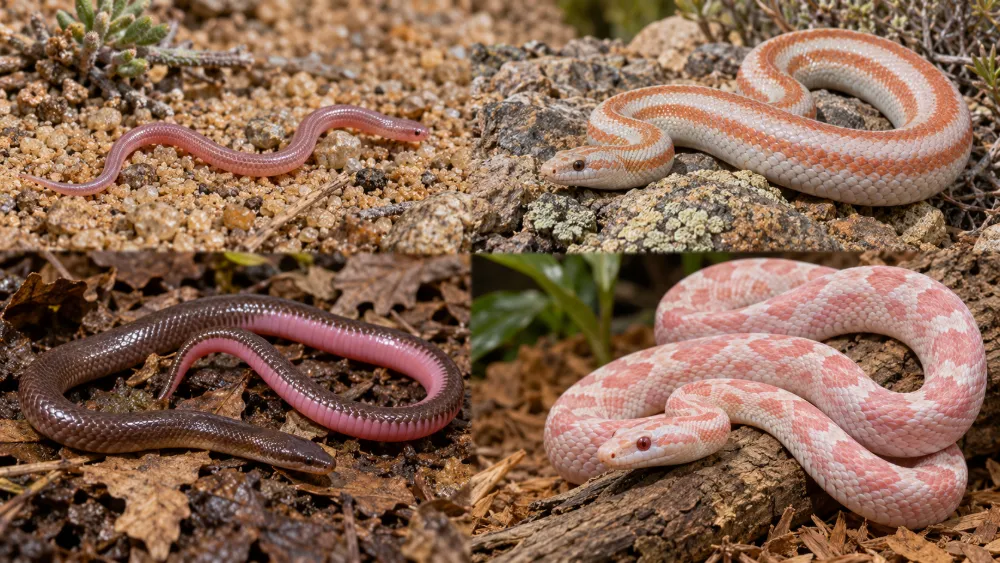
Are There Really Pink Snakes?
Yes.
However, a completely bubblegum-pink wild adult snake is much less common than internet photographs may suggest.
Natural pink coloration usually appears in one of several forms:
a pale pink or mauve entire body;
rose-colored stripes;
a pink belly;
pink coloration in juveniles;
or pale skin created by unusual genetic coloration.
Captive snake breeders have also developed color morphs that can appear far pinker than typical wild snakes.
Pink Snake Identification at a Glance
| Snake | Pink Feature | Where Found |
|---|---|---|
| Western Threadsnake | Whole body may be pink or mauve | Southwestern United States and Mexico |
| Rosy Boa | Rose, orange or reddish longitudinal stripes; some pinkish undersides | Southwestern United States and northwestern Mexico |
| Eastern Worm Snake | Strong pink underside | Eastern United States |
| Juvenile Eastern Hognose | Young snakes can have a pinkish background | Eastern North America |
| Snow Corn Snake | Pale white and pink captive coloration | Captive morph |
| Coral or Salmon Snow Corn Snake | Selective breeding intensifies pink or coral tones | Captive morph |
1. Western Threadsnake
Scientific name: Rena humilis / historically Leptotyphlops humilis
The Western Threadsnake is probably one of the best answers if someone asks whether a naturally pink wild snake exists.
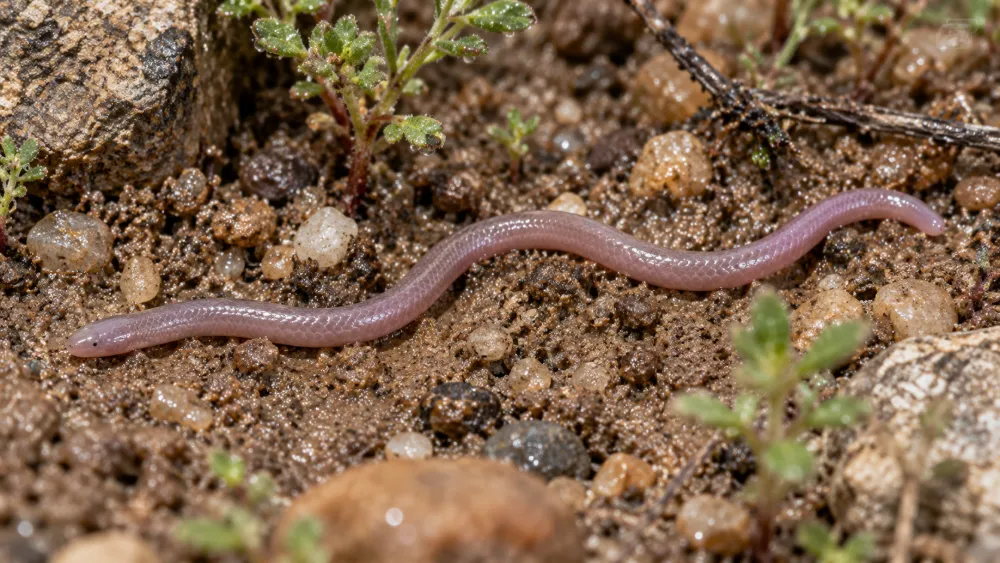
Field guides describe the species as ranging from pink to gray or mauve.
It is extremely slender and can easily be mistaken for a large earthworm.
Typical identification features include:
a very thin cylindrical body;
smooth shiny scales;
tiny dark eyes visible beneath scales;
a head barely distinguishable from the neck;
and a short spine at the end of the tail.
Western Threadsnakes spend much of their lives underground and commonly emerge after warm rains.
They feed largely on ants, termites and their larvae and pupae.
2. Rosy Boa
Genus: Lichanura
The Rosy Boa has the most obvious “pink” name on this list, but there is an important catch:
many Rosy Boas are not actually pink.
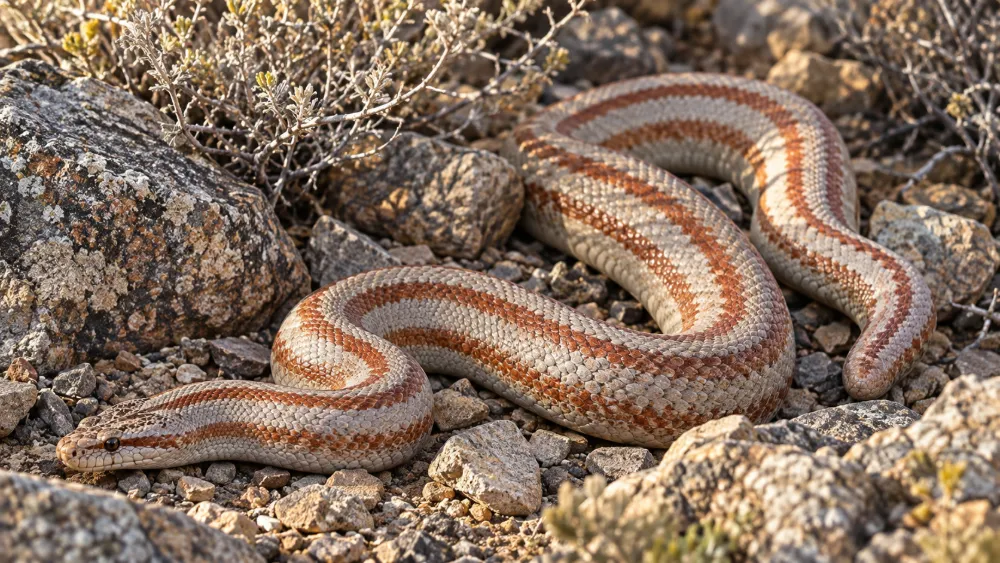
Wild Rosy Boas usually have three longitudinal stripes running down the body.
Those stripes may be:
brown;
dark brown;
orange;
reddish-brown;
or rose-colored.
The background can range from gray and tan to cream or nearly white.
Some populations therefore have a distinctly rosy appearance, while others look brown, orange or gray.
Interestingly, the common name may have originated from the pinkish underside found in some Baja California specimens rather than from an entirely pink body.
How Big Is a Rosy Boa?
Rosy Boas are much larger and heavier than threadsnakes.
Published measurements place adults roughly between 43 and 112 centimeters in length, with many animals around 75 centimeters.
The body is thick, the scales are smooth and the tail is short and blunt.
This makes a Rosy Boa relatively easy to separate from a thin worm-like threadsnake.
3. Eastern Worm Snake
Scientific name: Carphophis amoenus
The Eastern Worm Snake is often included in photographs of “pink snakes,” but most of the animal is actually brown.
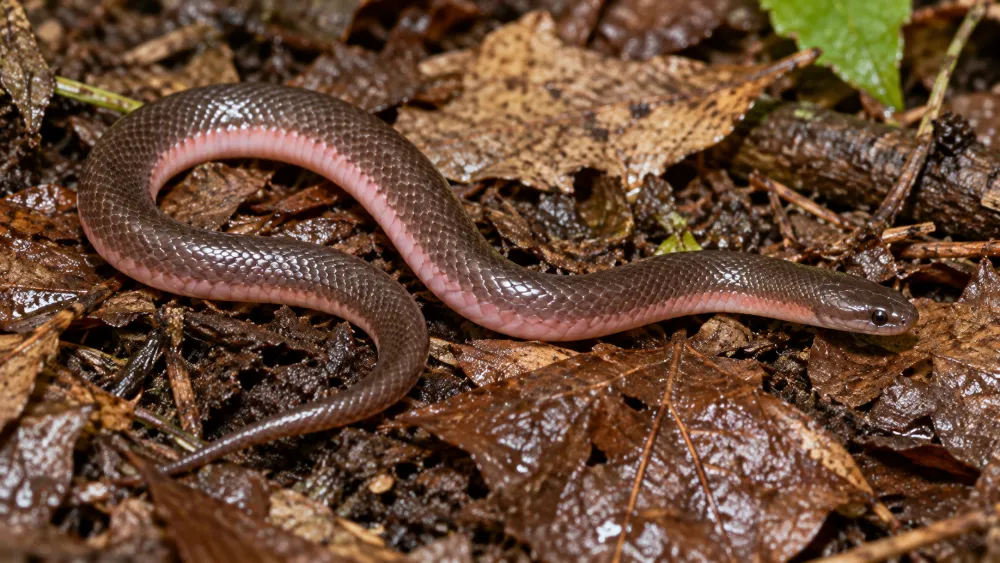
The back is generally plain tan to dark brown with smooth, glossy scales.
The underside is the interesting part.
It is normally a distinctive pinkish color that extends upward onto the lowest one or two rows of scales along each side.
When the snake twists or curls, that pink underside can become surprisingly prominent.
Most Eastern Worm Snakes are less than about 10 inches long, although individuals may reach roughly 13 inches.
They spend most of their lives beneath:
soil;
leaf litter;
logs;
rocks;
and other forest-floor cover.
Can an Eastern Worm Snake Be Completely Pink?
Almost all have a brown upper surface and pink lower surface.
However, unusually colored individuals have been documented.
The Virginia Herpetological Society records an historical all-pink female from Arlington, Virginia.
That is an abnormal individual rather than the standard appearance of the species.
This distinction matters because exceptional photographs should not be used to describe the normal color of an entire species.
4. Juvenile Eastern Hognose Snake
Scientific name: Heterodon platirhinos
An Eastern Hognose can occasionally create another type of “pink snake” sighting.
Young Eastern Hognose Snakes may have a pinkish background color covered by dark brown or black blotches.
As the snakes mature, their coloration becomes extraordinarily variable.
Adults may be:
tan;
brown;
gray;
reddish;
yellowish;
greenish-gray;
or almost completely black.
The easiest structural clue is the strongly upturned snout used for digging.
So a pinkish juvenile hognose should not be confused with a uniformly pink threadsnake.
5. Snow Corn Snake
Species: Pantherophis guttatus
Many of the most striking pink snakes shown online are not separate wild species at all.
They are captive-bred color morphs.
The Snow Corn Snake is one of the best-known examples.
Instead of the normal wild corn snake's orange, red, black and brown coloration, snow morphs are extremely pale.
Young animals commonly show combinations of:
white;
cream;
pale peach;
and pink.
The eyes are usually pink or reddish.
As these snakes age, some become whiter while others develop yellow, peach or pink tones.
Is a Snow Corn Snake a Separate Species?
No.
A normal corn snake and a Snow Corn Snake belong to the same species.
“Snow” refers to inherited coloration maintained through captive breeding.
This is an important distinction whenever searching for “pink snake species.”
A color morph is not the same thing as a species.
6. Coral and Salmon Snow Corn Snakes
Selective breeding has produced Snow Corn Snake lines with even stronger pink coloration.
Names used in the reptile hobby include:
Coral Snow;
Salmon Snow;
Bubblegum Snow;
and other line-bred variations.
Some of these animals can appear dramatically pink or coral, especially when young.
However, breeder terminology is not always standardized, and the exact appearance can change with age and genetic background.
That is why an intensely pink pet snake should not automatically be treated as a naturally pink wild species.
Why Are Some Snakes Pink?
Pink coloration can arise for several different reasons.
1. Normal Species Coloration
Western Threadsnakes can naturally occur in shades described as pink or mauve.
2. Pink Undersides
Eastern Worm Snakes usually have pink bellies even though their backs are brown.
3. Age
Some snakes look pinker as juveniles than they do as adults.
Eastern Hognose Snakes provide one example.
4. Genetic Color Morphs
Captive breeding can reduce dark pigments and reveal pale pink, cream or white coloration.
Snow Corn Snakes are a familiar example.
5. Individual Variation
Even within the same wild species, individuals and regional populations may differ dramatically in color.
Are Pink Snakes Venomous?
Color cannot tell you whether a snake is venomous.
The snakes in this guide include several species that pose little danger to humans, but “pink snake” is only a visual description—not a biological safety category.
Lighting, unusual coloration, juvenile patterns and genetic abnormalities can make an unfamiliar snake look very different from a field-guide photograph.
Never pick up an unidentified wild snake simply because it is pink, small or attractive.
Pink Snake or Worm?
Western Threadsnakes and Eastern Worm Snakes are frequently mistaken for earthworms.
Look closely and a snake has:
clearly arranged overlapping scales;
a recognizable head;
eyes, even if extremely small;
and reptilian movement rather than the segmented body of an earthworm.
Threadsnakes are particularly convincing mimics because the head and tail are blunt and the eyes are extremely reduced.
Pink Snake Identification by Location
| If You Are In... | A Possible Pink-Looking Snake |
|---|---|
| Arizona or the desert Southwest | Western Threadsnake or Rosy Boa |
| Southern California | Rosy Boa |
| Eastern United States woodland | Eastern Worm Snake |
| Eastern North America with upturned snout | Juvenile Eastern Hognose |
| Pet collection or reptile expo | Snow or other captive-bred color morph |
FAQ
What snake is completely pink?
The Western Threadsnake can naturally appear pink or mauve over much of its body. Captive-bred snake morphs can be even more intensely pink.
Are Rosy Boas actually pink?
Some have rose, reddish or orange coloration, but many Rosy Boas are mostly gray, cream, tan or brown. The species name should not be interpreted as meaning every individual is pink.
What is the tiny pink snake that looks like a worm?
In the southwestern United States, it may be a Western Threadsnake. These tiny fossorial snakes can be pink, gray or mauve and strongly resemble earthworms.
What snake has a pink belly?
The Eastern Worm Snake has a characteristic pinkish belly that extends slightly upward along the sides of its otherwise brown body.
Are there pink snakes in Arizona?
Yes. Western Threadsnakes can be naturally pink or mauve, and Rosy Boas also occur in parts of Arizona with reddish, orange or rose-colored markings.
Are there pink snakes in California?
Rosy Boas occur in southern California and may show reddish or rose-colored longitudinal markings. Color varies significantly between individuals and populations.
What is a pink and white pet snake?
One common possibility is a Snow Corn Snake or a related selectively bred corn snake morph.
Is a Snow Corn Snake naturally found in the wild?
The corn snake is a wild species, but the Snow Corn Snake appearance is a captive-bred color morph rather than a separate naturally pink species.
Are pink snakes dangerous?
Pink coloration does not indicate whether a snake is dangerous. Never use color alone to decide whether an unidentified wild snake is safe to handle.
Final Answer
There is no single species called a “pink snake.”
If you see a very small, uniformly pink or mauve, worm-like snake in the American Southwest, a Western Threadsnake is one of the strongest possibilities.
A heavier snake with three rose, orange or brown longitudinal stripes may be a Rosy Boa. In eastern North America, a small brown snake with a clearly pink underside may be an Eastern Worm Snake.
Extremely pale bubblegum-pink snakes seen in pet collections are often captive-bred color morphs such as Snow Corn Snakes rather than naturally pink wild species.
The best identification therefore combines color, pattern, body shape, size and geographic location—never color alone.
Related Reading
Sources Used for Fact Checking
Reptiles and Amphibians of Arizona — Western Threadsnake
Reptiles and Amphibians of Arizona — Rosy Boa
Animal Diversity Web — Rosy Boa
South Carolina Partners in Amphibian and Reptile Conservation — Eastern Worm Snake
Virginia Herpetological Society — Eastern Wormsnake
Animal Diversity Web — Eastern Hognose Snake
Reptiles Magazine — Corn Snake Color Morphs