Whale sharks work as giant filter-feeding fish built for slow, efficient life in warm oceans. They swim with broad mouths open to take in water, trap tiny prey such as plankton and fish eggs, and push the filtered water back out through the gills. Their huge size, spotted skin, powerful tail, broad head, and specialized feeding structures all help them survive in open marine environments. In simple terms, a whale shark works by moving steadily, filtering food, conserving energy, and traveling widely to find rich feeding areas.
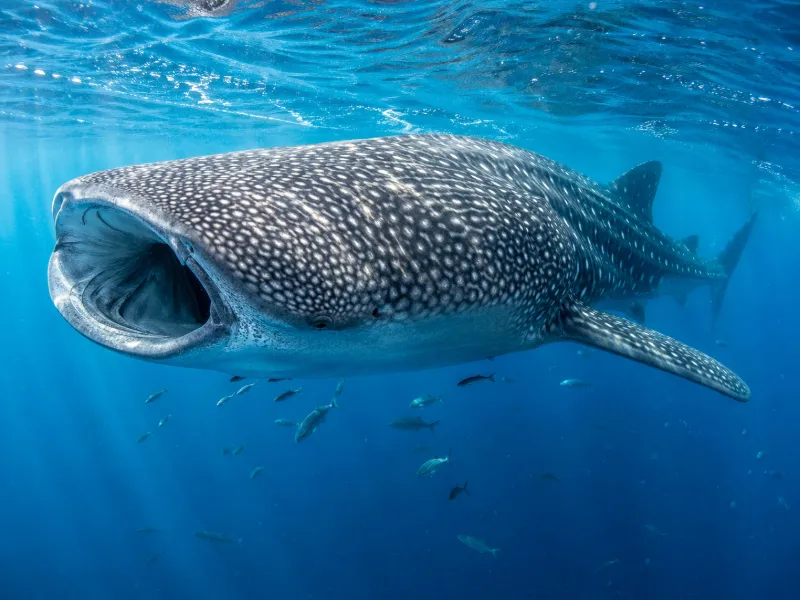
Although whale sharks are the largest fish on Earth, they are not fearsome hunters of large prey. They are gentle filter feeders whose body design is very different from that of fast predatory sharks. Their enormous mouths, broad flat heads, and slow cruising style make sense once you understand how they feed and move through the ocean.
In this guide, you will learn how whale sharks work, from feeding and breathing to swimming, growth, migration, and survival in the open sea.
Quick answer
| Feature | How it works in a whale shark |
|---|---|
| Main feeding style | Filter feeding on plankton, fish eggs, and other very small prey |
| Mouth function | Takes in large volumes of water and food particles |
| Gills | Help with breathing and allow filtered water to exit the body |
| Body shape | Large, streamlined body built for steady cruising |
| Tail | Provides propulsion for long-distance swimming |
| Skin pattern | Unique spot pattern that may help with camouflage and identification |
| Main habitat | Warm tropical and subtropical oceans |
| Why it is successful | It combines huge size, efficient filter feeding, and wide movement across productive waters |
What is a whale shark?
A whale shark is the largest living fish in the world. Despite its size, it is not a whale and not a mammal. It is a shark, which means it belongs to the cartilaginous fishes, a group that includes other sharks, rays, and skates.
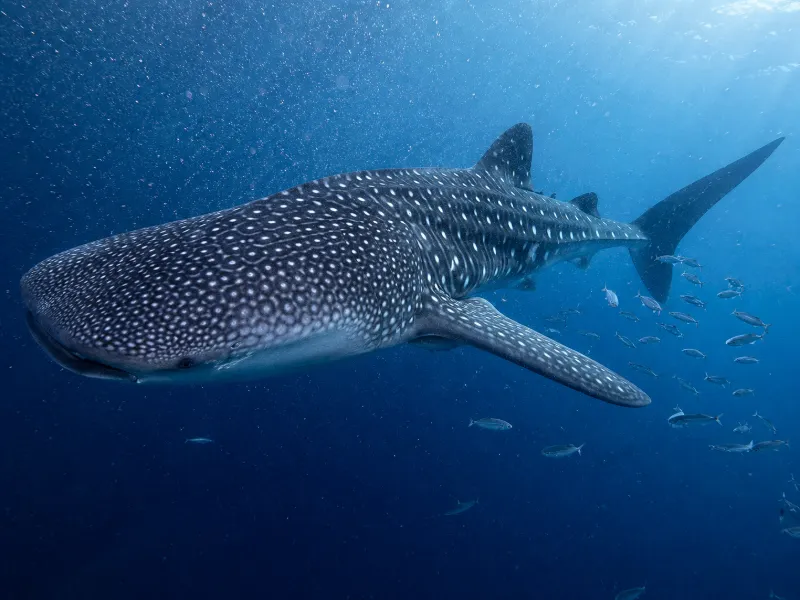
The whale shark is easy to recognize because of its massive size, wide flat head, broad front-facing mouth, and pale spots and stripes on dark skin. It is often seen near the surface in warm seas, especially where food is concentrated.
What makes the whale shark especially fascinating is that it combines enormous body size with a feeding system based on tiny prey rather than large animals.
Why whale sharks are so big
Whale sharks are able to reach great size partly because their feeding method lets them exploit abundant small food sources spread through large areas of ocean. Instead of depending on large prey animals one at a time, they feed on dense concentrations of tiny organisms whenever conditions are favorable.
Large size may also help with long-distance travel, heat balance, and protection from many predators. A very large body can store energy, support powerful swimming muscles, and reduce vulnerability once the shark is mature.
In other words, the whale shark’s huge size is not random. It fits a life built around ocean travel and large-scale feeding on small prey.
How whale sharks feed
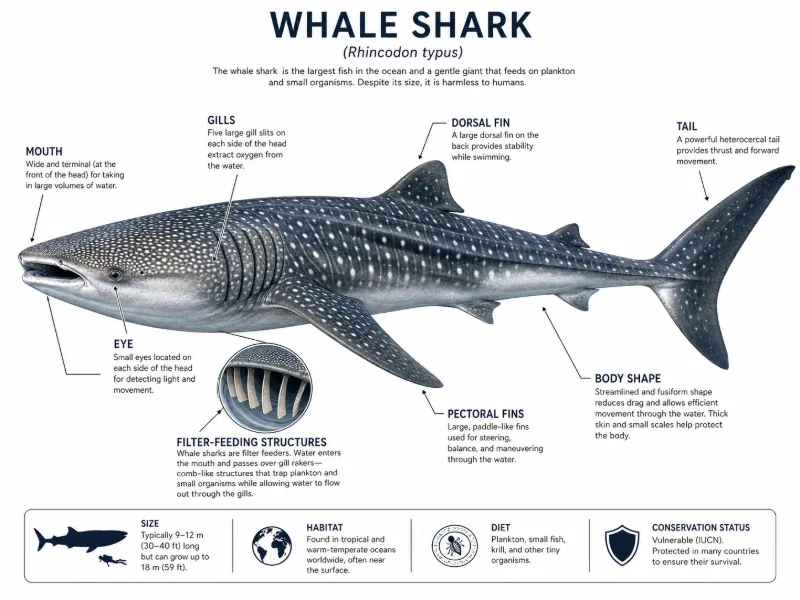
Whale sharks are filter feeders. They take in water through the mouth and separate edible material from the water before pushing the water back out through the gill openings.
The food they collect may include plankton, tiny crustaceans, fish eggs, small schooling animals, and other suspended organic particles. In rich feeding areas, a whale shark can process very large volumes of water.
This feeding style is very different from the dramatic hunting behavior people often imagine when they think of sharks. A whale shark works more like a giant moving filtration system than an active predator of large fish or marine mammals.
How the mouth works
The whale shark’s mouth is extremely large and sits at the front of the head, which helps it take in water efficiently while swimming forward. This front-facing design is especially useful for a fish that feeds by moving through clouds of tiny prey near the surface or in the water column.
When feeding, the mouth opens wide and allows water, suspended prey, and fine organic material to enter. The shark does not need to bite large prey apart in the way many other sharks do. Instead, the mouth functions mainly as an intake system.
Its jaws also contain many tiny teeth, but these do not play the same main role they do in predatory sharks. The whale shark’s success depends far more on filtration than on biting power.
How the filtering system works
Inside the mouth and throat region, whale sharks have specialized filtering structures that help trap food while letting water pass through. These structures prevent tiny prey from simply washing back out.
As the water moves through the feeding system, edible particles are concentrated and swallowed, while the filtered water exits through the gill area. This lets the shark keep feeding almost continuously when conditions are right.
This is one of the most important parts of how whale sharks work. Without efficient filtration, a giant shark could not survive on tiny drifting prey.
What whale sharks eat
Whale sharks eat some of the smallest prey available in marine ecosystems. Their diet often includes plankton, krill-like animals, fish eggs, larval organisms, and other small drifting or weak-swimming prey.
They may also feed where baitfish or spawning events create dense food patches. In these situations, the water can be especially rich in tiny edible particles, making filter feeding highly efficient.
The exact diet varies with place and season, but the overall pattern stays the same: whale sharks succeed by feeding on many small prey items rather than a few large ones.
How whale sharks breathe
Like other sharks, whale sharks breathe using gills. Oxygen is taken from water as it passes over the gill surfaces. Breathing and feeding are closely linked because both involve moving water through the mouth and across the gill region.
When not feeding actively with an open mouth, a whale shark still needs water flow across the gills to extract oxygen. Slow steady swimming helps maintain that flow, and some water movement can also be assisted by pumping actions in the mouth and pharynx.
This means the whale shark’s large body is constantly supported by a highly effective water-processing system for both respiration and feeding.
How whale sharks swim
Whale sharks are strong but usually unhurried swimmers. Their bodies are long and streamlined, with a powerful tail that provides forward thrust. Rather than making tight, fast bursts like some predatory sharks, they often cruise steadily over long distances.
This style suits an animal that needs to cover large ocean areas in search of productive feeding zones. It also helps conserve energy. A giant animal benefits from steady efficient motion more than from constant rapid acceleration.
The large pectoral fins help with balance and steering, while the tail provides most of the propulsion.
How whale sharks find food
Whale sharks likely use a combination of sensory cues to locate good feeding areas. These may include chemical cues, changes in water conditions, visual information, and memory of productive seasonal sites.
They are often associated with places where plankton blooms, fish spawning, or concentrated surface productivity create feeding opportunities. In some regions, whale sharks return seasonally to the same general areas when conditions are right.
This suggests that the whale shark’s success is not just about body size. It is also about finding the right places at the right times.
How their skin pattern works
Whale sharks are covered in pale spots and stripes against a darker background. This pattern may help break up the outline of the body in sunlight-filtered water, especially from above or at a distance. In the ocean, spotted and mottled patterns can reduce visibility by blending with shifting light and shadow.
The pattern is also important because each whale shark appears to have its own unique spot arrangement. Researchers can use photographs of the skin pattern, especially near the head and gill area, to identify individuals over time.
So the skin pattern may help both the shark in nature and scientists who study it.
How whale sharks grow and reproduce
Whale sharks appear to grow slowly and may take a long time to mature. This matters because animals that mature slowly are often more vulnerable to population decline when they face fishing pressure or accidental capture.
Their reproduction is still not fully understood in every detail, but whale sharks are known to produce live young rather than laying eggs externally. The young begin life as small versions of the adult body plan, though of course far smaller and more vulnerable.
Because so much of their life happens in the open ocean, some parts of their early development and breeding biology remain difficult for researchers to observe directly.
Why whale sharks migrate
Whale sharks move widely because food in the ocean is patchy and seasonal. Productive feeding opportunities appear in one region and then fade, so a large filter feeder benefits from mobility.
Migration or long-distance travel may also be linked to breeding, temperature, or broader ocean circulation patterns. In many places, whale sharks appear only at certain times of year, which suggests that they track changing conditions across huge marine spaces.
This wide-ranging movement is one reason they are so difficult to study and protect fully.
How whale sharks survive despite slow feeding
At first glance, it may seem surprising that such a huge fish can survive on tiny prey. The answer lies in efficiency. Whale sharks do not need to chase fast animals constantly. Instead, they exploit rich food patches and process large volumes of water when prey is abundant.
Their large body also supports long-distance travel between feeding opportunities. A whale shark does not need a dramatic kill every day. It needs access to enough productivity over time to support its body.
This is similar in principle to other giant filter-feeding animals. The strategy works not because each prey item is large, but because the total volume of prey can be enormous.
Are whale sharks dangerous?
Whale sharks are not considered dangerous hunters of humans. They are gentle giants whose feeding style is based on tiny prey, not large animals. They do not have the body design or behavior of an active hunter of people.
That said, they are still enormous wild animals. Any very large animal can accidentally injure a person through collision, tail movement, or careless close contact. Respectful distance is always important in the wild.
The main danger around whale sharks is usually human behavior toward them, not the other way around.
Why whale sharks matter in the ocean
Whale sharks are important because they are part of the structure of warm ocean ecosystems. As giant filter feeders, they connect plankton-rich productivity with the lives of larger marine animals and coastal food webs.
They also serve as flagship animals for marine conservation. Because they are large, recognizable, and widely loved, they help draw attention to ocean health, sustainable tourism, and the need to protect migratory marine species.
Even a single whale shark can carry ecological, scientific, and cultural value far beyond its own body.
Why whale sharks are vulnerable
Whale sharks face threats because they are large, slow-growing, and dependent on large-scale ocean habitats. Threats can include vessel strikes, accidental capture in fishing gear, targeted hunting in some regions, and disturbance from unmanaged tourism.
Their slow life history makes recovery harder if populations decline. An animal that matures slowly and ranges widely across political borders is not easy to protect.
Understanding how whale sharks work biologically also helps explain why they need careful conservation. Their life strategy is effective in nature, but vulnerable to human pressure.
How whale sharks work in one simple idea
If you reduce the entire animal to one core principle, the whale shark works by combining giant size with efficient filtration. It moves through warm oceans, locates food-rich water, takes in huge amounts of water through the mouth, traps tiny prey, breathes through the gills, and uses steady swimming to connect one feeding opportunity to the next.
Everything about the animal supports that system: the huge mouth, the filtering structures, the broad head, the streamlined body, the strong tail, and the ability to travel long distances.
It is a giant built not for dramatic attack, but for patient processing of the ocean itself.
Final takeaway
Whale sharks work as massive, efficient filter-feeding fish adapted for life in warm oceans. They feed by taking in water through their huge mouths, trapping tiny prey, and pushing filtered water across the gills. Their large size, steady swimming, wide migrations, and specialized feeding structures allow them to survive on dense patches of very small marine organisms. Rather than acting like classic predatory sharks, whale sharks function more like gentle ocean cruisers designed to process food-rich water on a giant scale.
FAQs
How do whale sharks eat if they are sharks?
Whale sharks are sharks, but instead of hunting large prey, they filter tiny prey from the water using specialized feeding structures.
Do whale sharks breathe through their mouths?
They take in water through the mouth, and oxygen is extracted as water passes over the gills.
Why are whale sharks so big if they eat tiny prey?
Their large size works because they can process huge volumes of water and exploit rich feeding areas over large ocean distances.
Are whale sharks dangerous to humans?
They are not considered dangerous hunters of humans, but they should still be treated respectfully as very large wild animals.