No, turtles do not have teeth. All living turtles, including sea turtles, freshwater turtles, snapping turtles, and tortoises, have hard, toothless beaks instead. These beaks have sharp or crushing surfaces that help turtles bite, cut, and process different foods. Some turtles can deliver powerful bites even without teeth. Baby turtles also possess a temporary structure called an egg tooth, which helps them break out of their eggshells. However, this structure is not a true tooth and disappears as the turtle grows.
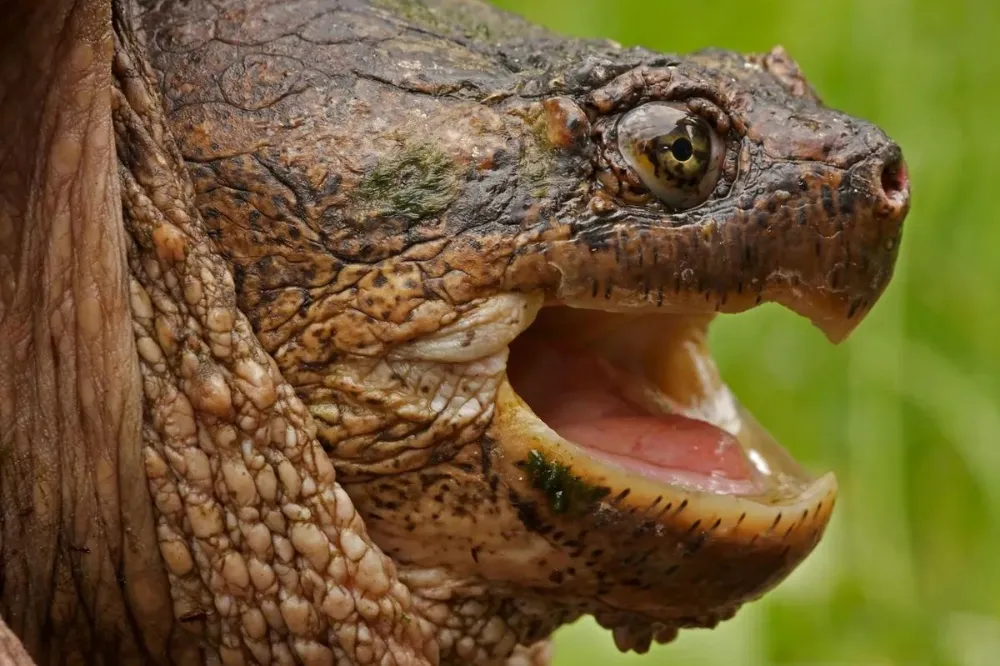
A snapping turtle's sharp, hooked beak allows it to bite and tear food without teeth.
Why Don't Turtles Have Teeth?
Modern turtles evolved specialized beaks that perform many of the feeding functions normally associated with teeth. Their jaws are covered by a tough, keratin-rich structure called the rhamphotheca.
Keratin is a structural protein also found in bird beaks, claws, and human fingernails. In turtles, it forms a durable covering over the upper and lower jaws.
The shape of a turtle's beak depends partly on its diet and feeding habits.
Meat-eating turtles: Often have sharp, hooked beaks for gripping and tearing animal prey.
Plant-eating turtles: May have broad or serrated beak edges for cutting vegetation.
Shellfish-eating turtles: Some possess expanded crushing surfaces that help break hard-shelled prey.
Omnivorous turtles: Have feeding structures suited to consuming both plant and animal material.
Although the beak replaces teeth, the jaw muscles and underlying bones remain important for producing bite force.
What Do Turtle Teeth Look Like?
Because living turtles do not have true teeth, what people sometimes describe as turtle teeth are actually parts of their beaks, jaw ridges, or other specialized mouth structures.
A turtle's beak can have pointed tips, sharp cutting edges, and irregular surfaces that resemble teeth from certain angles.
For example, snapping turtles have prominent hooked upper beaks. Some other turtles have broad jaw surfaces suited to crushing mollusks.
These features can look tooth-like, but they are not individual teeth with the same anatomy as mammalian or crocodilian teeth.
Do Snapping Turtles Have Teeth?
No. Neither common snapping turtles nor alligator snapping turtles have true teeth.
Instead, they possess powerful jaws and sharp, hooked beaks that can cause painful injuries.
The common snapping turtle (Chelydra serpentina) uses its mouth to capture and process a wide range of foods, including fish, aquatic invertebrates, amphibians, and vegetation.
The alligator snapping turtle (Macrochelys temminckii) also has a formidable beak and strong jaws. It is known for using a worm-like appendage inside its mouth to help lure certain fish within striking distance.
A snapping turtle does not need teeth to deliver a dangerous bite. Its jaw strength, sharp beak, and defensive behavior are sufficient reasons to avoid placing fingers near its mouth.
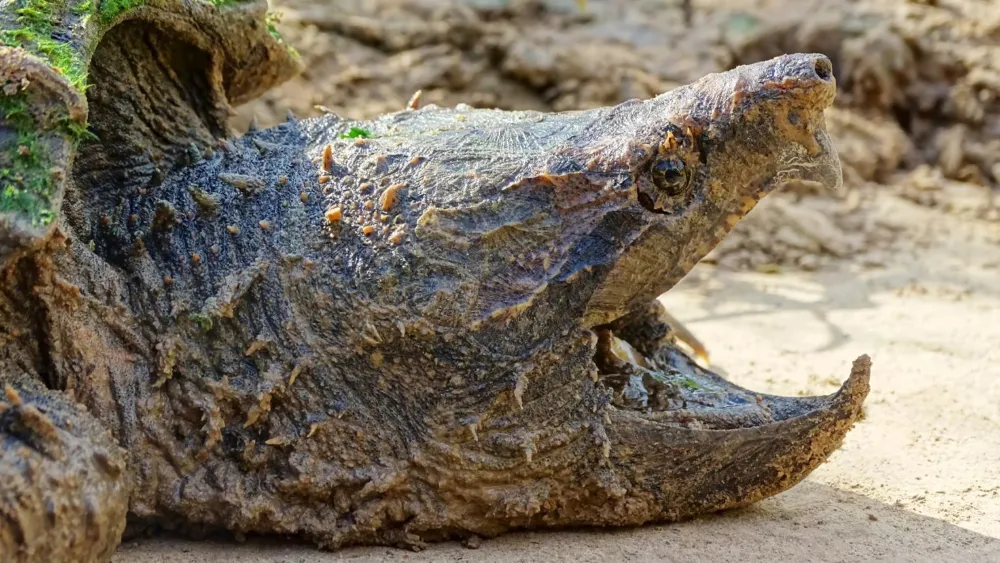
Alligator snapping turtles have strong jaws and sharply hooked beaks rather than true teeth.
Do Sea Turtles Have Teeth?
No. All living sea turtle species are toothless, although their beaks differ considerably in shape.
These differences reflect their feeding specializations.
| Sea Turtle | Beak Adaptation | Typical Foods |
|---|---|---|
| Green sea turtle | Serrated cutting edges | Seagrasses and algae, especially in adults |
| Loggerhead sea turtle | Strong crushing jaws | Crabs, mollusks, and other hard-bodied prey |
| Hawksbill sea turtle | Narrow, pointed beak | Marine sponges and other invertebrates |
| Leatherback sea turtle | Sharp beak edges and specialized throat structures | Jellyfish and other gelatinous animals |
Green sea turtles can use serrated jaw edges to crop aquatic vegetation. Loggerheads have powerful jaws capable of crushing many hard-shelled invertebrates.
Hawksbills use their relatively narrow beaks to reach food in reef crevices.
Leatherback sea turtles have unusual backward-pointing papillae inside their mouths and throats. These structures help retain slippery prey during swallowing. Although they look like spikes or teeth, they are not true teeth.
Explore more species differences in our guide to the seven types of sea turtles.
Do Baby Turtles Have Teeth?
Baby turtles have a temporary structure commonly called an egg tooth, but it is not a true tooth.
The egg tooth, also known as a caruncle, is a small, hardened projection near the front of the upper beak.
When a baby turtle is ready to hatch, it uses this structure to help break through its eggshell.
After hatching, the egg tooth is no longer needed. It gradually disappears as the young turtle develops, although the timing varies among species and individuals.
Unlike a true tooth, the caruncle does not contain the same specialized dental tissues.
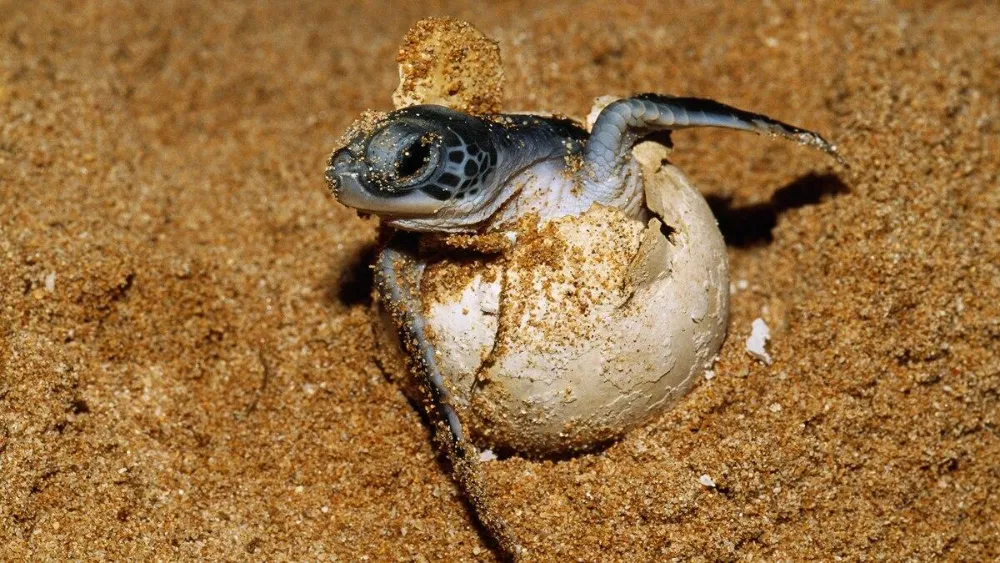
Newly hatched turtles use a temporary egg tooth to help break through their eggshells.
How Do Turtles Eat Without Teeth?
Turtles eat by combining their beaks, powerful jaw muscles, tongues, and other mouth structures.
Depending on the species and food type, a turtle may bite off pieces, tear material apart, crush prey, or swallow smaller items whole.
Herbivorous tortoises often crop plants using their beak edges before swallowing. Some aquatic turtles use strong jaws to break shells or other hard food items.
Turtles do not chew exactly like humans. Most cannot grind food with opposing rows of teeth, so their feeding movements and food processing differ from those of mammals.
The ability to eat without teeth is not unique to turtles. Birds also use toothless beaks, although their feeding anatomy and evolutionary history are different.
For other examples, see animals that do not have teeth.
Can a Turtle Bite Hurt Without Teeth?
Yes. A turtle can deliver a painful bite even though it has no teeth.
Bite strength and injury risk vary greatly with species, body size, and circumstances.
Large snapping turtles are particularly capable of causing serious injuries because of their strong jaws and sharp beaks.
Smaller pet turtles can also bite, especially when frightened, restrained, or confused by a finger near food.
A turtle should never be encouraged to bite a hand for entertainment or testing. Wild turtles should be observed without unnecessary handling.
Did Prehistoric Turtles Have Teeth?
Yes. Some early members of the turtle evolutionary lineage possessed true teeth.
One important fossil is Odontochelys semitestacea, an early turtle relative from the Late Triassic period, approximately 220 million years ago.
Unlike modern turtles, it had teeth in its jaws and a body structure that differed from the fully developed shell of living turtles.
Other early turtle-lineage fossils provide evidence of the gradual evolution of toothless jaws and specialized beaks.
Over evolutionary time, true teeth disappeared from the lineage leading to living turtles, while keratinized beaks became important feeding structures.
That evolutionary change helps explain why no living turtle has ordinary teeth today.
Turtle Beaks vs. Teeth: Key Differences
| Feature | Turtle Beak | True Teeth |
|---|---|---|
| Main material | Keratin-rich outer covering | Mineralized dental tissues |
| Structure | Continuous covering over the jaws | Individual dental units |
| Main function | Cutting, gripping, tearing, or crushing | Biting and processing food |
| Found in living turtles | Yes | No |
| Varies with diet | Yes | Yes, in toothed animals |
Both structures help animals process food, but they differ significantly in their anatomy and development.
Do Tortoises Have Teeth?
No. Tortoises are a land-adapted group of turtles, and like all living turtles, they have toothless beaks.
Many tortoises primarily eat grasses, leaves, flowers, and other plant material. Their beaks help them crop and tear vegetation.
Some tortoises have noticeable ridges along their beak edges, which can resemble small teeth.
These are beak structures rather than true teeth.
Learn more about the differences between turtles and tortoises.
Frequently Asked Questions
How many teeth does a turtle have?
Every living turtle has zero true teeth. Turtles use keratin-covered beaks to bite and process food instead.
Do red-eared slider turtles have teeth?
No. Red-eared sliders have toothless beaks and can use their jaws to bite food or defend themselves.
Can turtles bite off a finger?
Large turtles can inflict serious injuries, but whether a bite causes amputation depends on many factors. Never test a turtle's bite strength or place fingers near the mouth of a large snapping turtle.
Do box turtles have teeth?
No. Box turtles have hard beaks that allow them to eat foods such as insects, worms, fruits, and vegetation.
Are the spikes inside a leatherback turtle's mouth teeth?
No. The backward-pointing structures are called papillae. They help retain slippery prey and guide food toward the digestive tract.
Why do baby turtles have an egg tooth?
The egg tooth helps a hatchling break through its eggshell. It is temporary and is not a true tooth.
The Bottom Line
Turtles do not have teeth, but their specialized beaks make them remarkably effective feeders. Snapping turtles use sharp beaks and powerful jaws, many tortoises use beaks to cut plants, and sea turtles possess mouth structures adapted to different diets.
Even a tiny hatchling begins life with a temporary egg tooth, while some ancient turtle relatives had genuine teeth millions of years ago. Together, these adaptations show how turtles evolved to feed successfully without the dental structures found in many other vertebrates.