What do you call a group of pandas?
The most commonly cited collective noun is an embarrassment of pandas.
It is one of the more unusual animal group names in English, but there is an important catch: giant pandas rarely form permanent social groups in the wild. Adult pandas are generally solitary animals, so an “embarrassment” is much more useful as a fun collective noun than as a description of normal panda social structure.
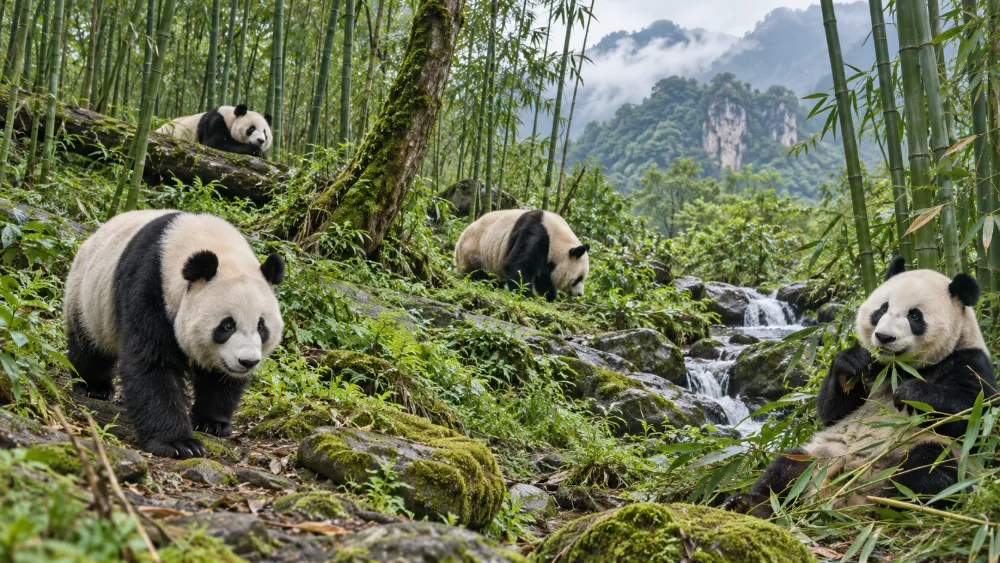
Quick Answer: What Is a Group of Pandas Called?
A group of giant pandas is commonly called an embarrassment of pandas.
You may also encounter playful alternatives such as a cupboard of pandas or a bamboo of pandas, but these terms are much less consistently used.
In scientific or everyday wildlife writing, researchers usually do not need a special collective noun because adult giant pandas normally spend most of their lives alone.
| Term | Meaning | How It Is Used |
|---|---|---|
| Embarrassment | Popular collective noun for pandas | Trivia, vocabulary and animal-group-name lists |
| Group | Several pandas considered together | Ordinary descriptive language |
| Community | Locally connected individuals whose ranges overlap | Ecological research |
| Mother and cub | The most important natural close social unit | Normal panda reproduction and development |
Why Is a Group of Pandas Called an Embarrassment?
The phrase “an embarrassment of pandas” has become the most widely repeated special collective noun for giant pandas.
It is tempting to explain the name by saying that pandas are clumsy, awkward or easily embarrassed. However, the exact historical origin of the expression is not well documented.
For that reason, stories claiming that the term was officially created because pandas “fall over all the time” should be treated as entertaining explanations rather than proven etymology.
The important distinction is that embarrassment is a linguistic collective noun, not a scientific description of panda behavior.
Is “Embarrassment of Pandas” Really Correct?
Yes, if you are answering a collective-noun or animal-trivia question.
Organizations including WWF have used an embarrassment as the expected answer for a group of pandas.
But that does not mean zoologists studying pandas routinely write sentences such as “an embarrassment moved through the forest.”
In ecological writing, ordinary terms such as individuals, pandas, local population or community are more useful because they describe the actual biological situation.
Do Giant Pandas Actually Live in Groups?
Usually, no.
Adult giant pandas are generally solitary.
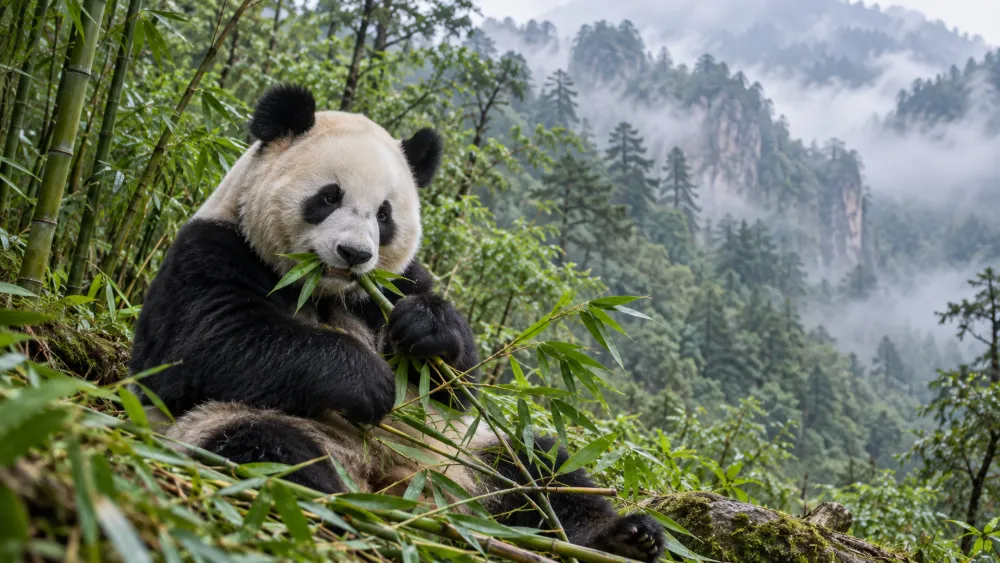
A male and female normally do not live together as a permanent pair. They become much more interested in one another during the breeding season, when scent and vocal signals help animals locate potential mates.
After breeding, the animals return to largely independent lives.
This makes giant pandas very different from highly social mammals such as wolves, lions or many primates.
Are Pandas Completely Antisocial?
No. “Solitary” does not mean that pandas have no social system.
Giant pandas communicate through:
scent marking;
vocalizations;
occasional direct meetings;
and information left throughout overlapping home ranges.
Smithsonian's National Zoo notes that recent research has identified local communities containing approximately seven to 15 giant pandas.
Within one of these areas, male home ranges may overlap substantially, while females generally overlap less.
The pandas are therefore aware of other animals around them even when they are not physically traveling together as a group.
That is very different from an animal herd in which members remain together throughout much of the day.
When Do Giant Pandas Come Together?
The clearest reason for adult pandas to seek one another out is reproduction.
Female giant pandas have a very short fertile period each year. During the breeding season, scent marks and vocalizations become especially important as males and females locate and assess one another.
Several males may sometimes be present in the broader area around a receptive female, but this temporary gathering should not be confused with a permanent social group.
Outside the breeding period, adults usually prefer considerably more personal space.
Do Mother Pandas Stay With Their Cubs?
Yes. The strongest long-term social bond in a wild giant panda's life is usually between a mother and her cub.
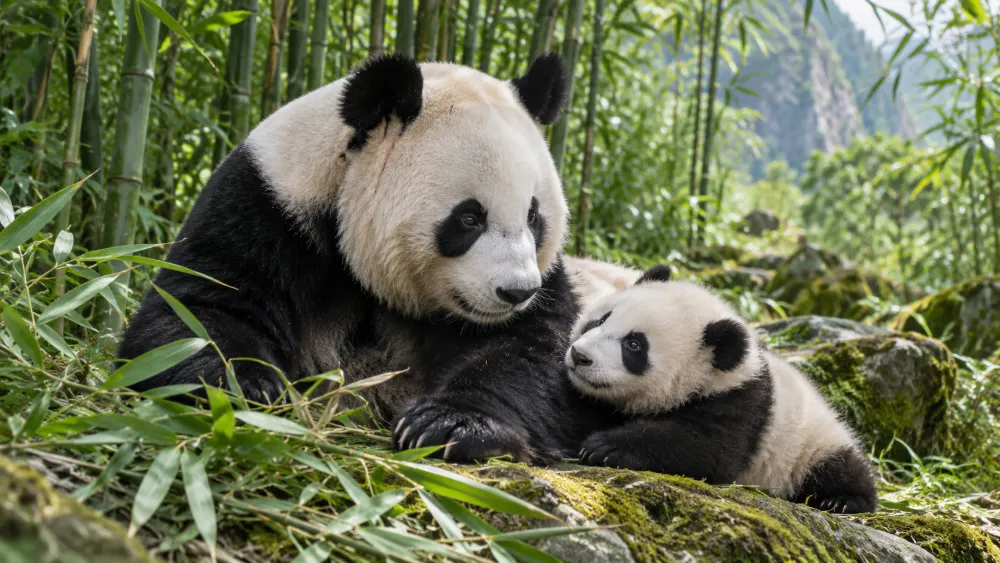
Newborn giant panda cubs are extraordinarily small and helpless.
They are born blind, with very little ability to move independently, and depend completely on their mother for warmth, milk and protection.
Smithsonian reports that cubs may remain with their mothers for roughly one and a half to three years before becoming independent.
Once independence develops, the young panda begins the largely solitary lifestyle typical of adults.
What Is a Baby Panda Called?
A baby panda is called a cub.
This follows the terminology used for other bears.
A newborn giant panda is remarkably tiny compared with its mother. Smithsonian describes newborn cubs as weighing only around 3–5 ounces.
That is roughly 1/900 of the mother's size, making giant panda newborns exceptionally small relative to adult body size.
They do not begin life with the fully developed appearance most people associate with pandas. Newborn cubs are pink, nearly hairless and blind.
Are Giant Pandas Really Bears?
Yes.
The giant panda (Ailuropoda melanoleuca) belongs to the bear family, Ursidae.
This was debated historically because pandas have several unusual anatomical and dietary characteristics, but modern genetic evidence firmly places giant pandas within the bear family.
Despite eating a diet dominated by bamboo, their digestive anatomy still retains many characteristics inherited from carnivorous ancestors.
Are Giant Pandas and Red Pandas Closely Related?
No.
Despite sharing the word “panda,” they belong to different families.
The giant panda belongs to Ursidae, the bear family.
The red panda belongs to Ailuridae, its own distinct mammalian family.
They share some ecological similarities—most famously an appetite for bamboo—but they are not simply large and small versions of the same animal.
What Is a Group of Red Pandas Called?
There is no comparably important scientific collective noun for red pandas.
You may find various playful terms online, but red pandas are also largely solitary animals outside breeding and maternal care.
As with giant pandas, ordinary phrases such as a group of red pandas are perfectly understandable and scientifically clearer than forcing an exotic collective noun into every sentence.
Why Are Giant Pandas Solitary?
Their lifestyle is closely connected to ecology.
Bamboo is abundant in the right habitat but relatively low in usable energy compared with many calorie-rich foods.
Giant pandas therefore spend a large portion of their time feeding.
Maintaining separate home ranges can reduce constant direct competition and allows animals to move among bamboo patches while still communicating indirectly through scent.
Being solitary should not be interpreted as loneliness in the human sense. It is the normal social strategy that evolved in the species.
Do Pandas Recognize Other Pandas Nearby?
Yes.
Pandas use scent extremely extensively.
They leave chemical information on trees, rocks and other surfaces. These signals can communicate information about identity, sex and reproductive condition without requiring two pandas to meet face to face.
They also produce several vocalizations during direct social interactions, including bleats, chirps, honks, barks and other sounds.
This creates a social network that is much less visually obvious than a herd of deer or a flock of birds.
Is “Cupboard of Pandas” Correct?
You may encounter a cupboard of pandas on collective-noun lists, along with other imaginative expressions.
However, “embarrassment” is by far the answer most commonly expected in modern trivia and search results.
Because these colorful terms are not formal zoological classifications, it is better not to treat every online variation as equally authoritative.
If the question is simply “What is a group of pandas called?”, embarrassment is the clearest answer.
Collective Noun vs. Real Social Group
This distinction is useful for many animal names.
A collective noun tells us something about language.
A social group tells us something about biology.
For giant pandas:
Collective noun: an embarrassment of pandas.
Normal adult lifestyle: mostly solitary.
Temporary adult interaction: mainly associated with reproduction.
Strongest family group: mother and cub.
Wider social structure: overlapping local communities connected through scent and occasional encounters.
Keeping those ideas separate gives a much more accurate picture than simply memorizing an unusual vocabulary word.
FAQ
What do you call a group of pandas?
A group of giant pandas is commonly called an embarrassment of pandas.
Why is it called an embarrassment of pandas?
The exact historical origin is unclear. The name is a whimsical English collective noun and should not be interpreted as a scientific description of panda behavior or personality.
Is a group of pandas called a cupboard?
“Cupboard of pandas” appears on some collective-noun lists, but “embarrassment of pandas” is much more widely recognized today.
Do pandas live in groups?
Adult giant pandas normally live mostly solitary lives. They communicate through scent and vocalizations and may interact during breeding, but they do not usually form permanent herds or packs.
Do male and female pandas stay together?
No. Giant pandas do not normally form permanent breeding pairs. Males and females interact primarily around the breeding season.
What is a baby panda called?
A baby panda is called a cub.
How long does a panda cub stay with its mother?
Giant panda cubs can remain with their mothers for roughly one and a half to three years before becoming independent.
Are pandas bears?
Yes. Giant pandas are members of the bear family, Ursidae.
Final Answer
A group of pandas is commonly called an embarrassment of pandas.
It is a memorable collective noun, but it should not give the impression that giant pandas normally live in large social groups.
In the wild, adult giant pandas are mostly solitary. They communicate with nearby pandas through scent and sound, come together mainly for breeding, and mothers remain with their cubs until the young animals are ready for independence.
So the easy trivia answer is “an embarrassment.” The more interesting biological answer is that seeing a genuine group of adult wild pandas together would be unusual.
Related Animal Group Names
Sources Used for Fact Checking
Smithsonian's National Zoo and Conservation Biology Institute — Giant Panda
Smithsonian's National Zoo — Giant Panda FAQs
World Wildlife Fund — Animal Collective Nouns