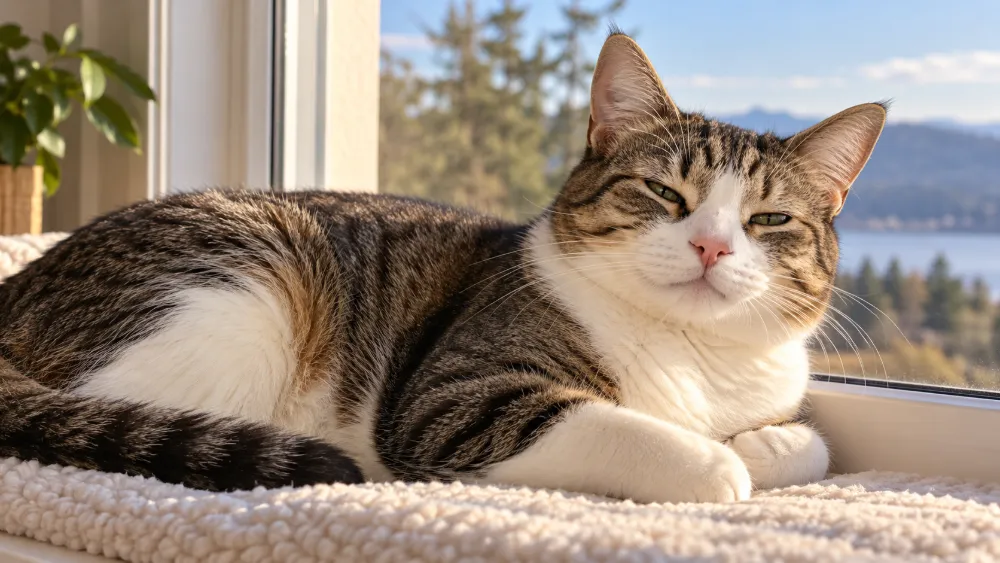
A cat can sometimes look as though it is smiling, especially when its eyes are soft and the corners of its mouth appear slightly curved.
But cats do not smile in exactly the same way humans do.
A human smile is a deliberate facial expression with a strong social meaning. In cats, happiness and comfort are communicated through a combination of the eyes, ears, whiskers, posture, tail and behavior rather than through a simple upward movement of the mouth.
One of the closest feline equivalents to a friendly smile may be the slow blink—a relaxed sequence of half-closing and gently narrowing the eyes during a positive interaction.
Can Cats Smile?
Cats can produce facial expressions that humans interpret as smiling, but there is no good evidence that they intentionally pull the corners of the mouth upward to communicate happiness in the same way people do.
A relaxed cat may naturally have:
softly narrowed eyes;
relaxed facial muscles;
neutral ears;
loose whiskers;
a relaxed jaw;
and a naturally curved muzzle.
Together, these features can create a face that looks like a smile to us.
The important point is to read the entire cat rather than focusing only on the mouth.
What Does a Happy Cat Face Look Like?
A comfortable cat generally looks soft rather than tense.
| Feature | Relaxed or Positive Cat |
|---|---|
| Eyes | Soft, normal or gently narrowed |
| Ears | Neutral or comfortably forward |
| Whiskers | Loose and naturally positioned |
| Muzzle | Relaxed rather than tense |
| Body | Loose posture, resting or approaching voluntarily |
| Tail | Relaxed or upright during friendly approach |
No single feature proves a cat is happy.
Context is essential.
Is a Slow Blink a Cat Smile?
The slow blink is often described informally as a “cat smile.”
That description is not literally correct, but it captures an important idea.
A slow blink typically involves:
the cat looking calmly toward another individual;
partially closing the eyes;
sometimes closing them fully for a moment;
and reopening them slowly.
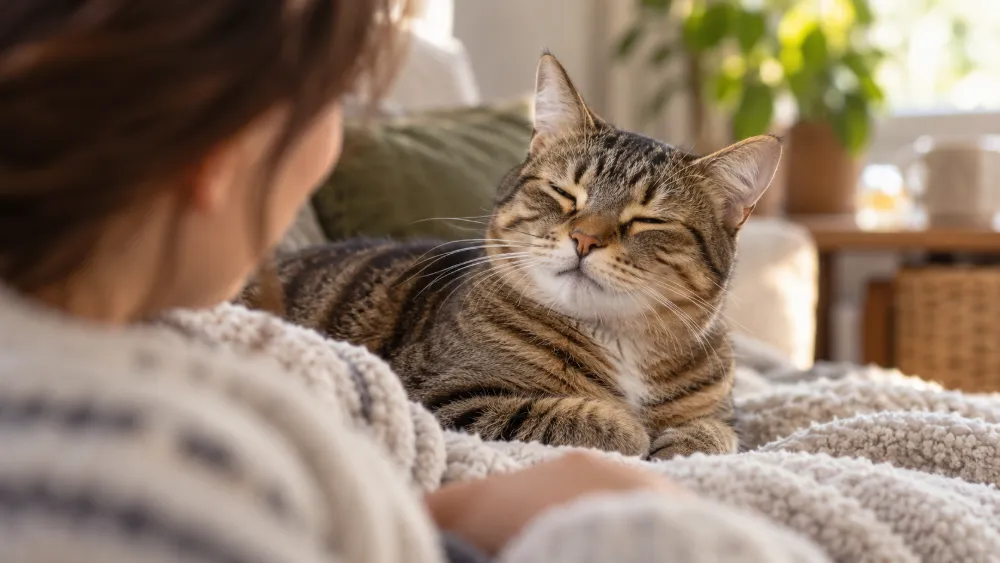
Experimental research has found that cats perform more eye-narrowing movements when humans slow blink toward them.
Cats were also more likely to approach an unfamiliar experimenter after a slow-blink interaction than after the person simply maintained a neutral expression.
That makes the slow blink one of the strongest scientifically studied examples of positive facial communication between cats and humans.
How Do You Slow Blink at a Cat?
You can try a simple, non-invasive interaction:
Sit or stand at a comfortable distance.
Avoid staring intensely.
Look toward the cat with a relaxed face.
Slowly narrow your eyes.
Close them gently for a brief moment.
Open them slowly again.
If the cat is comfortable, it may respond with its own half-blinks or eye narrowing.
Do not move closer simply because the cat blinks.
Let the cat decide whether it wants to approach.
Does a Cat Slow Blink Mean “I Love You”?
Calling the slow blink “I love you” is a popular interpretation, but it goes beyond what science can prove.
A better description is:
Slow blinking appears to occur in calm, positive social interactions and may communicate friendly or non-threatening intent.
A cat may slow blink toward an owner, another familiar person or sometimes another cat.
But we should be cautious about translating animal behavior into exact human sentences.
Do Cats Have Facial Expressions?
Absolutely.
Cats are capable of producing far more facial variation than their reputation for being “expressionless” suggests.
A study observing cat-to-cat interactions documented 276 distinct combinations of facial movements.
These included changes involving:
ears;
eyes;
whiskers;
lips;
nose;
and mouth movements.
The researchers found that facial signals differed between friendly and unfriendly social interactions.
So while cats may not use a human-style smile, their faces are still an important communication system.
Why Does My Cat Look Like It Is Smiling?
Some cats naturally have facial anatomy that gives the impression of a smile.
The shape of the:
muzzle;
whisker pads;
cheeks;
eyes;
and coat markings
can produce an upward-curving appearance around the mouth.
This is especially obvious in photographs taken when the cat is relaxed.
However, the apparent smile may simply be the normal resting structure of the face.
Can Cats Smile With Their Mouth Open?
An open mouth should not automatically be interpreted as a smile.
There are several reasons a cat may open its mouth.
Flehmen Response
After smelling something interesting, a cat may briefly open its mouth and appear to make a strange grimace.
This is called the flehmen response.
It helps move odor molecules toward the vomeronasal organ, which analyzes chemical signals.
The expression may look like a grin, but it has nothing to do with smiling.
Panting
Cats can open their mouths and pant when they are:
very hot;
highly stressed;
or physically exhausted.
Persistent open-mouth breathing in a resting cat can also indicate a medical problem and should not be mistaken for a happy facial expression.
Does Purring Mean a Cat Is Smiling?
Purring is frequently associated with comfortable social situations.
A relaxed cat may purr while:
being stroked;
resting beside a familiar person;
nursing kittens;
or settling into a comfortable sleeping area.
But purring does not always mean happiness.
Cats may also purr when stressed, frightened, injured or ill.
Always interpret purring together with the cat's posture and surroundings.
How Do Cats Show Happiness?
A happy or comfortable cat may show several behaviors at once.
Slow Blinking
Gentle eye narrowing during a relaxed social interaction.
Tail Up
An upright tail during approach is commonly associated with friendly social behavior.
Relaxed Posture
The muscles look loose rather than rigid or ready to escape.
Social Rubbing
Cats may rub the head or body against familiar people and animals.
Kneading
Some cats rhythmically push their paws into soft surfaces when relaxed.
Resting Nearby
A cat voluntarily sleeping or resting close to you is often demonstrating trust and comfort.
Can Cats Laugh?
There is no evidence that domestic cats laugh in the human sense.
Humans laugh using characteristic vocal sounds and facial expressions associated with humor and social interaction.
Cats have their own vocal repertoire, including:
meows;
purrs;
trills;
chirps;
growls;
and hisses.
None has been demonstrated to function as a direct feline equivalent of human laughter.
Can Cats Understand Human Smiles?
Cats can learn information from human faces, voices and behavior, but a human smile should not be assumed to have exactly the same meaning to a cat that it has to another human.
Cat-human communication is multimodal.
A cat may respond to:
facial movements;
tone of voice;
body posture;
movement;
and previous experience with that person.
The slow blink is currently much better supported as a specific positive human-to-cat facial signal than ordinary tooth-showing human smiles.
Can Showing Teeth Frighten a Cat?
There is no universal rule that a human showing teeth will frighten every cat.
Domestic cats learn individual human habits.
However, leaning over a cat, staring directly, moving quickly or invading its personal space can be threatening regardless of whether the person is smiling.
A relaxed body posture and gentle slow blink are generally clearer low-threat signals.
How Can You Tell a Happy Face From a Painful Face?
This is particularly important because a quiet cat is not necessarily a comfortable cat.
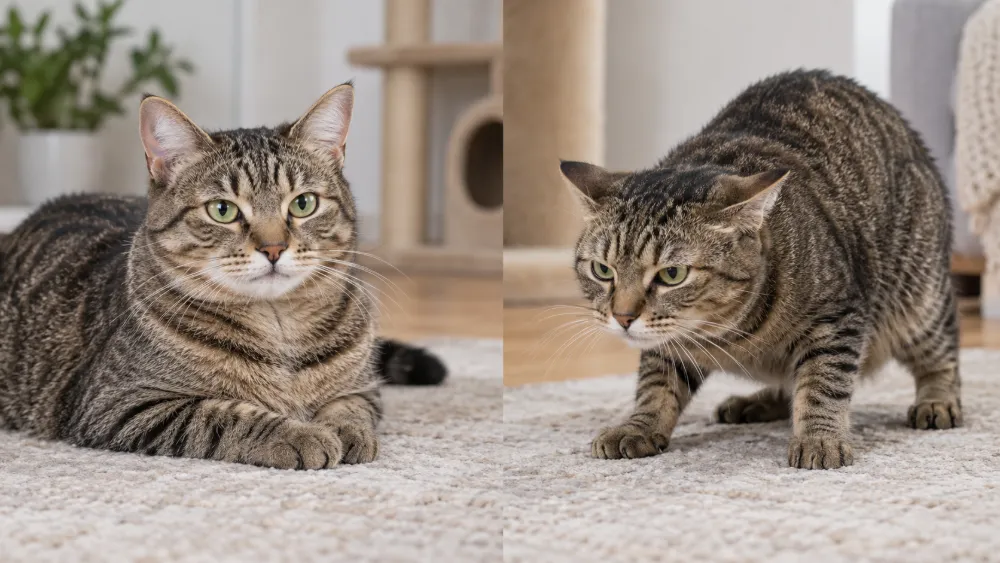
Veterinary researchers developed the Feline Grimace Scale to help identify acute pain.
It evaluates five facial features:
ear position;
eye or orbital tightening;
muzzle tension;
whisker position;
and head position.
A painful cat may show flattened ears, narrowed eyes, a tense muzzle, altered whisker position and a lower head posture.
This is very different from simply seeing a relaxed cat with gently narrowed eyes.
Is Squinting Always a Slow Blink?
No.
This distinction is important.
A relaxed slow blink happens briefly during an otherwise comfortable interaction.
Persistent squinting can instead indicate:
eye irritation;
corneal injury;
infection;
pain;
or another medical problem.
If a cat keeps one eye closed, has discharge, redness or repeatedly paws at the eye, veterinary assessment is appropriate.
Do Cats Smile at Other Cats?
Cats use numerous facial movements during interactions with one another.
Recent observational research has found hundreds of distinct facial-movement combinations during cat-cat encounters.
Some occur primarily in affiliative interactions, while others are associated with less friendly encounters.
That means cats clearly use their faces socially—even if “smile” is not the best scientific label for those expressions.
FAQ
Can cats really smile?
Cats can look like they are smiling, but they do not appear to use a human-style mouth smile as a specific signal of happiness. Relaxed facial muscles and slow blinking are better indicators of positive emotion.
What is a cat smile?
The term is often used informally for the slow blink: a calm sequence of eye narrowing and partial eye closure during positive social interaction.
Why does my cat look like it is smiling?
The natural shape of the muzzle and whisker pads can make the mouth appear curved upward, especially when facial muscles are relaxed.
Does slow blinking mean a cat loves you?
It is better described as positive or friendly communication rather than translating it literally as “I love you.” Research shows cats respond positively to human slow blinking.
Should I slow blink at my cat?
You can. Use gentle eye narrowing from a comfortable distance and allow the cat to decide whether to respond or approach.
Does purring mean my cat is happy?
Often, but not always. Cats can also purr during stress, illness or pain, so body language and context should be considered.
Can cats laugh?
There is no scientific evidence that cats laugh in the same way humans do.
Why does my cat open its mouth after smelling something?
It may be performing the flehmen response, which helps analyze chemical information. The expression can resemble a strange smile but is not a happiness signal.
Can a cat's facial expression show pain?
Yes. The validated Feline Grimace Scale uses changes in the eyes, ears, muzzle, whiskers and head position to assess acute pain.
Is squinting a sign that my cat is happy?
A brief slow blink in a relaxed context can be positive. Persistent squinting, especially in one eye, may indicate pain or an eye problem.
Final Answer
Cats can look like they are smiling, but they do not smile with their mouths in the same deliberate social way humans do.
The best clues to a happy cat are a relaxed face and body, soft eyes, neutral ears, relaxed whiskers, comfortable social behavior and sometimes slow blinking.
The slow blink is especially interesting because experimental research shows that cats respond to humans who perform it and are more willing to approach after slow-blink interactions.
So if you want to “smile” at a cat, the most feline way may not involve your mouth at all.
Relax your face, gently narrow your eyes, slowly blink—and let the cat decide whether to smile back in its own language.
Related Reading
Sources Used for Fact Checking
Scientific Reports — The Role of Cat Eye Narrowing Movements in Cat–Human Communication
Behavioural Processes — Feline Faces: Social Function of Domestic Cat Facial Signals
Scientific Reports — Development and Validation of the Feline Grimace Scale