Few animals attract more exaggerated size stories than the anaconda.
Claims of 30-foot, 40-foot and even larger snakes have circulated for generations, but reliable measurements tell a much more complicated story.
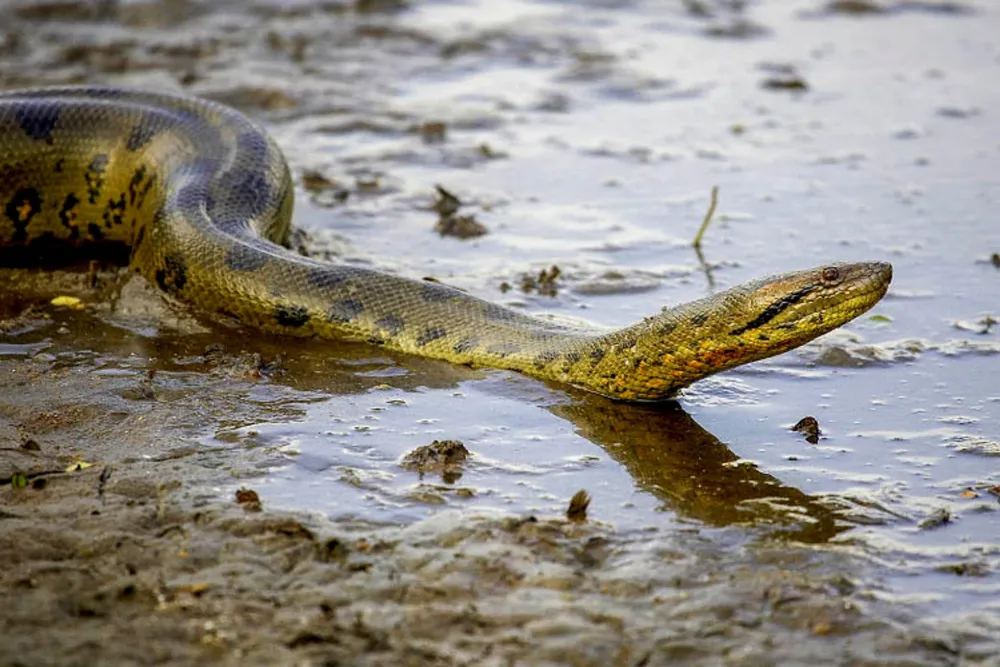
Guinness World Records cites a historical report of a female green anaconda from Brazil measuring 8.45 meters (27 feet 9 inches) long with a girth of approximately 111 centimeters (44 inches).
That animal is often described as the largest anaconda ever recorded.
However, its body weight was estimated rather than directly established to modern scientific standards, and giant-anaconda reports should be separated from the much better documented measurements produced by long-term field studies.
Modern scientific records confirm that green anacondas can exceed 5.2 meters in length and 97 kilograms in weight, making them the heaviest living snakes in the world.
Largest Anaconda Ever Recorded at a Glance
| Record or Claim | Size | How Reliable? |
|---|---|---|
| Historical Brazilian female cited by Guinness | 8.45 m (27 ft 9 in) | Historical reported measurement |
| Girth of same animal | 111 cm (44 in) | Reported |
| Modern scientifically verified green anacondas | More than 5.2 m | Strong field evidence |
| Verified modern mass | More than 97 kg (214 lb) | Strong field evidence |
| 30–40 ft giant-anaconda stories | 9–12+ m | Generally unverified |
How Big Was the Largest Anaconda Ever Reported?
Guinness World Records cites a female green anaconda reportedly shot in Brazil around 1960.
The snake was reported to measure:
8.45 meters;
27 feet 9 inches;
with a girth of approximately 111 centimeters (44 inches).
This is the figure most often used for the largest individual anaconda on record.
Its exact mass is less certain.
Published estimates vary because the animal was not weighed in the same controlled way used for a living research specimen.
For that reason, it is better to treat the extraordinary length as a historical record report and avoid presenting a calculated weight as though it were directly measured.
What Is the Largest Reliably Measured Wild Anaconda?
Modern scientific field studies give us a more conservative picture.
Researchers studying wild green anacondas have documented specimens exceeding approximately 5.2 meters and 97 kilograms.
These records are especially valuable because the animals were physically captured and measured using repeatable scientific methods.
A separate natural-history report from the Venezuelan Llanos described a very large female measuring approximately 5.6 meters.
Snakes in this size class are already exceptionally large animals.
Why Are Giant Anaconda Measurements So Difficult?
Measuring a huge snake sounds simple until the animal begins moving.
A snake's body bends continuously and cannot be treated like a rigid ruler.
Researchers have therefore developed methods that follow the natural midline of the body with a string or measuring device rather than forcibly stretching the snake.
Several measurements can then be repeated and averaged.
This matters because different methods can produce different total lengths.
Can Stretching a Snake Change Its Measured Length?
Yes.
Snake length can vary depending on:
whether the animal is relaxed or struggling;
whether it is stretched;
whether the measurement follows the body's curves;
and how precisely the head and tail endpoints are defined.
This is one reason old giant-snake stories based on skins or poorly documented measurements require caution.
A dried snake skin can also be stretched significantly beyond the animal's original body length.
Are Green Anacondas the Longest Snakes in the World?
No.
The reticulated python is generally recognized as the world's longest living snake species.
Green anacondas are instead famous for something different:
they are the world's heaviest living snakes.
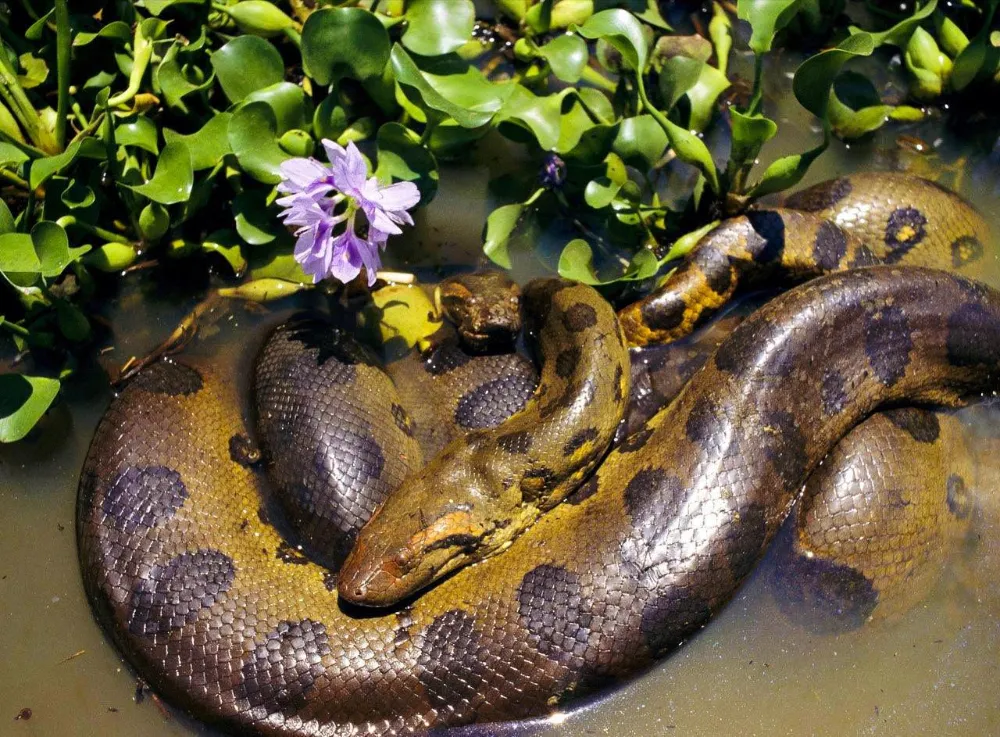
A giant female anaconda is extraordinarily thick-bodied.
A reticulated python of similar length usually has a noticeably more slender build.
Green Anaconda vs. Reticulated Python
| Feature | Green Anaconda | Reticulated Python |
|---|---|---|
| Main size record | Heaviest living snake species | Longest living snake species |
| Body build | Extremely thick and heavy | Longer and relatively slender |
| Primary habitat | Aquatic and wetland habitats | Forests, wetlands and other tropical habitats |
| Native region | South America | South and Southeast Asia |
How Much Can a Green Anaconda Weigh?
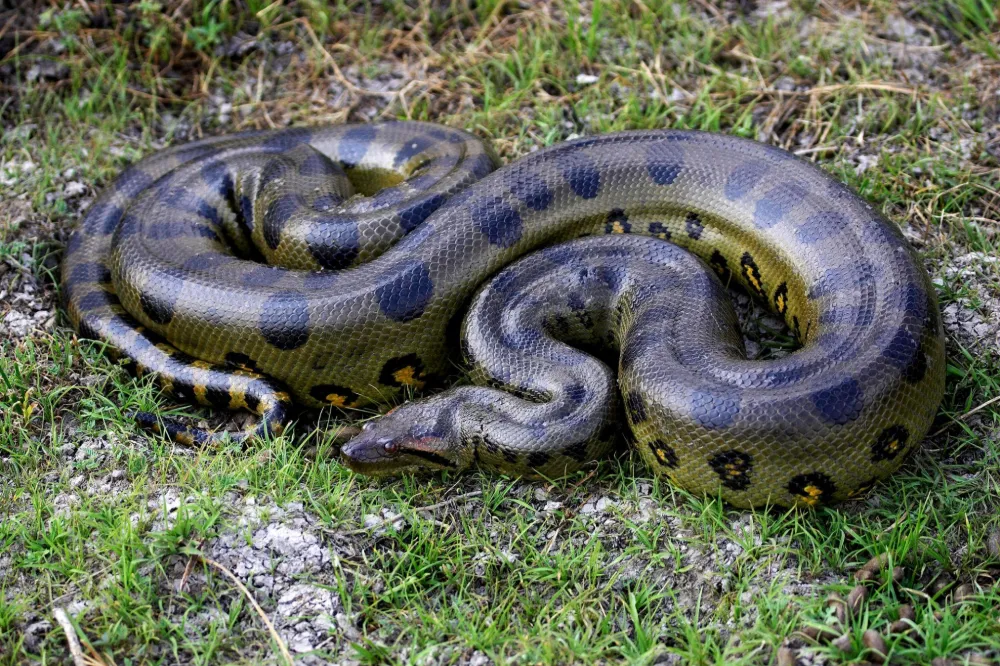
A typical adult female is much lighter than internet images of record-sized snakes might suggest.
Guinness gives typical adult female green anacondas at approximately 30 to 70 kilograms (65 to 155 pounds) and roughly 3 to 5 meters long.
Exceptionally large females can become much heavier.
Pregnancy and recent feeding can also have a major effect on body mass.
A large anaconda that recently swallowed substantial prey may temporarily weigh far more than the same animal when fasting.
Can an Anaconda Weigh 500 Pounds?
Extremely large green anacondas have historically been estimated at approximately 500 pounds or more.
But there is a major difference between an estimated mass and a snake physically weighed on calibrated equipment.
When discussing record animals, direct measured weight should always be treated as stronger evidence than calculations based on length and girth.
Why Are Female Anacondas So Much Bigger Than Males?
Green anacondas show extreme sexual size dimorphism.
Adult females are much longer and dramatically heavier than adult males.
Large female size is associated with reproductive biology because bigger females can carry large numbers of developing young.
Field research on anacondas has documented mating aggregations in which one massive female may be surrounded by numerous much smaller males.
Virtually every truly giant green anaconda is therefore expected to be female.
Do Anacondas Lay Eggs?
No.
Anacondas give birth to live young.
The embryos develop inside the female rather than being deposited as external eggs.
A very large pregnant female can carry numerous offspring, adding substantially to her total mass during the reproductive season.
What Do Giant Anacondas Eat?
Green anacondas are ambush predators.
Their prey can include:
Large females are capable of taking substantially larger prey than smaller males.
They kill primarily by constriction.
Rather than simply “crushing bones,” constriction interferes rapidly with circulation and the ability of the prey's cardiovascular system to function.
Could a Giant Anaconda Eat a Human?
A very large anaconda is physically capable of overpowering large prey, and encounters with humans should always be treated cautiously.
However, well-documented predation on humans is extraordinarily rare.
Sensational stories of anacondas routinely hunting people are not supported by the frequency of documented field observations.
Humans are not a normal major prey item.
Are There Really 30-Foot Anacondas?
There is no strong modern scientific evidence for living anacondas routinely reaching 30 feet.
A 30-foot snake would measure approximately 9.14 meters.
That is substantially longer than even the famous 8.45-meter historical report cited by Guinness.
Without a specimen, calibrated measurement or strong photographic evidence, a claimed 30-foot anaconda should be treated as unverified.
What About 40-Foot or 50-Foot Anacondas?
Stories of 40-foot and 50-foot anacondas are part of giant-snake folklore rather than established modern zoological records.
Several factors can make wild snakes look much larger than they are:
distance;
water distortion;
forced perspective;
partial visibility;
and inaccurate eyewitness estimates.
A snake moving through vegetation or muddy water can be especially difficult to estimate accurately.
Why Do Anacondas Look So Huge in Water?
Green anacondas are highly aquatic.
The water supports their heavy bodies, allowing massive females to move much more efficiently than they can on dry land.
Only a portion of the snake may be visible at any one time.
This can make estimating its total length extremely difficult.
Where Do the Largest Anacondas Live?
Green anacondas inhabit wetlands, slow-moving rivers, flooded grasslands, swamps and tropical lowlands of South America.
Famous study areas include the Venezuelan Llanos, where researchers have spent years capturing and measuring wild anacondas.
Other populations occur across parts of the Amazon and Orinoco drainage systems and neighboring tropical regions.
Are There Two Green Anaconda Species?
Traditionally, all green anacondas were classified as Eunectes murinus.
Research published in 2024 proposed recognizing two genetically distinct green-anaconda species:
Northern Green Anaconda — Eunectes akayima
Southern Green Anaconda — Eunectes murinus
The proposed split was based largely on genetic divergence together with geographic and morphological evidence.
Because taxonomic changes can take time to become universally adopted, some references and older research still use Eunectes murinus broadly for animals now assigned to both populations.
How Large Are Typical Green Anacondas?
Record-sized snakes can distort people's expectations.
Most adult green anacondas are nowhere near 8 meters long.
Adult females commonly fall in roughly the 3-to-5-meter range, while males are considerably smaller.
This makes even a 5-meter wild female an exceptionally impressive snake.
How Do Scientists Measure a Giant Anaconda?
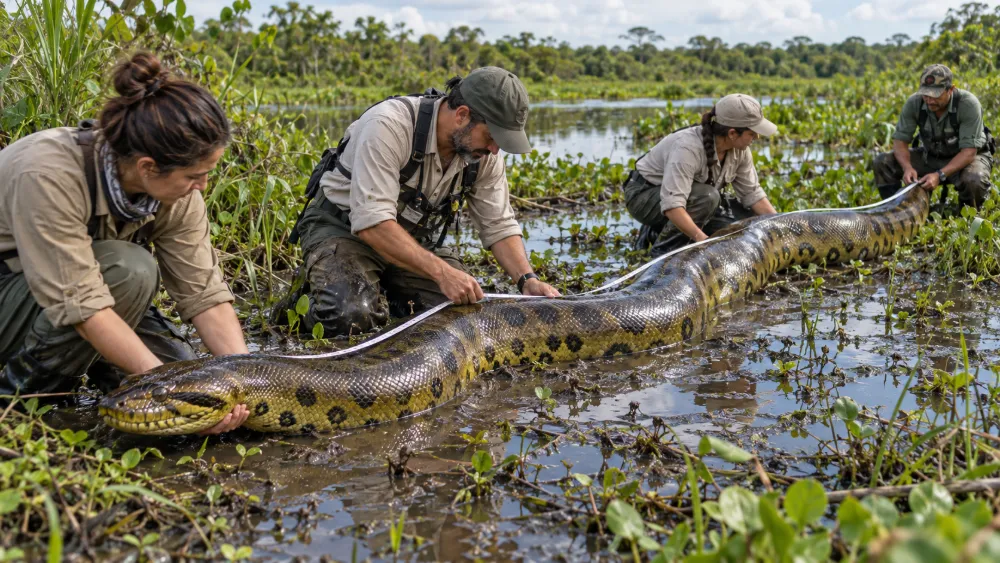
Researchers studying live anacondas must prioritize both human and animal safety.
After safely restraining the snake, a flexible line can be run along the approximate midline of its naturally curved body.
The line is then measured separately.
Repeating the process several times reduces measurement error.
Researchers may also record:
body mass;
girth;
head dimensions;
sex;
reproductive condition;
and body condition.
What Was the Largest Snake Ever?
If the question means the longest modern snake species, the reticulated python wins.
If it means the heaviest living snake species, the green anaconda wins.
Prehistoric snakes were even larger.
Titanoboa cerrejonensis, an extinct snake from Paleocene South America, is estimated to have reached roughly 13 meters in length.
However, this estimate is reconstructed from fossils and should not be compared directly with measurements taken from a living snake.
FAQ
What is the largest anaconda ever recorded?
Guinness World Records cites a historical female green anaconda reportedly measuring 8.45 meters (27 feet 9 inches) with a girth of about 111 centimeters.
How big is the largest scientifically verified anaconda?
Modern scientific literature documents verified green anacondas exceeding approximately 5.2 meters long and 97 kilograms in body mass.
Can an anaconda grow to 30 feet?
There is no strong modern scientific evidence for a reliably measured 30-foot green anaconda. Such claims should be treated cautiously unless supported by direct measurement.
Can an anaconda weigh 500 pounds?
Historical giant individuals have been estimated near or above 500 pounds, but the strongest modern directly measured field records are generally lower. Pregnancy and recent feeding can also greatly change body mass.
What is the heaviest snake in the world?
The green anaconda is recognized as the heaviest living snake species.
What is the longest snake in the world?
The reticulated python is the world's longest living snake species.
Which is bigger, a python or an anaconda?
Reticulated pythons generally win in total length, while green anacondas are heavier and more massively built.
Are female anacondas bigger than males?
Yes. Female green anacondas are dramatically larger than males and show one of the most extreme examples of female-biased size dimorphism among snakes.
Are there anacondas over 40 feet long?
No 40-foot green anaconda has been reliably documented by modern scientific measurement.
Where do giant anacondas live?
Green anacondas inhabit South American wetlands, including parts of the Amazon and Orinoco basins and the flooded Llanos.
Final Answer
The answer to “What is the largest anaconda ever recorded?” depends on how strict we are about the evidence.
Guinness World Records cites a historical female green anaconda reported at 8.45 meters (27 feet 9 inches) long.
However, its weight was estimated rather than established through the kind of controlled field measurements used by modern researchers.
Modern scientific studies have reliably documented green anacondas exceeding about 5.2 meters and 97 kilograms, with other field observations describing females around 5.6 meters.
Those numbers may sound less spectacular than online stories of 30- or 40-foot snakes, but a five-meter anaconda is already one of the most massive snakes alive.
Green anacondas are not generally the world's longest snakes—that title belongs to reticulated pythons—but their extraordinary body thickness makes them the heaviest living snake species.
Related Reading
Sources Used for Fact Checking
Guinness World Records — Longest Snake Species / Largest Anaconda Reports
Guinness World Records — Heaviest Reptile
Smithsonian's National Zoo — Green Anaconda
Rivas et al. — Natural History of the Green Anaconda in the Venezuelan Llanos
Rivas et al. — What Is the Length of a Snake?
Rivas et al. — Green Anaconda Field Research
Rivas et al. 2024 — Anaconda Taxonomy and Northern Green Anaconda