Orange is one of the easiest bird colors to notice, but identifying an orange bird can still be surprisingly difficult.
Some species are almost entirely orange, while others have only an orange breast, throat, head or wing patch.
If you see an orange bird in North America, start by checking:
where the orange appears;
whether the bird also has black, blue or gray feathers;
its overall size;
bill shape;
and where in North America you saw it.
This guide covers 10 of the most useful orange birds to recognize in the United States and Canada.
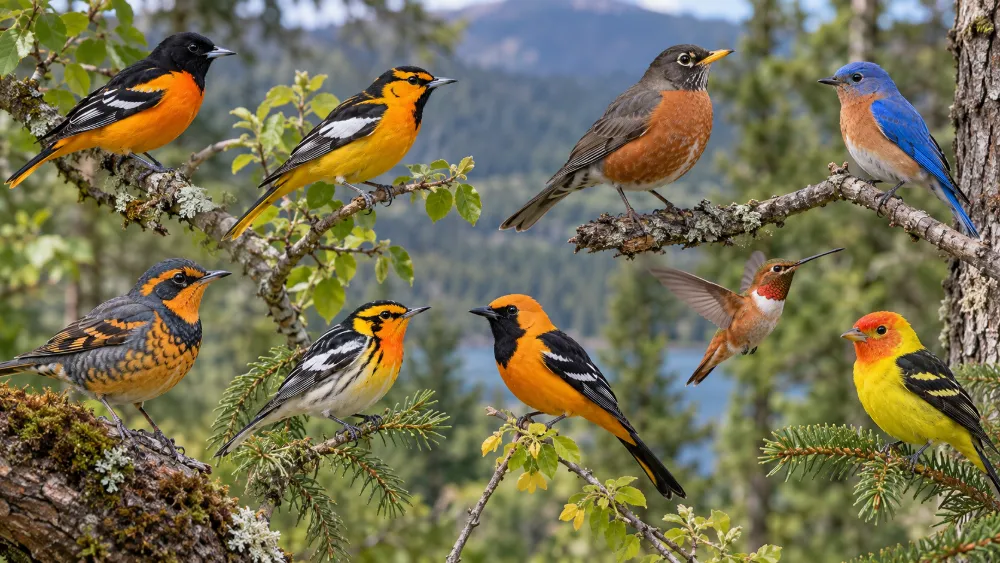
Orange Bird Identification Chart
| Bird | Orange Pattern | Best Identification Clue |
|---|---|---|
| Baltimore Oriole | Bright orange breast, belly and rump | Completely black head |
| Bullock's Oriole | Bright orange face and body | Black eye line and large white wing patch |
| American Robin | Orange-red breast | Large thrush, dark back, yellow bill |
| Eastern Bluebird | Rusty-orange chest | Brilliant blue wings and back |
| Varied Thrush | Burnt-orange breast and eyebrow | Dark breast band |
| Blackburnian Warbler | Flame-orange face and throat | Tiny black-and-white warbler |
| Hooded Oriole | Yellow-orange to flame orange | Black throat and slightly curved bill |
| American Redstart | Bright orange patches | Black body with orange wings and tail |
| Rufous Hummingbird | Rusty-orange over much of body | Tiny hummingbird |
| Western Tanager | Orange-red head | Yellow body and black wings |
1. Baltimore Oriole
Scientific name: Icterus galbula
The male Baltimore Oriole is one of the most recognizable orange birds in eastern North America.
Look for:
a completely black head;
black upper back;
brilliant orange breast and belly;
orange rump;
orange outer tail feathers;
and black wings with white markings.
Females and immature birds are less dramatically colored and may be yellow-orange rather than vivid orange.
Baltimore Orioles are often found high in deciduous trees, parks, woodland edges and suburban neighborhoods.
2. Bullock's Oriole
Scientific name: Icterus bullockii
Bullock's Oriole is the western counterpart most likely to be confused with a Baltimore Oriole.
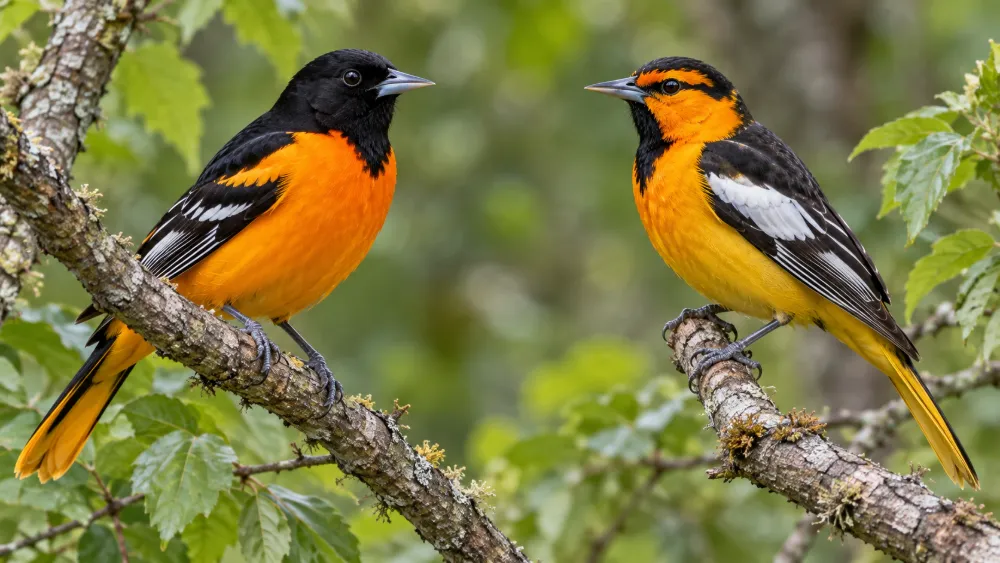
Adult males have:
bright orange underparts;
an orange face;
a black line through the eye;
a black throat;
a black back;
and a large white wing patch.
The face is the easiest distinction.
A male Baltimore Oriole has an entirely black head, while a male Bullock's Oriole has an orange face divided by black markings.
Baltimore Oriole vs. Bullock's Oriole
| Feature | Baltimore Oriole | Bullock's Oriole |
|---|---|---|
| Head | Entirely black in adult male | Orange with black eye line |
| Throat | Black | Black |
| Wing | White wingbars | Large white wing patch |
| Main U.S. range | East and central regions | West |
3. American Robin
Scientific name: Turdus migratorius
If the bird is larger and hopping across a lawn, the answer may simply be an American Robin.
Adult robins have:
a warm orange to reddish-orange breast;
dark gray-brown upperparts;
a yellow bill;
and a relatively large thrush-shaped body.
American Robins are among the most widespread birds in North America.
They frequently forage on lawns, pulling earthworms and insects from the soil, and also eat large amounts of fruit.
4. Eastern Bluebird
Scientific name: Sialia sialis
A bird that is blue on top but orange underneath may be an Eastern Bluebird.
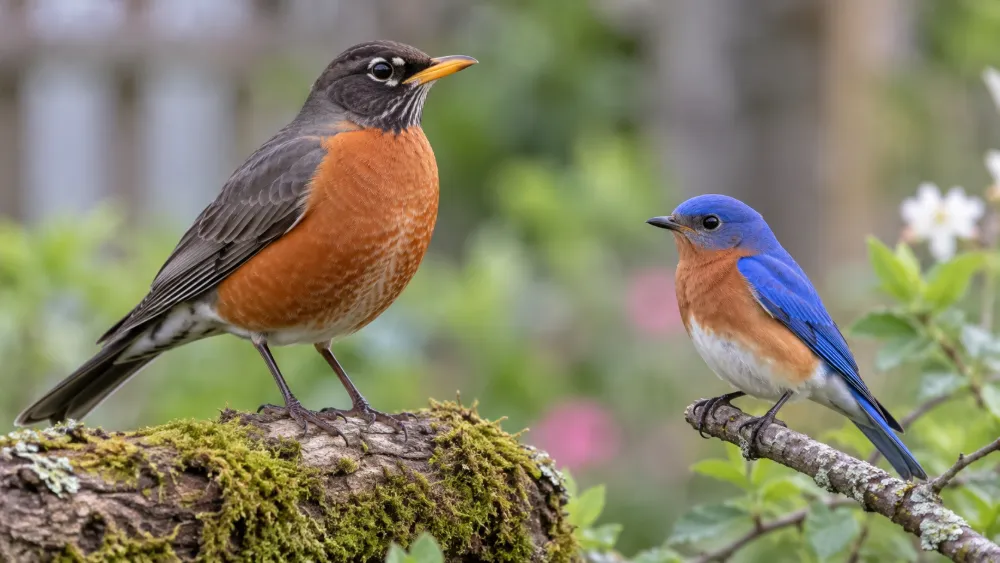
Adult males have:
bright blue head, back, wings and tail;
a rusty-orange throat and chest;
and a white lower belly.
Females are more subdued, with grayish upperparts, blue wings and tail, and a softer orange-brown chest.
Eastern Bluebirds often sit on fence posts, wires or low branches while watching the ground for insects.
American Robin vs. Eastern Bluebird
Both can have orange chests, but they are easy to separate once you see the back.
American Robin: larger, dark gray-brown above.
Eastern Bluebird: smaller, distinctly blue above, especially in males.
5. Varied Thrush
Scientific name: Ixoreus naevius
The Varied Thrush looks almost like an American Robin redesigned in orange, gray and black.
Adult males have:
a slate-blue-gray back;
rich burnt-orange throat and belly;
a dark breast band;
an orange eyebrow;
and orange markings in the wings.
Females show the same general pattern but are browner and less strongly contrasting.
Varied Thrushes are strongly associated with humid forests of western North America, especially the Pacific Northwest.
6. Blackburnian Warbler
Scientific name: Setophaga fusca
If the bird is tiny and the orange is concentrated on the throat and face, check for a male Blackburnian Warbler.
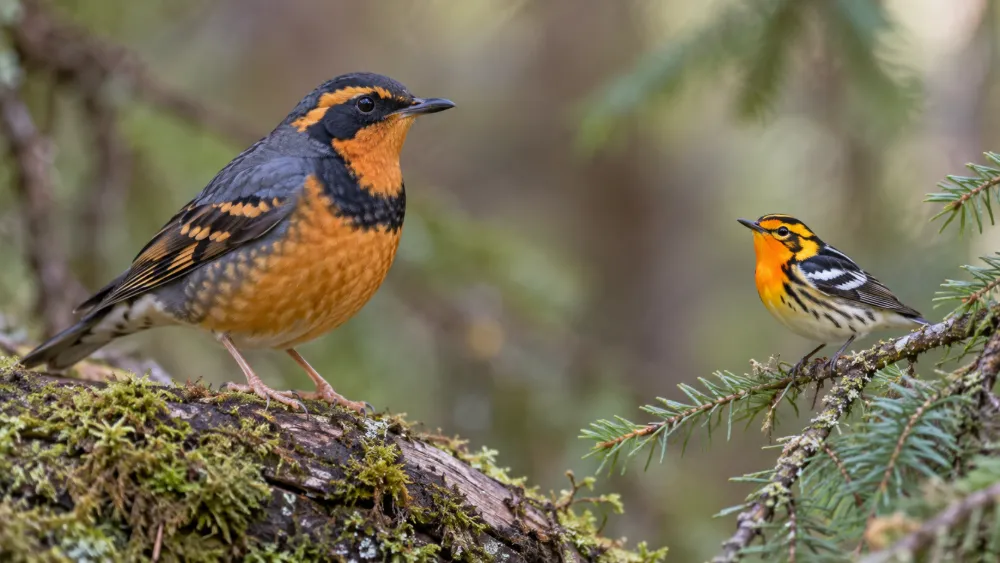
Breeding males have a spectacular flame-orange throat and face combined with:
a black crown;
black facial markings;
black-and-white wings;
and a pale underside.
They are much smaller than orioles and robins.
Blackburnian Warblers often forage high in the forest canopy, so spring migration may provide the easiest opportunities to see one closer to eye level.
7. Hooded Oriole
Scientific name: Icterus cucullatus
Hooded Orioles are long, slender orioles of the southwestern United States and Mexico.
Adult males vary geographically from yellow to brilliant flame orange.
Look for:
a yellow-orange or orange body;
black throat;
black around the eye;
black wings and tail;
a large white wingbar;
and a slightly curved bill.
Birds from south Texas and eastern Mexico can be particularly orange.
Hooded Orioles are strongly associated with palms in many suburban areas.
8. American Redstart
Scientific name: Setophaga ruticilla
The adult male American Redstart is not orange all over.
Instead, it is mostly black with vivid orange patches.
Look for bright orange on:
the sides of the breast;
the bases of the wing feathers;
and the tail.
The bird frequently fans its wings and tail while foraging, making the orange patches flash conspicuously.
Females and young males replace much of the male's orange with yellow.
9. Rufous Hummingbird
Scientific name: Selasphorus rufus
If your orange bird is tiny and hovering at flowers, the Rufous Hummingbird is an obvious candidate.
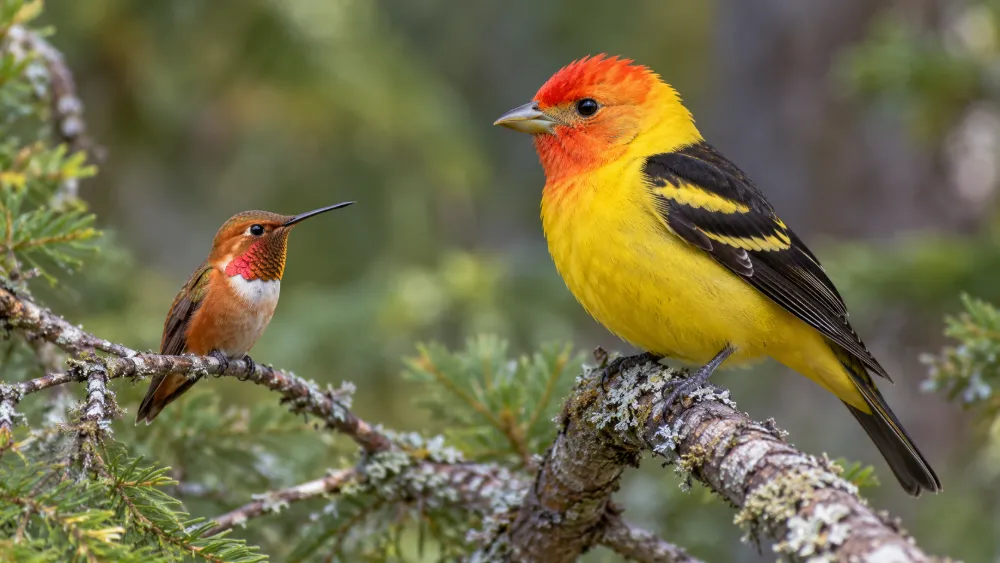
Adult males can appear intensely rusty orange over much of the:
back;
sides;
belly;
and tail.
The throat is iridescent and can flash red, orange, yellow or even green depending on the angle of the light.
Females are greener above but still show rusty coloration on the flanks and tail.
10. Western Tanager
Scientific name: Piranga ludoviciana
A breeding male Western Tanager is not primarily orange, but its head can be spectacularly orange-red.
Look for:
a flaming orange-red head;
a bright yellow body;
black wings;
black back and tail;
and prominent wingbars.
This species occurs mainly in western North America during the breeding season.
It is usually associated with forests and wooded habitats rather than lawns or open urban areas.
How to Identify a Black and Orange Bird
If the bird is strongly black and orange, start with four possibilities.
| Bird | Quick Clue |
|---|---|
| Baltimore Oriole | Black entire head + orange body |
| Bullock's Oriole | Orange face + black eye line |
| Blackburnian Warbler | Tiny bird + flame-orange throat |
| American Redstart | Mostly black + flashing orange patches |
What Bird Has an Orange Breast?
If orange is mostly limited to the chest or belly, consider:
American Robin — large, dark-backed bird with orange-red breast;
Eastern Bluebird — blue above with rusty-orange chest;
Varied Thrush — burnt orange below with dark breast band;
Baltimore Oriole — vivid orange below with black head;
Bullock's Oriole — orange breast and face with black markings.
Small Orange Bird Identification
For a very small bird, narrow the search to body shape and behavior.
Hovering at flowers: Rufous Hummingbird.
Tiny forest bird with fiery orange throat: Blackburnian Warbler.
Small active black bird flashing orange wings and tail: male American Redstart.
Orange Bird in Eastern North America
Common possibilities include:
Baltimore Oriole;
American Robin;
Eastern Bluebird;
Blackburnian Warbler;
and American Redstart.
Season matters because several of the brightest orange species are migratory.
Orange Bird in Western North America
Likely candidates include:
Bullock's Oriole;
Varied Thrush;
Hooded Oriole;
Rufous Hummingbird;
Western Tanager;
and American Robin.
Why Are Some Birds Orange?
Orange bird feathers often obtain their coloration from carotenoid pigments acquired through diet.
Birds cannot simply manufacture all carotenoids from nothing, so food provides important pigment precursors.
The exact final color depends on:
species;
genetics;
diet;
pigment metabolism;
feather structure;
sex;
and age.
This is one reason males and females of the same species can look dramatically different.
Why Are Male Birds Often More Orange?
In several orange bird species, adult males are more brightly colored than females.
Baltimore Orioles, Bullock's Orioles, Blackburnian Warblers, Rufous Hummingbirds and Western Tanagers all show strong sex-related plumage differences.
Bright plumage can function in mate attraction and social signaling, while more subdued coloration may provide greater camouflage.
Is the Orange-crowned Warbler Orange?
Usually not in the way its name suggests.
The Orange-crowned Warbler is mostly olive-green to yellowish.
Adults have a small orange patch on the crown, but it is often concealed and can be extremely difficult to see.
So a strongly orange bird is unlikely to be an Orange-crowned Warbler simply because of the name.
FAQ
What is the most common orange bird?
The American Robin is one of the most widespread orange-breasted birds across North America. Baltimore Orioles and Bullock's Orioles are more intensely orange but are seasonal and more regionally distributed.
What bird is orange and black?
Baltimore Orioles, Bullock's Orioles, Hooded Orioles, male American Redstarts and male Blackburnian Warblers all combine black with orange.
What bird has an orange breast?
American Robins, Eastern Bluebirds and Varied Thrushes are common possibilities. Look at the back color and body size to separate them.
What orange bird has a black head?
An adult male Baltimore Oriole has a completely black head combined with brilliant orange underparts.
What orange bird has blue wings?
An adult male Eastern Bluebird has vivid blue upperparts and a rusty-orange chest.
What tiny bird is orange?
A male Rufous Hummingbird is extremely small and can appear bright rusty orange across much of its body.
What orange bird has a fiery throat?
A breeding male Blackburnian Warbler has a striking flame-orange face and throat.
What orange bird lives in the Pacific Northwest?
The Varied Thrush is especially characteristic of western and Pacific Northwest forests and has a rich burnt-orange underside.
Are female orioles orange?
Some females show yellow or orange tones, but they are generally less dramatically orange-and-black than adult males.
Is an Orange-crowned Warbler bright orange?
No. It is mainly olive-yellow, and the small orange crown patch is frequently hidden.
Final Answer
If you see an orange bird, first determine where the orange appears.
A completely black head with an orange body strongly suggests a male Baltimore Oriole, while an orange face crossed by black markings points toward a Bullock's Oriole.
A larger lawn bird with an orange-red chest is probably an American Robin, while blue wings and an orange chest indicate an Eastern Bluebird.
In western forests, a burnt-orange bird with a dark breast band may be a Varied Thrush.
For very small birds, look for a flame-orange Blackburnian Warbler, an orange Rufous Hummingbird or an American Redstart flashing orange patches from otherwise black wings and tail.
Color is the first clue—but size, pattern, range and behavior are what turn “an orange bird” into a confident identification.
Related Reading
Sources Used for Fact Checking
Cornell Lab of Ornithology — Baltimore Oriole
Cornell Lab of Ornithology — Bullock's Oriole
Cornell Lab of Ornithology — American Robin
Cornell Lab of Ornithology — Eastern Bluebird
Cornell Lab of Ornithology — Varied Thrush
Cornell Lab of Ornithology — Blackburnian Warbler
Cornell Lab of Ornithology — Hooded Oriole
Cornell Lab of Ornithology — Rufous Hummingbird
Cornell Lab of Ornithology — Western Tanager