Ask which big cat is the strongest, and you will usually hear one of four answers: tiger, lion, jaguar or leopard.
The problem is that “strongest” is not a single scientific measurement. A large animal may have more total muscle, another species may have a more powerful bite for its size, while a smaller cat may be exceptionally good at lifting or carrying prey.
So there is no official zoological title for the “strongest big cat in the world.” The best answer depends on what kind of strength we are measuring.
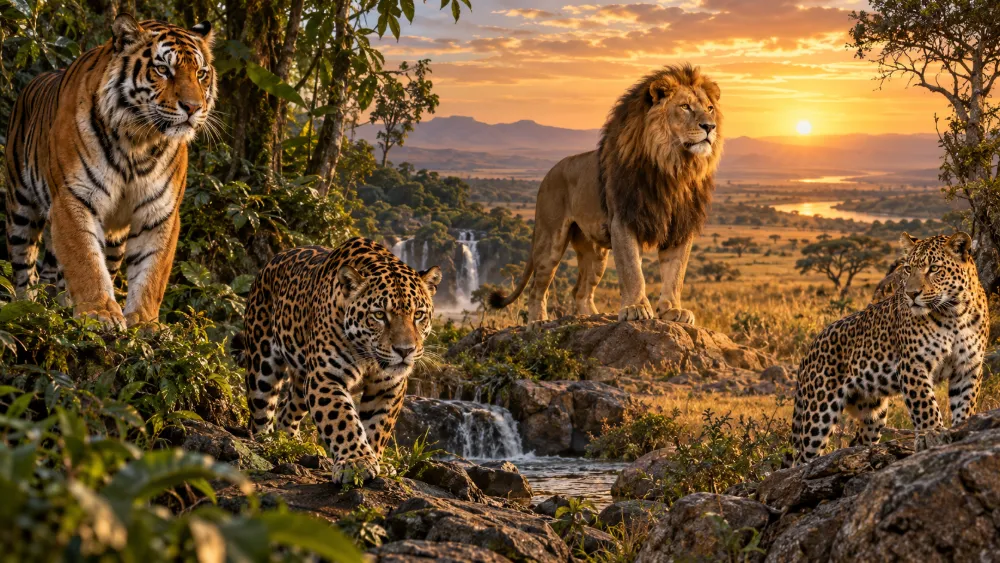
If we mean overall body size and potential raw muscular power, the tiger is the strongest candidate because it is the largest living cat species. If we mean bite strength, the jaguar stands out. Leopards are extraordinary climbers capable of hauling kills into trees, while lions combine individual power with something most other big cats do not have: coordinated group strength.
Quick Answer: What Is the Strongest Big Cat?
There is no single scientific winner because strength can be measured in different ways.
| Type of Strength | Big Cat That Stands Out | Why |
|---|---|---|
| Overall size and raw body power | Tiger | The tiger is the largest living cat species |
| Bite strength | Jaguar | Exceptionally powerful jaws and skull-biting hunting technique |
| Carrying and climbing strength | Leopard | Regularly hauls kills into trees |
| Cooperative power | Lion | Lions can hunt and defend territory socially |
That makes the tiger a reasonable answer if someone asks simply for the most powerful big cat overall—but the jaguar may be the more impressive animal if the question is specifically about jaws.
Tiger: The Best Candidate for Raw Body Strength
The tiger (Panthera tigris) is the largest living member of the cat family.
That matters when discussing strength. Muscle force does not scale perfectly with body weight, but a large adult tiger possesses an enormous frame, heavily developed shoulders, powerful forelimbs and the muscle needed to overpower large prey.
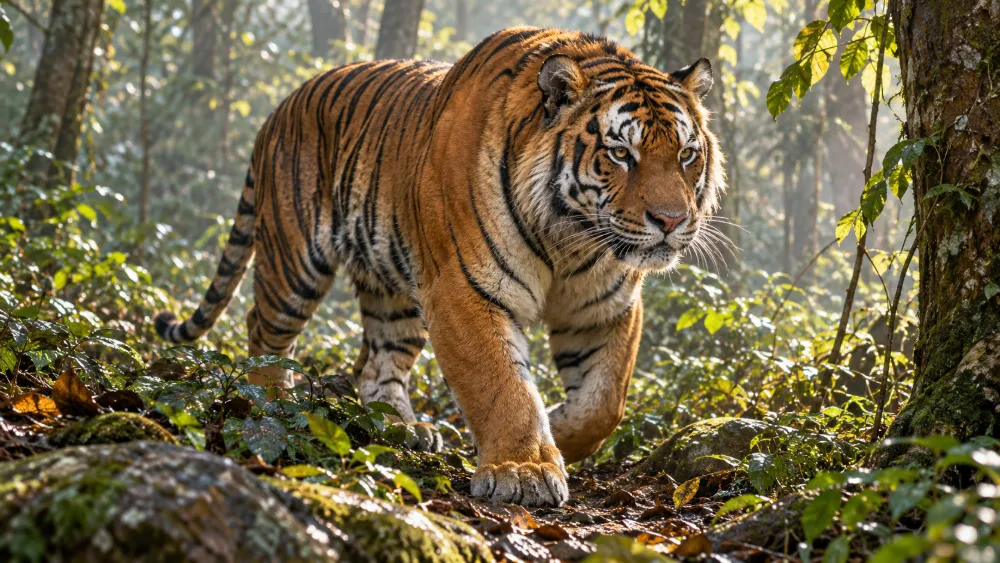
Tigers are usually solitary hunters. Unlike lions, they cannot normally rely on several members of a pride to help restrain prey. A tiger therefore needs enough individual strength to perform the stalk, explosive attack and restraint largely by itself.
The species hunts animals such as deer and wild pigs, and populations living in different parts of Asia vary substantially in body size.
This variation is important. It is misleading to assign one exact weight to “a tiger” because sex, age, region, prey availability and individual condition all matter.
Our largest cats in the world guide looks specifically at body size rather than strength.
Does being the biggest automatically make the tiger the strongest?
Not in every possible sense.
The largest body gives tigers a major advantage in total muscular potential, but strength can also be measured relative to body mass or by the performance of a particular structure such as the jaw.
That is why the jaguar becomes especially important in this discussion.
Jaguar: The Big Cat With an Extraordinary Bite
The jaguar (Panthera onca) is not as large as the biggest tigers, but it has an exceptionally robust body and skull.
Compared with the more slender leopard, a jaguar usually looks compact and heavily built. It has a broad head, substantial jaw musculature and a hunting style that makes unusual use of that strength.
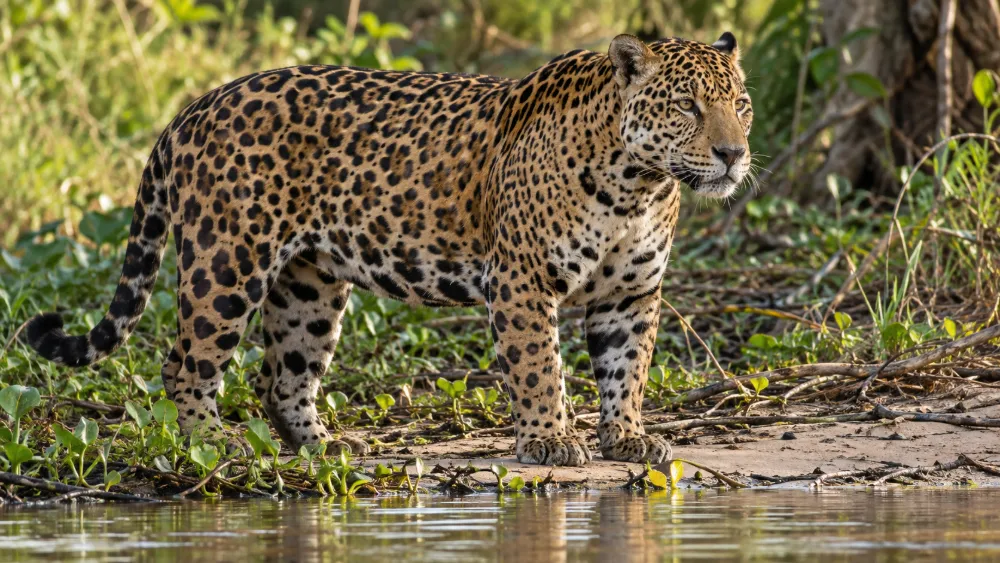
Jaguars are famous for attacking prey with powerful bites to the skull or other hard structures rather than relying exclusively on the throat hold commonly associated with many other large cats.
Their prey can include animals with formidable defenses, including caimans, turtles and armadillos.
National Geographic has described the jaguar as having the strongest bite among the big cats and notes that its bite is particularly impressive relative to its body size.
This does not mean a jaguar is stronger than a tiger in every part of the body. It means that jaw performance is one category in which the jaguar is exceptionally specialized.
If you sometimes confuse these cats with dark “panthers,” see our Panther vs. Jaguar guide.
Leopard: Remarkable Strength for Its Size
Leopards (Panthera pardus) illustrate why body weight alone does not tell the whole story.
A leopard is substantially smaller than a tiger and usually smaller than an adult lion or large jaguar. Yet it combines muscular power with exceptional climbing ability.
One of the leopard's signature behaviors is carrying or dragging kills into trees.
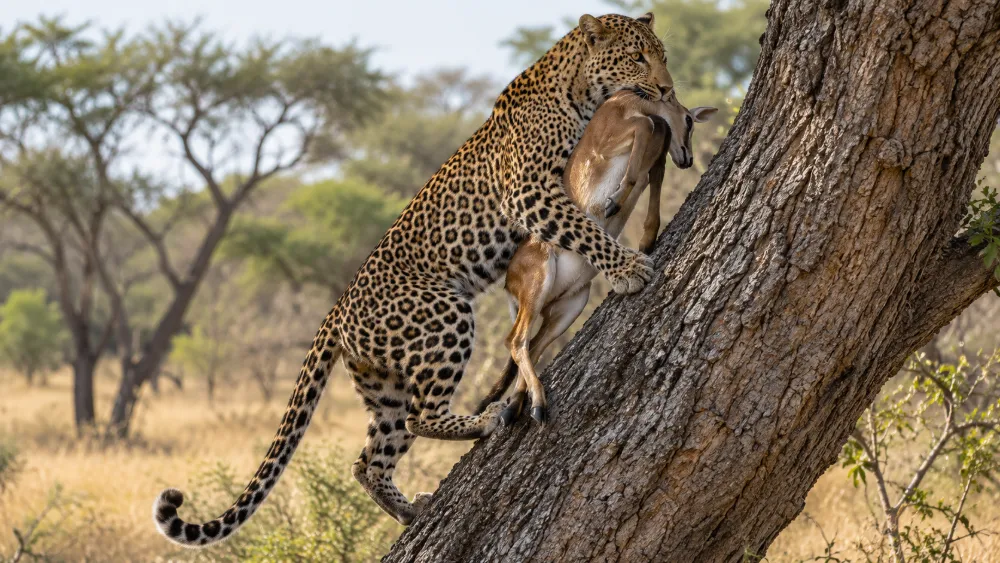
Storing food above the ground can reduce the risk of losing it to scavengers and competing predators. Getting a carcass into a tree requires the leopard to combine its jaws, neck, shoulders, forelimbs, claws and balance while climbing.
National Geographic describes leopards as powerful enough to haul kills into tree branches.
That makes the leopard one of the most impressive big cats when we consider functional strength relative to body size.
However, it would be misleading to turn that observation into a claim that a leopard is scientifically proven to be “pound-for-pound the strongest cat.” There is no standardized global strength competition testing all cat species under identical conditions.
Lion: Strength Amplified by Social Behavior
The lion (Panthera leo) is one of the largest living cats and an extremely powerful predator in its own right.
But lions differ from the other cats discussed here in one fundamental way: they are strongly social.
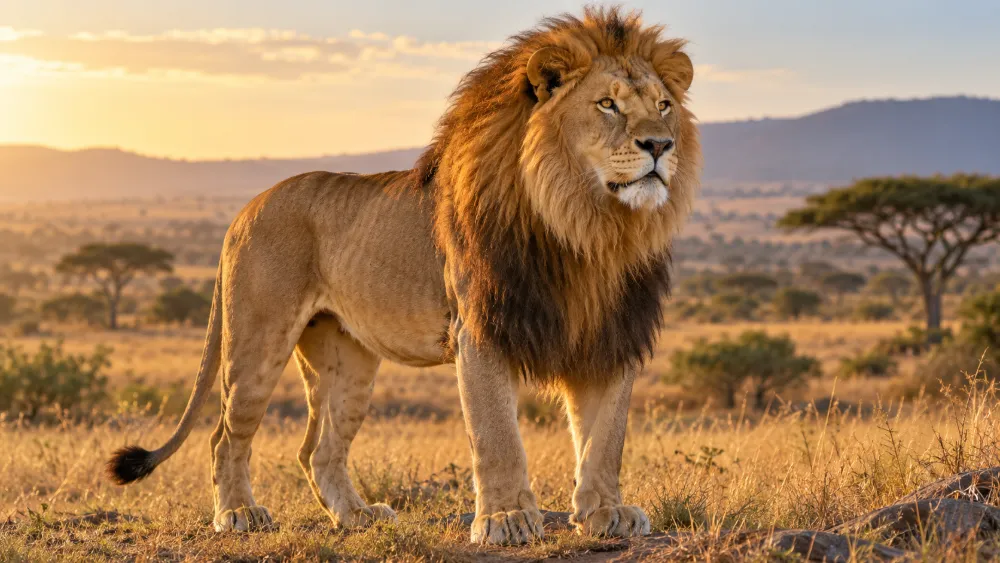
Female lions often cooperate during hunts, while males can play important roles in territorial defense and may also hunt independently.
Cooperation changes what a predator can achieve. A group of lions can surround, distract or restrain prey in ways that a solitary big cat cannot reproduce by muscle alone.
This means lions have two different kinds of power:
the considerable physical strength of an individual large cat;
and the combined strength of coordinated group behavior.
That second form of strength should not be confused with individual muscle power.
For a more detailed comparison of the two animals people most often put against each other, read our Lion vs. Tiger guide.
Is a Tiger Stronger Than a Lion?
If the question means individual raw physical power, a large tiger has a strong argument because tigers are the largest living cat species and are solitary predators with heavily muscled bodies.
But “tiger vs. lion” is not an experiment that biology provides a universal answer to.
Adults vary in:
sex;
age;
body mass;
health;
experience;
population;
and individual condition.
Turning those variables into a fictional fight and declaring that one species would always defeat the other is not a meaningful way to compare animal biology.
A better conclusion is that tigers tend to have the advantage in maximum individual body size, while lions have evolved a very different social strategy.
Is a Jaguar Stronger Than a Tiger?
It depends on what “stronger” means.
A tiger is much larger at the upper end of its size range, giving it greater total body mass and enormous muscular power.
A jaguar's special advantage is its jaw system. Its broad skull and powerful jaw muscles allow it to deliver extremely forceful bites, including bites through difficult structures such as reptile skulls and turtle shells.
So:
overall body size and raw power: tiger has the clearer advantage;
bite performance relative to size: jaguar stands out.
Both statements can be true at the same time.
Which Big Cat Has the Strongest Bite?
The jaguar is the big cat most consistently identified for exceptional bite strength.
Its jaw anatomy is unusually robust, and the species uses that power differently from many other large cats.
Rather than relying only on prolonged strangulation at the throat, jaguars may bite directly through the skull of prey. They can also tackle heavily protected animals such as caimans and turtles.
This is one reason simply comparing canine length does not tell you which animal has the most effective bite. Skull shape, muscle attachment, jaw leverage and hunting behavior all matter.
Which Big Cat Is Strongest Pound for Pound?
This phrase appears frequently online, but it needs caution.
There is no accepted scientific test in which every big cat has been measured performing the same lifting, pulling or pushing task and then ranked by body weight.
The jaguar's bite is exceptionally powerful relative to its size, and the leopard demonstrates extraordinary prey-carrying and climbing performance relative to its body size.
Neither fact creates an official overall “pound-for-pound strongest cat” title.
What About the Cheetah?
Cheetahs are large wild cats, but their bodies represent a very different evolutionary solution.
They are optimized for acceleration and high-speed pursuit rather than maximizing heavy muscular bulk.
A cheetah has a relatively light frame, long limbs and numerous adaptations related to running.
Calling the cheetah “weak” would therefore miss the point. Evolution does not build every predator for the same task.
The tiger, jaguar, leopard and cheetah are all members of the wider feline family, but each specializes in different aspects of predation. Our Types of Felines guide explains these groups in more detail.
Why Bite-Force Numbers Online Can Be Misleading
You may see websites assigning exact PSI values to lions, tigers, jaguars and leopards and then ranking them from strongest to weakest.
Those numbers should be treated carefully.
Bite force can be estimated using several methods, including skull measurements, biomechanical models and measurements from living animals. Results depend on factors such as where on the tooth row the bite is measured, the size of the individual and the assumptions in the model.
Comparing numbers copied from unrelated studies as if all animals were tested with the same method can therefore produce a false sense of precision.
For this reason, the more defensible conclusion is qualitative: the jaguar has an exceptionally powerful bite and unusually robust jaw anatomy, rather than claiming that every adult jaguar produces one exact PSI figure.
So, What Is the Most Powerful Big Cat?
If you need one short answer, the tiger is the strongest candidate for overall raw physical power because it is the largest living cat.
But that answer needs context.
The jaguar is arguably the standout specialist in jaw power. The leopard displays extraordinary climbing and prey-carrying strength for its size. Lions add cooperative hunting and territorial defense to considerable individual strength.
There is therefore no contradiction in saying that different species are strongest at different tasks.
FAQ
What is the strongest big cat in the world?
There is no official scientific overall ranking. The tiger is the strongest candidate for raw body power because it is the largest living cat, while the jaguar stands out for its exceptionally powerful bite.
Which big cat has the strongest bite?
The jaguar is widely recognized for having an exceptionally powerful bite among big cats. Its broad skull and strong jaw muscles allow it to attack hard structures and even bite through the skulls of some prey.
Is the tiger the strongest cat?
If strength means total body size and muscular potential, the tiger is a reasonable answer. It is the largest living cat species. That does not mean it leads every strength category.
Is a jaguar stronger than a lion?
The comparison depends on the measurement. Jaguars have particularly powerful jaws, while adult lions are generally larger and have considerable total body strength. There is no scientifically useful universal “winner” between the species.
Why are leopards considered so strong?
Leopards regularly move kills into trees, requiring substantial jaw, neck, shoulder and climbing strength. Their ability is especially impressive relative to their smaller body size.
Are lions stronger because they hunt in groups?
Group hunting increases what several lions can accomplish together, but cooperative power is different from the muscular strength of one individual lion.
Which is stronger, a tiger or a jaguar?
A tiger has the advantage in total body size and likely overall raw muscular power. A jaguar is more specialized for extreme jaw performance, especially relative to its size.
Final Thoughts
Searching for the “strongest big cat” sounds like a simple question, but biology gives a more interesting answer.
Tigers combine the largest living feline body size with the muscular demands of solitary hunting. Jaguars have extraordinarily powerful jaws. Leopards turn a smaller body into impressive climbing and carrying performance. Lions combine individual strength with social cooperation.
Instead of forcing four very different predators into one artificial strength ranking, it is more accurate to ask what each species has evolved to do exceptionally well.
If the question is simply about overall raw physical power, the tiger is the strongest candidate. If the question is about bite strength, look to the jaguar.