Frogs are amphibians. They belong to the class Amphibia and the order Anura, which includes both frogs and toads.
Reptiles belong to a different evolutionary group that includes animals such as snakes, lizards, turtles and crocodilians.
Frogs and reptiles can seem similar because both are vertebrates and both are ectothermic, meaning their body temperature is strongly influenced by the environment.
But their skin, reproduction, eggs and life cycles are fundamentally different.
Are Frogs Reptiles or Amphibians?
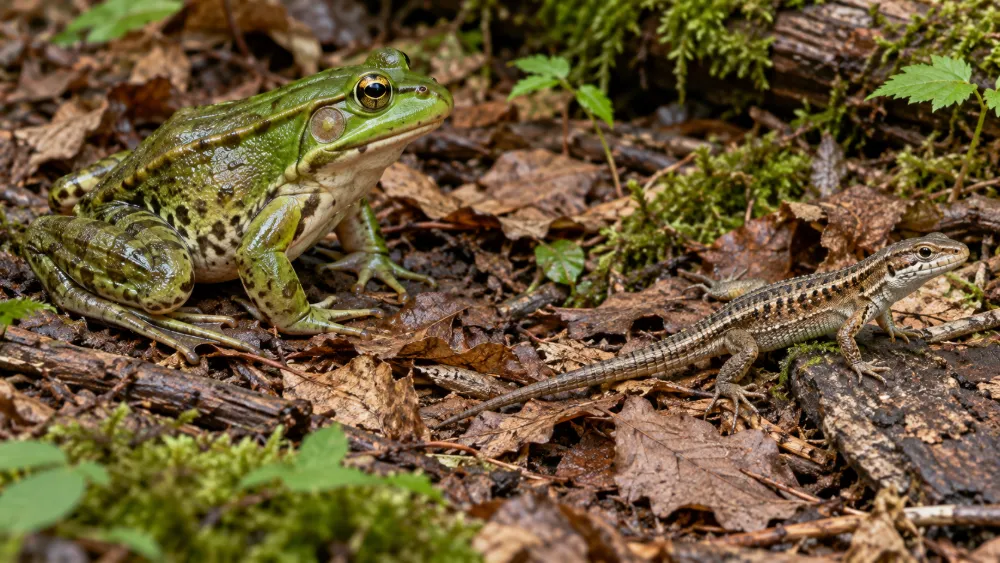
Frogs are amphibians.
Their basic scientific classification is:
| Classification | Frogs |
|---|---|
| Kingdom | Animalia |
| Phylum | Chordata |
| Class | Amphibia |
| Order | Anura |
The order Anura contains the animals commonly called frogs and toads.
What Is the Difference Between an Amphibian and a Reptile?
The easiest differences involve the skin and reproductive system.
| Feature | Frogs / Amphibians | Reptiles |
|---|---|---|
| Skin | Usually moist, thin and permeable | Dry, keratinized and scaled |
| Eggs | Usually soft, jelly-like and without a shell | Amniotic eggs or live birth |
| Fertilization | External in many frogs | Internal |
| Young | Often aquatic tadpoles | Usually resemble miniature adults |
| Metamorphosis | Common | No tadpole-style metamorphosis |
| Respiration | Lungs plus important gas exchange through skin in many species | Primarily lungs |
1. Frogs Have Permeable Skin
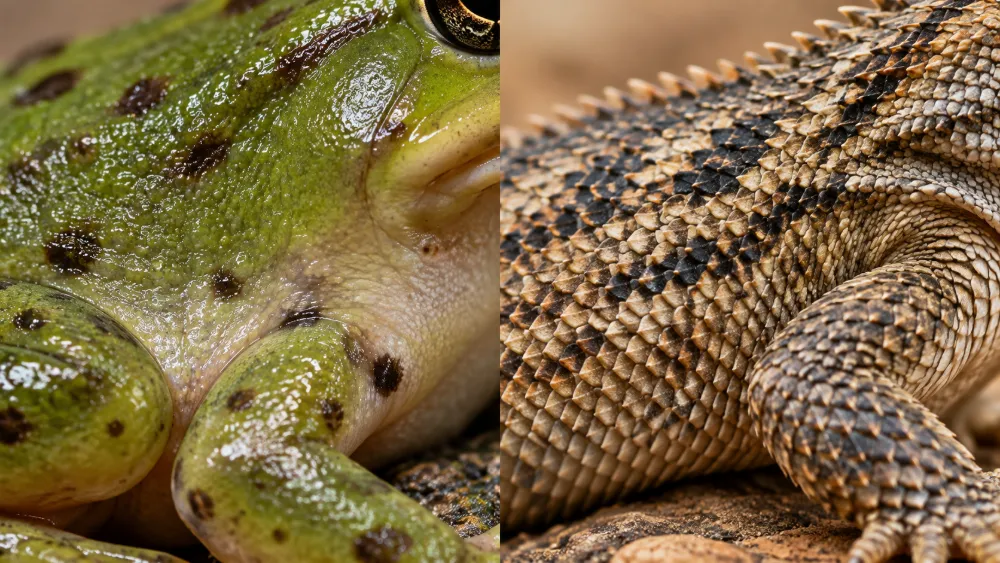
Frog skin is very different from reptile skin.
Most frogs have thin, moist and highly permeable skin.
This skin is biologically important because frogs can use it to:
absorb water;
exchange gases;
exchange ions;
and produce protective secretions.
Many frogs do not need to drink water through the mouth in the way mammals do.
Instead, water can be absorbed directly through specialized areas of skin.
This permeability is also one reason frogs are sensitive to environmental pollution and diseases that attack the skin.
Smithsonian notes that frog skin is much more permeable to the environment than human skin and is essential for normal water and ion balance.
2. Reptiles Have Dry Scales
Reptiles have much more heavily keratinized skin.
Snakes and lizards are covered with scales that:
protect the body;
reduce water loss;
resist physical damage;
and allow reptiles to live in much drier environments.
This difference is one of the quickest ways to separate a typical frog from a reptile.
Do Frogs Have Scales?
Typical frogs do not have the dry overlapping scales characteristic of reptiles.
Their exposed skin contains glands and remains biologically active in water balance and respiration.
This is a major reason frogs are classified as amphibians rather than reptiles.
3. Frog Eggs Usually Need Moisture
Most frog eggs do not have a hard or leathery shell.
Instead, they are surrounded by gelatinous material that helps protect the developing embryo.
Many species therefore lay their eggs:
in ponds;
streams;
temporary pools;
wet vegetation;
or other moist environments.
Some frogs have evolved remarkable exceptions and lay eggs on leaves, in foam nests or in moist terrestrial sites.
But even these eggs lack the classic amniotic egg that allowed reptiles to reproduce much more independently of open water.
4. Reptile Eggs Are Amniotic
Reptiles are amniotes.
An amniotic egg contains specialized membranes that support the developing embryo.
In egg-laying reptiles, the embryo is usually enclosed within a leathery or calcified shell that helps protect it from drying out.
This evolutionary development was extremely important because reproduction no longer had to depend on laying shell-less eggs directly in water.
Some reptiles give birth to live young instead of laying eggs, but they are still part of the amniote lineage.
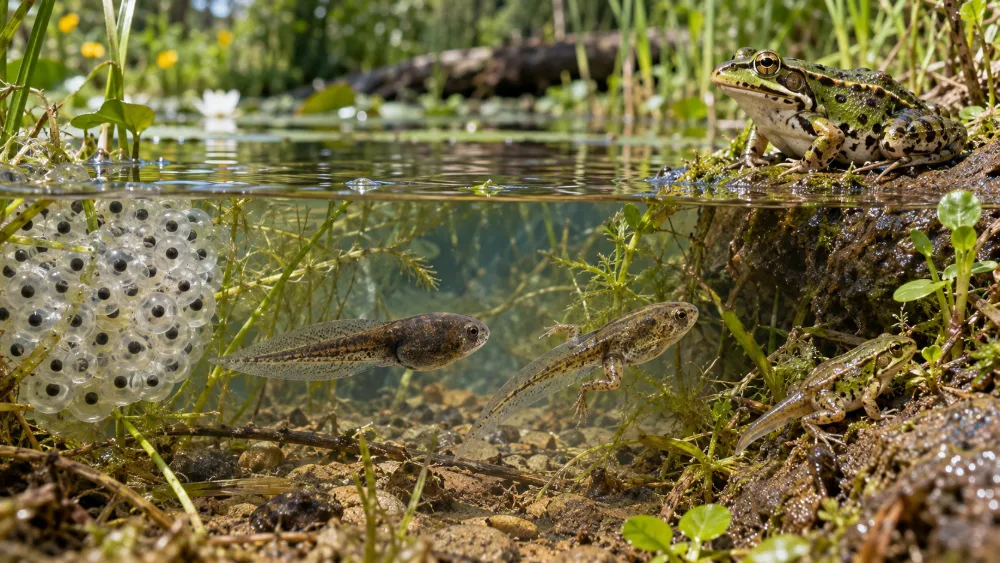
5. Frogs Commonly Begin Life as Tadpoles
One of the most familiar amphibian traits is metamorphosis.
A typical frog life cycle is:
Egg
Tadpole
Tadpole with legs
Froglet
Adult frog
The tadpole may look dramatically different from the adult.
Many tadpoles are:
fully aquatic;
equipped with gills;
tailed;
and adapted to feeding in water.
During metamorphosis, the body is reorganized into the adult frog form.
Do All Frogs Have Tadpoles?
No.
The tadpole-to-frog life cycle is widespread, but frogs are remarkably diverse.
Some species show direct development, meaning the embryo develops inside the egg and emerges as a tiny frog rather than as a free-swimming tadpole.
Other species have evolved unusual reproductive strategies involving:
eggs carried on the body;
tadpoles carried by parents;
foam nests;
tree holes;
and terrestrial development.
These exceptions do not make them reptiles.
6. Reptile Babies Usually Resemble Small Adults
A hatchling lizard, snake, turtle or crocodilian already has the general anatomy of an adult member of its species.
It grows and matures but does not transform through a tadpole stage.
This is another major difference between the typical amphibian and reptile life cycles.
Are Frogs Cold-Blooded?
Yes, in everyday terminology.
The more precise scientific term is ectothermic.
Frogs rely heavily on environmental heat to regulate body temperature.
Reptiles are also ectothermic.
This shared trait is one reason people sometimes assume frogs are reptiles.
But being ectothermic does not define a reptile.
Fish and many invertebrates are ectothermic too.
Do Frogs Breathe Through Their Skin?
Yes.
Many adult frogs use both lungs and their skin for respiration.
Gas exchange through the skin is called cutaneous respiration.
For this process to work efficiently, the skin must stay moist.
This helps explain why amphibian skin differs so dramatically from the thick, water-resistant skin of reptiles.
Can Frogs Breathe Underwater?
Many frogs can absorb some oxygen through the skin while underwater.
How important this is depends on:
species;
water temperature;
oxygen concentration;
activity level;
and life stage.
Tadpoles often rely heavily on gills, while adult frogs generally use lungs plus skin.
Are Toads Reptiles?
No.
Toads are amphibians too.
In biological classification, animals commonly called toads are part of the frog order Anura.
In other words:
all true toads are frogs in the broad scientific sense, and both are amphibians.
Frog vs. Toad
The words frog and toad describe general body types more than two perfectly separate evolutionary groups.
Typical toads tend to have:
drier-looking, bumpier skin;
shorter legs;
and more terrestrial habits.
But their skin is still amphibian skin, not reptilian scales.
Are Salamanders Reptiles?
No.
Salamanders are amphibians.
They belong to another major amphibian order, Caudata or Urodela.
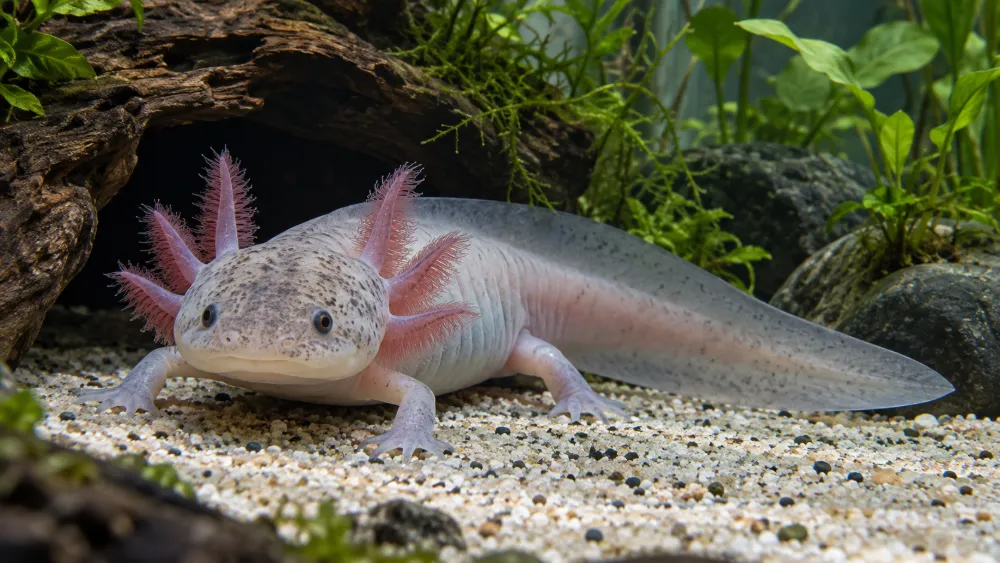
Axolotls are salamanders and are therefore amphibians too.
Are Newts Reptiles?
No.
Newts are a type of salamander and therefore belong to Amphibia.
They may look superficially lizard-like because they have:
four legs;
a long body;
and a tail.
But their skin and reproductive biology identify them as amphibians.
Are Caecilians Reptiles?
No.
Caecilians are limbless amphibians.
They can look superficially like:
worms;
snakes;
or eels.
But they belong to their own amphibian order and are more closely related to frogs and salamanders than to snakes.
Why Are Frogs and Reptiles Often Grouped Together?
The scientific field that studies amphibians and reptiles is called herpetology.
That historical grouping can make people assume the two are one biological group.
They are not.
Herpetologists study both because the animals share some broad ecological and physiological characteristics, including:
ectothermy;
similar field-survey methods;
many overlapping habitats;
and a long history of being studied together.
Smithsonian even maintains a combined Division of Amphibians and Reptiles while treating them as distinct taxonomic groups.
Are Frogs Related to Reptiles?
Yes, but only in a broad evolutionary sense.
Both are vertebrate tetrapods descended from ancient four-limbed ancestors.
However, the amphibian lineage and the lineage leading to reptiles, birds and mammals separated hundreds of millions of years ago.
A frog is therefore much more appropriately classified with other amphibians than with snakes or lizards.
Why Do Frogs Need Water More Than Reptiles?
Their permeable skin is the main reason.
Frogs can lose water rapidly through the body surface.
Many also depend on moist environments for reproduction.
Reptile scales greatly reduce evaporation, while their amniotic reproductive system makes them less dependent on standing water for breeding.
This does not mean every frog lives in water or every reptile lives in a desert.
Both groups contain species adapted to many habitats.
Can Frogs Live in Deserts?
Yes.
Some amphibians survive in surprisingly dry environments by:
burrowing underground;
becoming dormant during drought;
emerging after heavy rain;
and reproducing quickly in temporary pools.
The African bullfrog, for example, can spend long dry periods underground in aestivation.
But even desert frogs still have amphibian skin and reproductive biology.
FAQ
Are frogs reptiles?
No. Frogs are amphibians in the class Amphibia and order Anura.
Are frogs amphibians?
Yes. All frogs and toads belong to the amphibian order Anura.
Why aren't frogs reptiles?
Frogs have amphibian traits including permeable skin, shell-less eggs in most species and commonly a tadpole stage with metamorphosis. Reptiles have keratinized scales and belong to the amniote lineage.
Are toads reptiles?
No. Toads are amphibians and belong to the same order, Anura, as other frogs.
Are frogs cold-blooded?
Yes. Frogs are ectothermic, meaning environmental conditions strongly influence their body temperature.
Are reptiles cold-blooded too?
Yes. Reptiles are also ectothermic, but this shared trait does not make frogs reptiles.
Do frogs have scales?
Typical frogs do not have the dry keratinized scales characteristic of reptiles. Their skin is moist, glandular and permeable.
Do frogs breathe through their skin?
Yes. Many frogs exchange oxygen and carbon dioxide through their moist skin in addition to using lungs.
Do all frogs start as tadpoles?
No. Most familiar species do, but some frogs use direct development and hatch as miniature froglets.
Are salamanders reptiles?
No. Salamanders, including axolotls and newts, are amphibians.
Final Answer
Frogs are amphibians, not reptiles.
They belong to the class Amphibia and the order Anura.
Although frogs and reptiles are both ectothermic vertebrates, frogs have thin permeable skin, usually reproduce with shell-less eggs and commonly undergo a major metamorphosis from aquatic tadpole to adult.
Reptiles instead have keratinized scales and belong to the amniote lineage, allowing reproduction to be much less dependent on open water.
So the easiest rule is:
frog or toad = amphibian; snake, lizard, turtle or crocodilian = reptile.
Related Reading
Sources Used for Fact Checking
Smithsonian's National Zoo — Frog Taxonomy and Biology
Smithsonian National Museum of Natural History — Amphibians & Reptiles
Smithsonian's National Zoo — Amphibian Skin and Metamorphosis