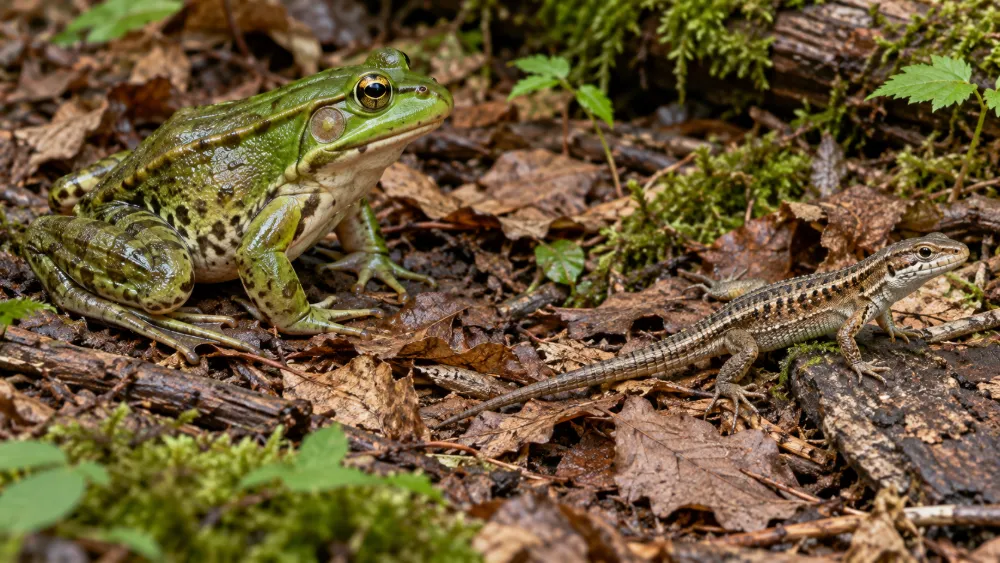
Most frogs reproduce sexually, but frog reproduction is far more diverse than simply laying eggs in a pond.
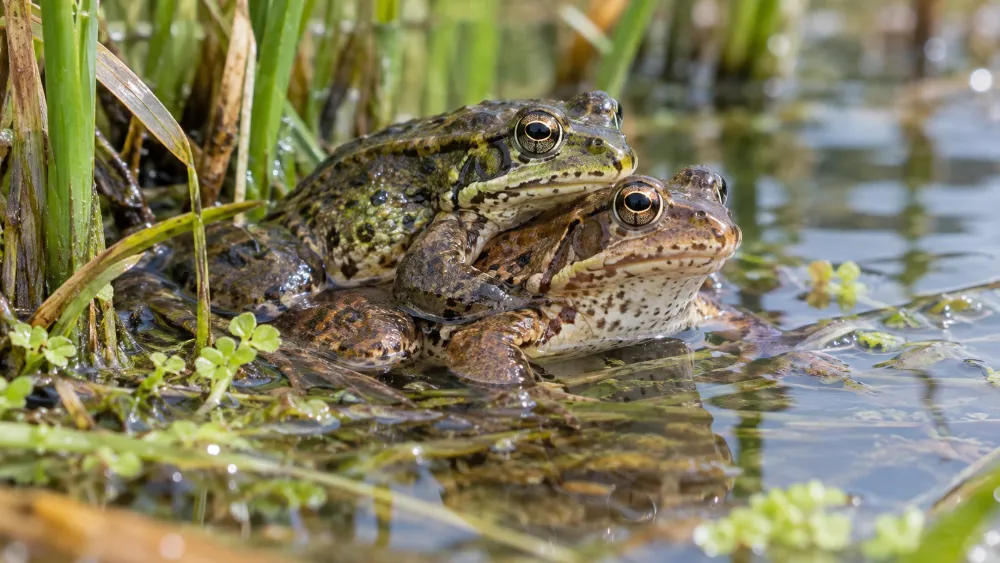
In a typical frog mating, a male clasps a female in a position called amplexus. As the female releases her eggs, the male releases sperm over them, producing external fertilization.
The embryos develop inside jelly-coated eggs, hatch as tadpoles and eventually transform through metamorphosis into froglets and then adult frogs.
However, thousands of frog species have evolved different strategies. Some lay eggs on leaves, underground or in foam nests. Some parents guard eggs or carry tadpoles, and some species skip the free-swimming tadpole stage entirely.
How Do Frogs Reproduce?
The typical frog reproductive cycle follows these steps:
A male attracts a female, often by calling.
The male clasps the female in amplexus.
The female releases eggs.
The male usually fertilizes the eggs externally.
Embryos develop inside the eggs.
Tadpoles hatch.
Tadpoles grow and undergo metamorphosis.
Young froglets develop into adults.
This is the familiar pattern, but individual frog species can differ dramatically in almost every step.
How Do Frogs Mate?
For many frogs, mating begins with sound.
Male frogs produce species-specific advertisement calls that help females locate potential mates.
The call can also communicate with rival males.
Breeding activity is often influenced by environmental conditions such as:
rainfall;
temperature;
humidity;
season;
and availability of suitable water.
In many temperate species, males gather around ponds or wetlands during a particular breeding season.
In tropical species, reproduction may be more closely associated with seasonal rainfall or may occur through much of the year when conditions remain favorable.
What Is Amplexus?
Amplexus is the characteristic mating embrace used by many frogs.
The male usually positions himself on the female's back and holds her with his forelimbs.
This keeps the male close to the eggs as the female releases them.
In many familiar frogs, the male grips the female around the area behind her front legs.
Other species use different amplexus positions.
For example, African clawed frogs use a form in which the male clasps the female farther back around the pelvic region.
Do Frogs Have Sex?
Frogs reproduce sexually, meaning offspring receive genetic material from both a male and a female.
However, mating usually does not involve the same type of internal copulation seen in mammals.
In most frogs, amplexus positions the pair so that eggs and sperm are released at approximately the same time.
Fertilization then occurs outside the female's body.
Is Frog Fertilization Internal or External?
Most frogs use external fertilization.
The female releases eggs and the male releases sperm onto or around them.
This commonly occurs:
in water;
on wet vegetation;
on damp leaves;
or in another moist nesting site.
External fertilization is not universal, however.
Frog reproductive biology is extremely diverse, and some lineages have evolved internal fertilization, direct development or forms of live-bearing reproduction.
Therefore, it is more accurate to say most frogs fertilize their eggs externally rather than all frogs do.
Do Frogs Lay Eggs?
Most frog species do lay eggs.
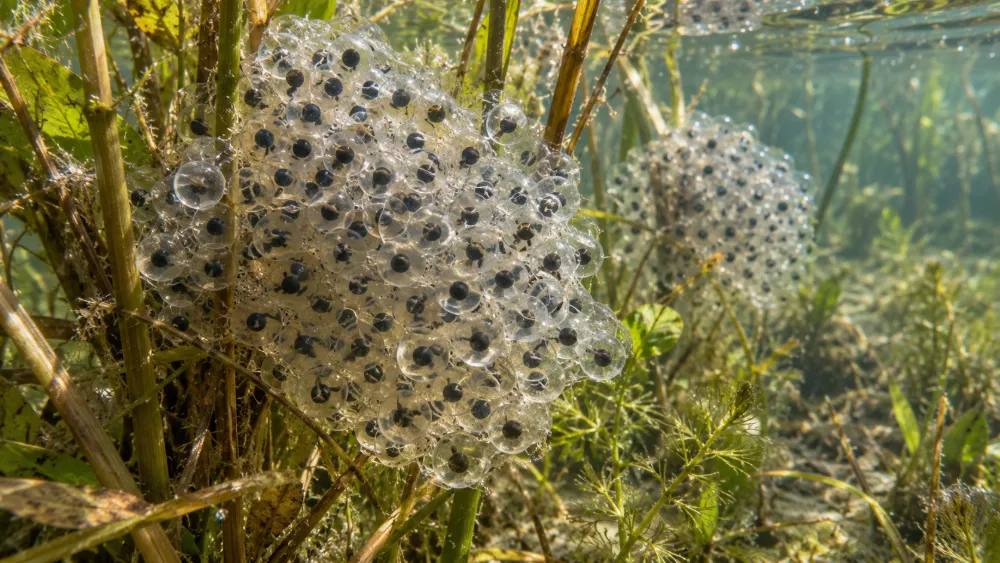
Typical frog eggs differ from bird or reptile eggs because they do not have a hard shell.
Instead, the developing embryo is usually surrounded by layers of jelly.
This gelatinous coating helps:
retain moisture;
protect the embryo;
attach eggs to vegetation in some species;
and provide a physical barrier around the developing embryo.
Because the eggs can dry out easily, most require water or a consistently moist environment.
What Do Frog Eggs Look Like?
Depending on the species, frog eggs may appear as:
large floating masses;
small clusters;
individual jelly-covered eggs;
strings;
or eggs attached to leaves or vegetation.
The embryo often appears as a dark spot inside a clear gelatinous sphere.
As development continues, the embryo elongates and begins to resemble a tiny tadpole.
Where Do Frogs Lay Eggs?
Many frogs lay eggs directly in freshwater.
Common sites include:
ponds;
temporary pools;
streams;
marshes;
ditches;
and shallow wetland vegetation.
But frogs have evolved many alternatives.
Some lay eggs:
on leaves above water;
in damp leaf litter;
inside tree holes;
in bromeliads;
under rocks or bark;
in foam nests;
or underground.
Can Frogs Lay Eggs Outside Water?
Yes.
This is one of the most important exceptions to the familiar pond-frog life cycle.
Lemur leaf frogs, for example, attach egg clutches to leaves overhanging water.
The embryos develop on the leaf, and after hatching the larvae fall into the water below.
Other species deposit eggs in wet leaf litter or humid terrestrial sites.
The key requirement is usually preventing the unprotected amphibian eggs from drying out.
How Many Eggs Do Frogs Lay?
There is no single number.
The number varies enormously among species.
Some frogs produce only a few relatively large eggs and invest substantial parental care in each offspring.
Others release hundreds or thousands of eggs.
For example, a female gray tree frog may deposit roughly 1,000 to 2,000 eggs during breeding.
By contrast, some poison frogs produce clutches containing only a few eggs.
This difference reflects different reproductive strategies rather than one species being more successful than another.
Why Do Some Frogs Lay Thousands of Eggs?
Eggs and tadpoles face heavy mortality from:
fish;
aquatic insects;
other amphibians;
birds;
drying ponds;
disease;
and changing environmental conditions.
Species that provide little parental care may compensate by producing large numbers of offspring.
Other frogs follow the opposite strategy: fewer eggs but greater parental investment.
How Long Do Frog Eggs Take to Hatch?
Hatching time depends on:
species;
temperature;
egg size;
water conditions;
and developmental strategy.
Some aquatic frog eggs can hatch within several days.
Gray tree frog tadpoles, for example, may hatch after approximately three to seven days depending on temperature.
Other frogs may spend considerably longer developing inside the egg.
What Happens After Frog Eggs Hatch?
In the familiar aquatic life cycle, a tadpole emerges.
A newly hatched tadpole is adapted primarily for life in water.
It typically has:
a long tail;
no functional adult-style legs initially;
aquatic respiratory structures;
and a feeding system different from that of the adult frog.
The tadpole then grows before undergoing one of the most dramatic transformations in vertebrate development.
How Does a Tadpole Turn Into a Frog?
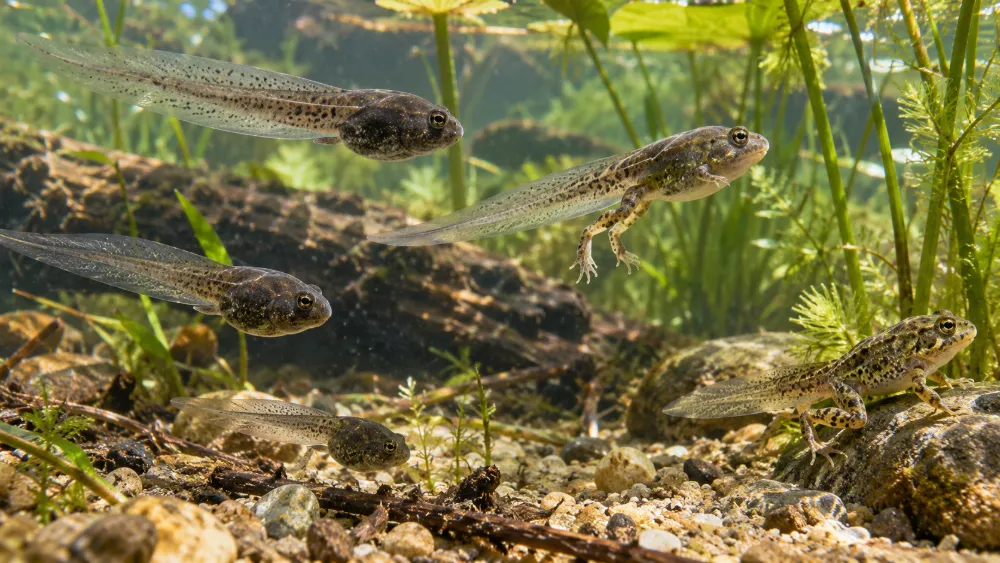
The transformation is called metamorphosis.
During metamorphosis:
hind legs develop;
front legs emerge;
lungs become increasingly important;
the digestive system changes;
the skull and mouth are remodeled;
and the tail is gradually resorbed.
The result is a young frog called a froglet.
Metamorphosis timing varies dramatically among species and environments.
Do All Frogs Have Tadpoles?
No.
Some frogs use direct development.
In these species, much of the development normally associated with a free-swimming tadpole happens inside the egg.
The young hatch as miniature froglets rather than aquatic tadpoles.
This allows some frog species to reproduce away from permanent ponds.
Do Parent Frogs Care for Their Babies?
Many familiar pond frogs provide little or no care after eggs are laid.
But parental care has evolved repeatedly among frogs.
Depending on the species, parents may:
guard eggs;
keep eggs moist;
transport tadpoles;
defend breeding sites;
or feed developing tadpoles.
This diversity makes frogs one of the most interesting vertebrate groups for studying reproductive behavior.
Do Frogs Carry Their Babies?
Some do.
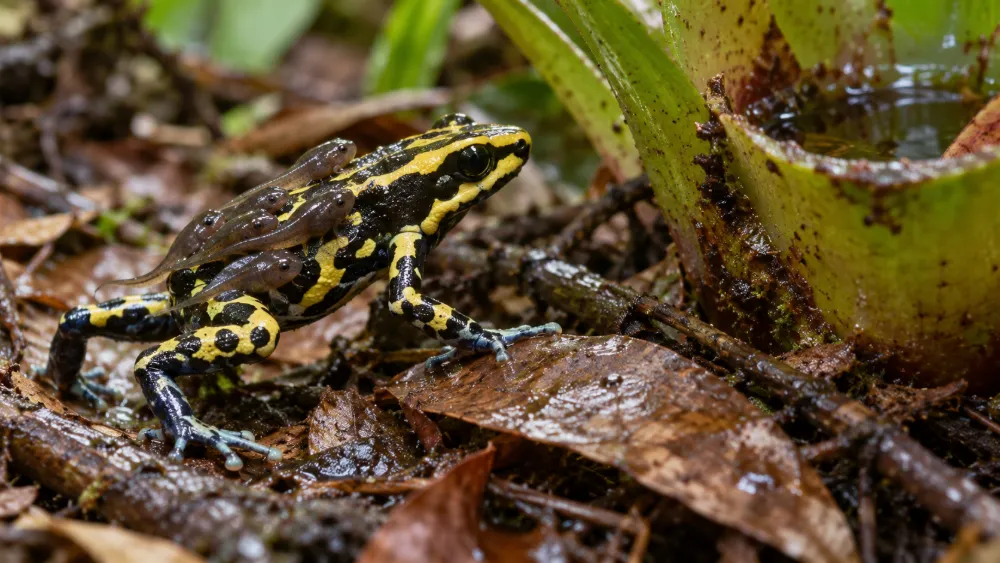
Poison frogs provide some of the best examples.
After the eggs hatch, an adult can allow tadpoles to climb onto its back and carry them to suitable water.
The destination may be:
a small stream;
a puddle;
a tree cavity;
or water held inside a bromeliad plant.
In some species, each tadpole is placed in a separate miniature water pool.
Do Mother Frogs Feed Tadpoles?
Some species do.
Certain poison frog females repeatedly visit tadpoles and deposit unfertilized eggs for them to eat.
Smithsonian describes species in which tadpoles depend heavily on these maternal food eggs during development.
This is very different from species that simply release thousands of eggs and provide no further parental care.
Do Male Frogs Care for Eggs?
In some species, yes.
Male parental care can include:
guarding egg clutches;
keeping them hydrated;
defending the breeding site;
or transporting tadpoles after hatching.
In other species, females provide most of the care, while some species use both parents.
Why Do Male Frogs Call?
The familiar croaking heard around wetlands is strongly connected to reproduction.
Male advertisement calls can communicate:
species identity;
location;
availability for mating;
and sometimes information related to body size or competitive ability.
Females can use these calls when selecting and locating males.
Different frog species have distinctive calls, which helps reduce mating between unrelated species sharing the same wetland.
Why Do Frogs Breed After Rain?
Rain can create ideal breeding conditions.
Heavy rainfall may:
fill temporary ponds;
increase humidity;
reduce the risk that eggs dry out;
create aquatic habitat for tadpoles;
and stimulate seasonal breeding behavior.
Some frogs remain hidden for long dry periods and emerge rapidly when heavy rain arrives.
Do Frogs Reproduce Asexually?
The normal reproductive system of frogs is sexual reproduction involving eggs and sperm.
Asexual reproduction is not the standard frog life cycle.
Some unusual genetic or developmental phenomena can occur in amphibians, but they should not be confused with the ordinary reproductive biology of frogs.
Can Two Female Frogs Reproduce?
Under normal natural reproduction, offspring require fertilization involving male and female gametes.
Two female frogs do not ordinarily produce fertilized offspring together.
Sex determination itself can be complex and differs among frog species, but that is separate from the basic requirement for fertilization.
At What Age Do Frogs Reproduce?
There is no universal age.
Small, rapidly developing species may mature relatively quickly.
Larger or slower-growing frogs can require several years.
Sexual maturity depends on:
species;
body size;
growth rate;
climate;
food availability;
and environmental conditions.
Do Toads Reproduce the Same Way?
Broadly, yes.
Toads are frogs in the biological sense and belong to the order Anura.
Many toads use amplexus and external fertilization like other frogs.
One familiar difference is that many true toads lay eggs in long gelatinous strings rather than the rounded egg masses associated with many pond frogs.
However, reproductive details vary among toad species as well.
FAQ
How do frogs reproduce?
Most frogs reproduce sexually. A male clasps a female in amplexus while she releases eggs, and the male usually fertilizes those eggs externally.
How do frogs mate?
Many frogs mate through amplexus, in which the male grips the female while eggs and sperm are released in close coordination.
Do frogs have internal or external fertilization?
Most frogs use external fertilization, although some unusual frog lineages have evolved other reproductive strategies.
Do frogs lay eggs?
Most frogs lay jelly-coated eggs, usually in water or another moist environment.
How many eggs does a frog lay?
It depends heavily on species. Some frogs lay only a few eggs, while others may produce hundreds or thousands.
Do all frog eggs hatch into tadpoles?
No. Many do, but direct-developing frogs remain inside the egg through the tadpole-like developmental stages and hatch as small froglets.
How long do frog eggs take to hatch?
Hatching time varies by species and temperature. Some aquatic species hatch within several days, while others require considerably longer.
Do frogs take care of their babies?
Some do. Frog parental care ranges from no care at all to guarding eggs, carrying tadpoles and feeding young with unfertilized eggs.
Why do frogs croak before mating?
Male advertisement calls help attract females and communicate with other males during breeding.
Why do frogs reproduce after rain?
Rain increases moisture and often creates temporary aquatic habitats that are suitable for eggs and tadpoles.
Final Answer
Most frogs reproduce when a male clasps a female in amplexus and fertilizes her eggs externally as she releases them.
The eggs commonly develop into aquatic tadpoles, which later undergo metamorphosis and become froglets.
But that familiar pond life cycle is only one version of frog reproduction.
Some frogs lay eggs on leaves or forest floors, some skip the free-swimming tadpole stage, and others guard eggs, carry tadpoles on their backs or even return to feed their offspring.
The best summary is therefore:
amplexus + eggs + external fertilization + tadpoles is the typical frog pattern, but frogs have evolved an extraordinary range of exceptions.
Related Reading
Sources Used for Fact Checking
Smithsonian's National Zoo — Gray Tree Frog
Smithsonian's National Zoo — Poison Frogs
Smithsonian's National Zoo — African Clawed Frog
Smithsonian's National Zoo — Lemur Leaf Frog