An albino snake is not a particular species.
Albinism and related pigment conditions can occur in many different snakes, from corn snakes and ball pythons to Burmese pythons and other species.
These snakes often look dramatically different from normally colored individuals because they produce little or no dark melanin pigment.
But one of the biggest misconceptions is that every albino snake must be completely white.
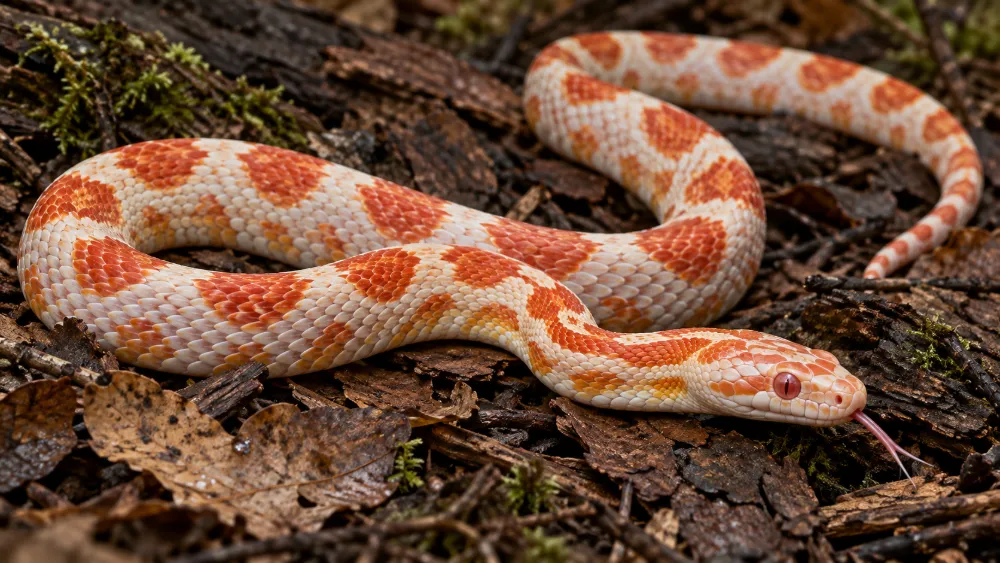
In reptiles, loss of melanin can leave other pigments intact, which is why many snakes sold or described as albino are actually combinations of white, cream, yellow, orange and red.
What Is an Albino Snake?
An albino snake is a snake with a genetic change that reduces or prevents the normal production of melanin.
Melanin is responsible for much of the black and brown pigmentation seen in snake skin and eyes.
When melanin production is severely reduced, the snake may lose most or all of its normal dark coloration.
Depending on the species and the specific mutation, an albino or amelanistic snake may appear:
white;
cream;
yellow;
orange;
red;
or a combination of these colors.
This happens because reptile coloration does not depend on only one pigment.
Why Aren't All Albino Snakes White?
Snake skin coloration is produced by several types of pigment and structural cells.
These include cells associated with:
dark melanin;
yellow pigments;
red pigments;
and reflective structural coloration.
If a mutation mainly disrupts melanin, yellow and red pigments can remain visible.
This is why an albino corn snake can still have brilliant orange or red markings even though the normal black borders have disappeared.
Albino vs. Amelanistic Snake
The terminology can become confusing.
In the reptile hobby, the word albino is often used for snakes that lack or severely reduce melanin.
Biologists may use the more specific term amelanism when the main defect involves loss of melanin rather than loss of every pigment type.
A scientific review of unusual coloration in wild snakes notes that terms such as albinism, amelanism, hypomelanism and leucism have often been used inconsistently.
For practical identification:
amelanistic usually means black or brown melanin is absent or strongly reduced;
albino is commonly used for severe melanin-deficient morphs;
hypomelanistic means melanin is reduced rather than completely absent.
Albino Snake vs. Leucistic Snake
Albino and leucistic snakes are often confused because both can look pale or white.
| Feature | Albino / Amelanistic | Leucistic |
|---|---|---|
| Main change | Loss or strong reduction of melanin production | Reduction or absence of pigment cells in much of the body |
| Body color | Often white, yellow, orange or red | Often white or nearly white |
| Pattern | Original pattern may remain in non-black colors | Pattern often greatly reduced or absent |
| Eyes | Often pinkish or reddish | May remain dark or blue |
A blue-eyed leucistic ball python is an excellent example.
It may have an almost entirely white body but vivid blue eyes.
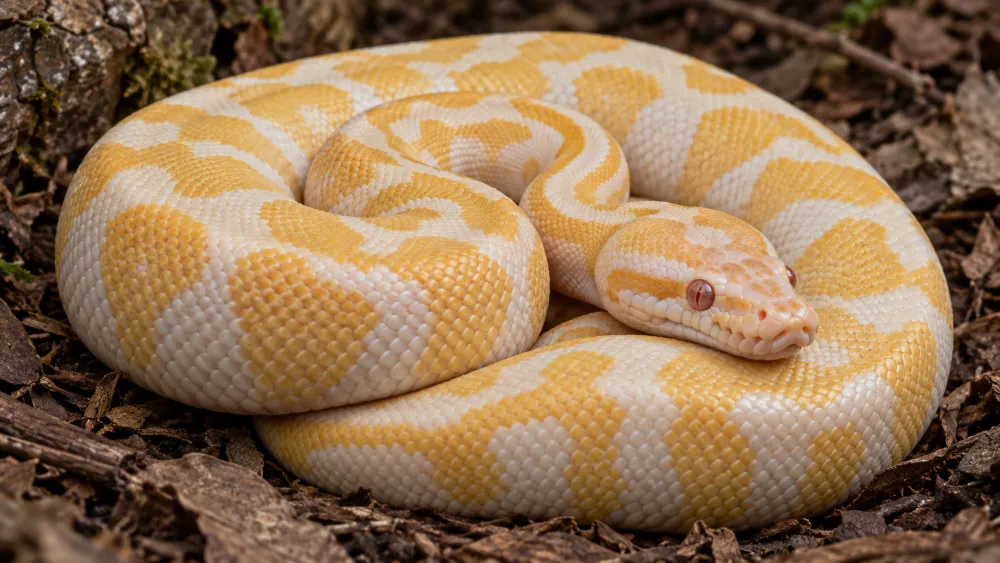
That is a different pigmentation phenotype from the yellow-and-white appearance of a typical albino ball python.
Do Albino Snakes Have Red Eyes?
Many do.
When there is very little melanin in the eye, blood vessels and underlying tissues can contribute to a reddish or pink appearance.
However, eye appearance varies with:
species;
specific mutation;
degree of melanin reduction;
and lighting conditions.
Therefore, a red eye is a useful clue but should not be treated as the only definition of an albino snake.
What Causes Albino Snakes?
Albino coloration is genetic.
Different mutations can disrupt different stages of pigment production.
One important gene is TYR, which encodes tyrosinase, an enzyme required for melanin synthesis.
Other pigmentation genes include:
OCA2;
TYRP1;
SLC24A5;
and several additional genes involved in pigment-cell development and melanosomes.
This means two snakes that both look “albino” do not necessarily have exactly the same genetic mutation.
Albino Ball Python Genetics
Scientific name: Python regius
Ball pythons provide one of the best-studied examples of reptile color-morph genetics.
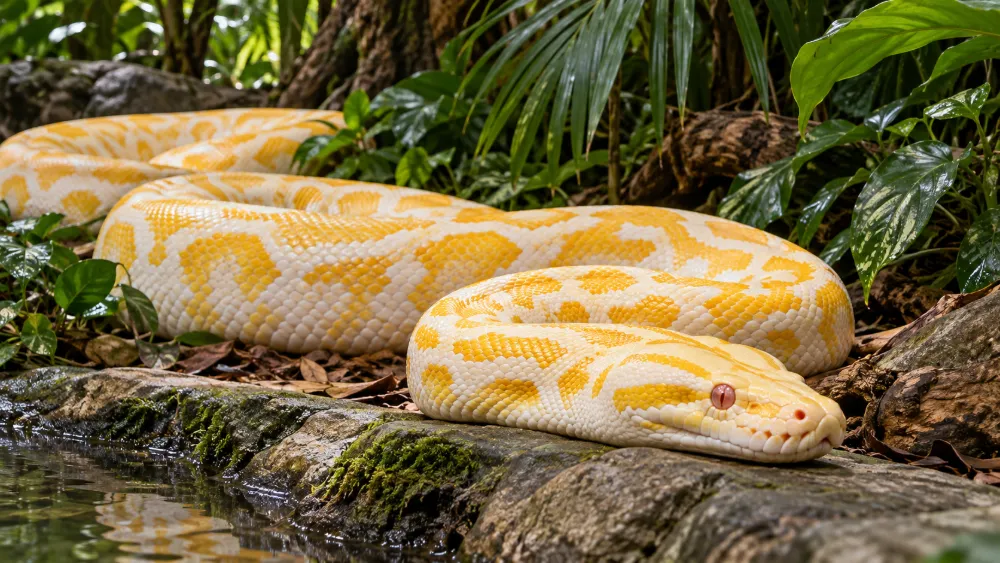
A genetic study of captive ball pythons found that:
the classic Albino morph was associated with variants in TYR;
Lavender Albino was associated with a deletion affecting OCA2;
and Ultramel was associated with variation involving TYRP1.
All three affect melanin, but to different degrees.
This demonstrates why “albino” is not a single universal mutation shared by every pale snake.
Albino Corn Snake
Scientific name: Pantherophis guttatus
Albino—or more precisely amelanistic—corn snakes are another classic example.
Instead of the black-bordered reddish saddles seen in wild-type corn snakes, amelanistic animals commonly show:
orange;
red;
cream;
and white coloration.
Researchers identified an insertion of a retrotransposon in the OCA2 gene associated with corn snake amelanism.
The mutation disrupts melanin while leaving the basic body pattern and non-melanin colors visible.
Albino Burmese Python
Scientific name: Python bivittatus
Albino Burmese pythons are among the most visually striking large albino snakes.
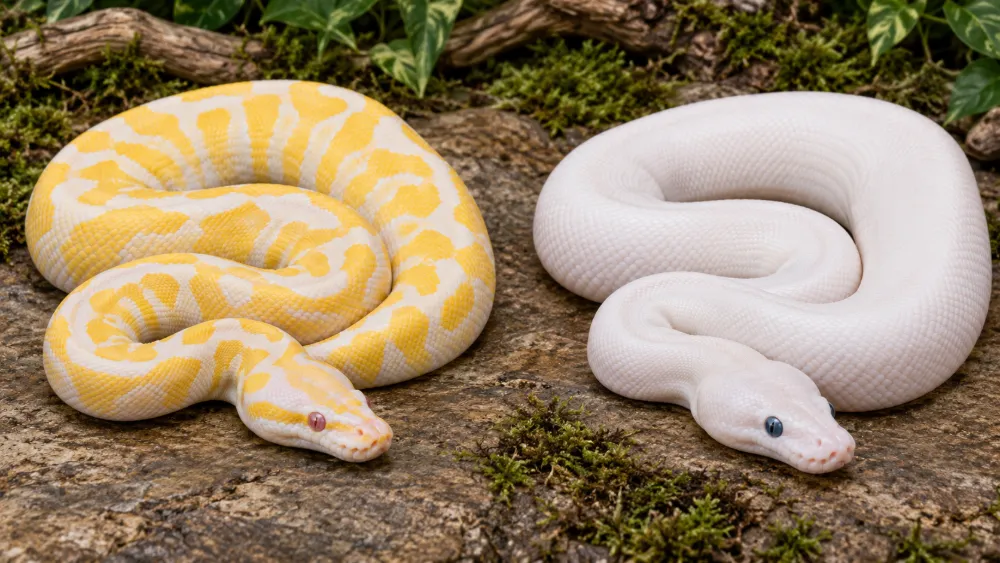
Instead of the dark brown and black pattern of a normal Burmese python, albino individuals often show:
cream or white backgrounds;
yellow markings;
orange or golden tones;
and pale eyes.
These animals are not a separate species.
They are color variants of the same Burmese python species.
Are Albino Snakes Rare?
In the wild, obvious albino or strongly amelanistic snakes are considered unusual.
The underlying mutations themselves are uncommon, and highly visible coloration may reduce camouflage in some habitats.
However, it is difficult to give one universal frequency because:
different species have different mutations;
many wild populations have never been studied specifically for color abnormalities;
and unusual individuals can easily go undocumented.
Albino snakes are far more familiar in captivity because breeders can deliberately pair animals carrying known pigmentation variants.
Can Albino Snakes Survive in the Wild?
Yes, some can.
Albinism does not automatically prevent a snake from feeding, growing or reproducing.
But unusual coloration can create disadvantages depending on the environment.
Possible challenges include:
reduced camouflage;
greater visibility to predators;
greater visibility to prey;
and effects of reduced eye pigmentation in some individuals.
The impact varies among species and habitats, so it is too simplistic to claim that every wild albino snake dies young.
Are Albino Snakes Blind?
No, not automatically.
Reduced pigmentation in the eyes can affect light sensitivity and visual development in some albino animals, but an albino snake should not simply be assumed to be blind.
Snakes also rely on several other senses.
Depending on the species, these can include:
chemical information collected with the tongue and vomeronasal system;
vibration sensitivity;
ordinary vision;
and, in some pythons and boas, infrared-sensitive facial pits.
Are Albino Snakes More Sensitive to Light?
Reduced eye pigmentation can make bright light more uncomfortable for some albino animals.
However, captive lighting requirements should still be based primarily on the biological needs of the snake species rather than assuming every albino morph requires identical special treatment.
Proper hides and opportunities to move away from intense illumination are important for snakes regardless of color morph.
Are Albino Snakes Venomous?
Albinism has nothing to do with venom.
A snake's venom status is determined by its species, not its color.
A non-venomous albino corn snake remains non-venomous.
If a venomous snake were albino, it would still be capable of producing and delivering venom.
Never identify a wild snake as harmless simply because it has unusual pale coloration.
Are White Snakes Always Albino?
No.
A white snake could be:
albino or amelanistic;
leucistic;
piebald;
another genetically selected captive morph;
or naturally pale for its species.
Color alone is not enough to determine the underlying genetic condition.
What Is a Blue-Eyed Leucistic Snake?
Blue-eyed leucistic ball pythons are almost completely white but retain striking blue eyes.
They are often abbreviated BEL.
A 2026 study identified EDNRB as a candidate gene associated with the blue-eyed leucistic phenotype in ball pythons.
This provides another good example of why a white snake should not automatically be called albino.
Albino vs. Piebald Snake
Piebaldism produces patches of normally pigmented skin separated by areas with little or no pigmentation.
An albino snake usually shows the pigmentation change throughout the body.
A piebald snake may instead have dramatic white areas next to completely normal-colored patterned areas.
The two conditions can also potentially occur together in captive breeding lines, making appearances even more complicated.
What Species Can Be Albino?
Albino or melanin-deficient individuals have been documented in many snake groups.
Familiar captive examples include:
corn snakes;
ball pythons;
Burmese pythons;
boa constrictors;
kingsnakes;
milk snakes;
and other colubrids and pythons.
A scientific review of abnormal coloration in wild Neotropical snakes compiled more than one hundred pigment-aberration cases across dozens of species and several snake families.
These included amelanism, hypomelanism, leucism, piebaldism and true albinism.
Do Albino Snakes Need Different Food?
No.
Color morph does not change the basic nutritional biology of the species.
An albino corn snake should eat an appropriate corn snake diet.
An albino ball python should receive a diet appropriate for ball pythons.
An albino Burmese python still has the feeding biology and eventual body size of a Burmese python.
Never choose prey type or feeding frequency based simply on the animal being albino.
Do Albino Snakes Stay Small?
No.
Albinism does not turn a species into a miniature version of itself.
An albino Burmese python can still grow into a very large python.
An albino ball python remains within the normal general body-size range of ball pythons.
Adult size is driven mainly by species, sex, genetics, nutrition and health—not whether the animal lacks melanin.
How Long Do Albino Snakes Live?
There is no universal “albino snake lifespan.”
An albino snake's expected lifespan should be based on its species.
A corn snake, ball python and Burmese python have very different potential adult sizes and care requirements, even if all three happen to be albino.
Good husbandry, nutrition, genetics and veterinary care are far more useful for estimating lifespan than color alone.
Are Albino Snakes Good Pets?
Whether a snake is suitable as a pet depends on the species—not simply the color morph.
An albino corn snake and an albino Burmese python may both lack melanin, but their husbandry requirements are dramatically different.
Before obtaining any snake, consider:
adult size;
lifespan;
enclosure requirements;
temperature and humidity;
feeding needs;
veterinary access;
and local laws.
A striking color is never a substitute for researching the species itself.
FAQ
What is an albino snake?
An albino snake is a snake with a genetic pigmentation condition that greatly reduces melanin. It is a color phenotype, not a separate snake species.
Why are albino snakes yellow instead of white?
Melanin mainly produces dark brown and black coloration. Yellow, orange and red pigments can remain even when melanin is missing, so many albino snakes are brightly colored rather than pure white.
Do albino snakes have red eyes?
Many have pinkish or reddish eyes because eye melanin is greatly reduced, but eye appearance varies among mutations and species.
Are albino snakes blind?
No. Albinism does not automatically make a snake blind, although reduced eye pigmentation can affect vision or light sensitivity in some animals.
What is the difference between albino and leucistic snakes?
Albino or amelanistic snakes primarily lose melanin and may retain yellow and red patterns. Leucistic snakes often have a much more uniformly white body and can retain blue or dark eyes.
Are white snakes albino?
Not necessarily. A white snake may be leucistic, piebald or another color morph rather than albino.
Are albino snakes venomous?
That depends entirely on the species. Albinism neither creates nor removes venom.
Are albino snakes rare?
They are unusual in natural populations but much more common in captivity because breeders can intentionally reproduce inherited color morphs.
Can albino snakes live in the wild?
Yes, but reduced camouflage or visual effects may create disadvantages in some habitats. Survival varies among species and environments.
Do albino snakes need special food?
No. Their diet should follow the nutritional requirements of their species.
How long do albino snakes live?
There is no single lifespan. Albino snakes generally have the species-specific lifespan of the snake they belong to, influenced by genetics, health and care.
Final Answer
Albino snakes are not a species—they are snakes with genetic changes that reduce normal melanin pigmentation.
That is why an albino snake does not necessarily look completely white.
Many retain yellow, orange or red pigments and appear dramatically colorful while lacking the black and brown markings found in normal individuals.
The exact genetics also differ among snakes. Classic albino ball pythons are associated with variation in TYR, Lavender Albinos with OCA2, while corn snake amelanism has also been linked to an OCA2 mutation.
And a white snake is not automatically albino. Leucistic snakes can be almost pure white while retaining blue or dark eyes because their pigmentation develops through a different mechanism.
The most useful rule is therefore simple: identify the species first and the color morph second. Color tells you how the snake looks; species tells you its size, diet, behavior, venom risk and care requirements.
Related Reading
Sources Used for Fact Checking
Scientific Reports — Amelanism in the Corn Snake and the OCA2 Gene
PLOS ONE — Genetics of Albino, Lavender Albino and Ultramel Ball Pythons
Genetics — Candidate Genes Underlying Hypomelanistic Morphs in Squamate Reptiles
Diversity / Herpetological Research — Aberrant Coloration and Terminology in Wild Snakes
Brazilian Journal of Biology — Genetics of Blue-Eyed Leucistic Ball Pythons