What's Inside a Sea Urchin?
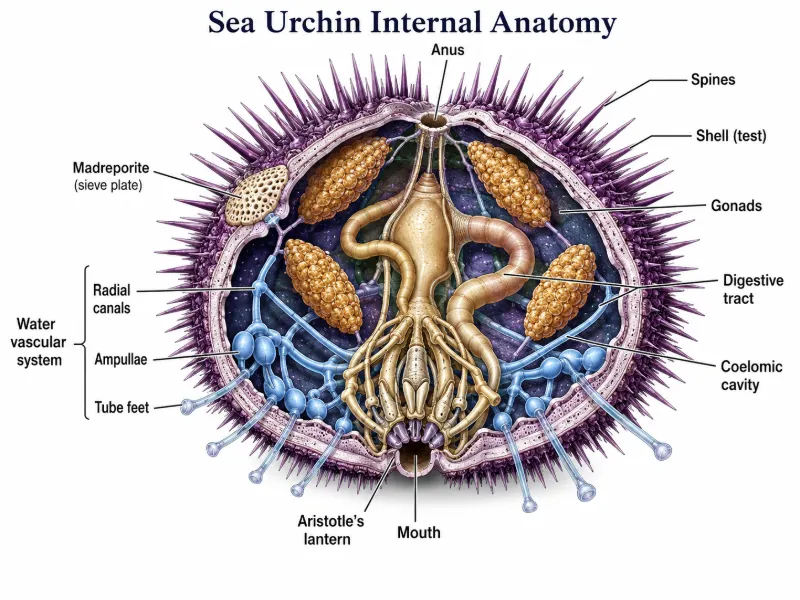
Although sea urchins have a simple appearance from the outside, their internal anatomy is remarkably specialized. Their organs are arranged inside a rigid shell called the test, which is covered externally with movable spines and tiny tube feet.
Most sea urchins have five-fold (radial) symmetry, meaning many of their internal organs are arranged in five repeating sections around the center of the body.
| Internal Structure | Function |
|---|---|
| Aristotle's Lantern | Five-part jaw used for scraping and chewing food |
| Digestive System | Digests algae, seaweed, and organic matter |
| Gonads | Produce eggs or sperm; edible as uni |
| Water Vascular System | Controls tube feet for movement and feeding |
| Nervous System | Coordinates movement and responses |
| Muscles | Move spines and jaw structures |
| Coelomic Fluid | Transports nutrients and immune cells |
The Hard Shell (Test)
Inside the spines lies the sea urchin's rigid shell, known as the test. Unlike the shell of a turtle or clam, the test is made from hundreds of tightly fused calcium carbonate plates.
This shell protects the internal organs while providing attachment points for muscles, spines, and tube feet.
Small openings in the shell allow tube feet, nerves, and reproductive products to pass through while maintaining structural strength.
Aristotle's Lantern: The Sea Urchin's Remarkable Jaw
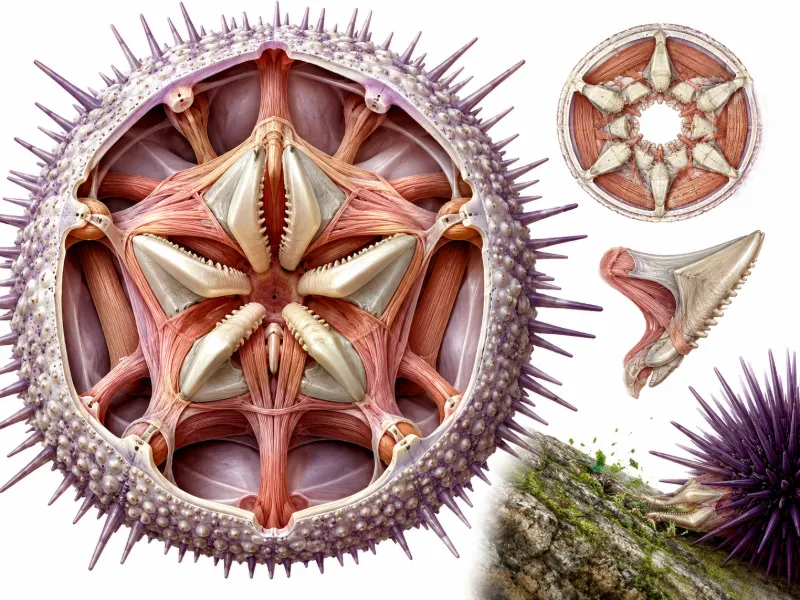
One of the most distinctive structures inside a sea urchin is Aristotle's lantern.
This highly specialized feeding apparatus consists of five continuously growing teeth supported by numerous muscles and skeletal elements. Together, they allow sea urchins to scrape algae from rocks, bite seaweed, and sometimes bore into limestone or coral.
The teeth wear down through use but continue growing throughout the animal's life.
The Digestive System
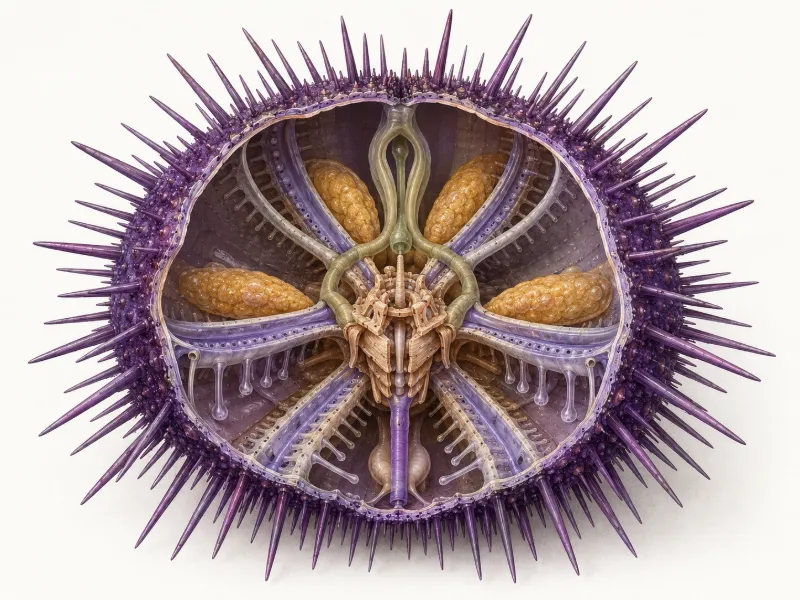
Food enters through the mouth on the underside of the sea urchin and passes through Aristotle's lantern before entering the digestive tract.
The digestive system typically includes:
Mouth
Esophagus
Stomach
Intestine
Anus located on the top surface
The intestine forms a loop around the inside of the shell, allowing nutrients to be absorbed efficiently before waste exits through the anus.
The Reproductive Organs (Gonads)
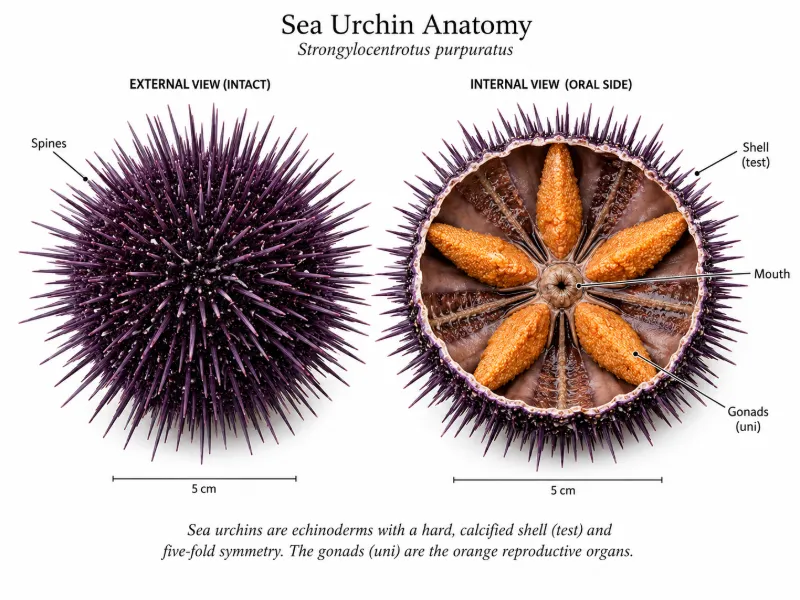
The largest structures inside many sea urchins are the gonads. Most species have five gonads arranged symmetrically around the digestive tract.
These organs produce eggs in females and sperm in males. During the breeding season, mature reproductive cells are released into the surrounding seawater, where fertilization usually occurs externally.
In many culinary traditions, these gonads are harvested and sold as uni. Although people often describe uni as "sea urchin eggs," the edible portion is generally the reproductive organ itself rather than loose eggs.
The Water Vascular System
Like other echinoderms, sea urchins possess a water vascular system that uses seawater instead of blood pressure to operate hundreds of tube feet.
This hydraulic system helps sea urchins:
Walk across rocks
Grip surfaces
Capture food
Exchange gases
Sense the environment
The system is one of the defining characteristics of echinoderms.
Spine Muscles and Internal Skeleton
Every spine is attached to the shell by muscles that allow surprisingly precise movement.
Sea urchins can point their spines toward potential threats, stabilize themselves on uneven surfaces, and assist with locomotion.
Beneath these muscles, the internal skeleton supports the entire body while remaining relatively lightweight.
The Nervous System
Sea urchins do not have a brain like vertebrates. Instead, they possess a nerve ring surrounding the mouth and multiple radial nerves extending through the body.
This decentralized nervous system coordinates spine movement, feeding, tube foot activity, and responses to light, touch, and chemicals in the surrounding water.
Although simple compared with mammals, this system is highly effective for their lifestyle.
Body Fluid Instead of Blood
Sea urchins do not have blood in the same way humans do. Instead, much of the space inside the body is filled with coelomic fluid.
This fluid transports nutrients, removes waste products, distributes immune cells, and helps maintain internal pressure.
Specialized cells within the fluid contribute to wound healing and defense against pathogens.
What Does a Sea Urchin Look Like Inside?
When the shell is carefully opened from the underside, the interior often reveals five bright yellow, orange, or cream-colored gonads arranged in a star-like pattern.
At the center lies the digestive system, while Aristotle's lantern occupies the mouth region beneath the body. Surrounding these organs are muscles, connective tissues, and parts of the water vascular system.
The overall arrangement reflects the sea urchin's characteristic five-fold symmetry.
Why Is the Internal Anatomy Important?
The unique internal anatomy of sea urchins has enabled them to survive for more than 450 million years. Their efficient feeding apparatus, hydraulic movement system, protective shell, and specialized reproductive organs allow them to thrive in habitats ranging from shallow coral reefs to the deep ocean.
Scientists also study sea urchin anatomy because these animals have become important model organisms in developmental biology, embryology, and marine ecology.
FAQs
Is the orange part inside a sea urchin its eggs?
Not usually. The orange or yellow edible portion is generally the sea urchin's gonads (reproductive organs). Female gonads contain eggs during the breeding season, while male gonads contain sperm.
What is Aristotle's lantern?
Aristotle's lantern is the sea urchin's specialized jaw structure. It contains five teeth that continuously grow and are used to scrape algae and other food from hard surfaces.
Do sea urchins have a heart?
No. Sea urchins do not have a true heart. Instead, they rely on coelomic fluid and a water vascular system to transport materials throughout the body.
Do sea urchins have blood?
No. They do not have blood like mammals. Their body cavity contains coelomic fluid, which performs many transport and immune functions.
Can you eat the inside of a sea urchin?
Yes. The edible portion, known as uni, consists primarily of the gonads. It is considered a delicacy in many coastal cuisines, especially in Japan, Korea, Italy, Chile, and other seafood-producing regions.
What is the habitat of sea urchins?
What ocean animals eat sea urchins?
What is inside the sea urchin?
What organism is close to a sea urchin?